The Haruhi Suzumiya light novel series is often described as a “slightly” supernatural school story—and that label fits better than you’d expect. It starts out wearing the face of a typical Japanese high school narrative, then quietly tilts the ground underneath it. Before you realize it, you’re not watching chaos from a safe distance—you’re inside it, stuck in the same room with it, and weirdly invested.
If you’ve only heard the famous catchphrases or know the franchise mainly through its anime reputation, it’s easy to assume the appeal is just “iconic characters + big sci-fi gimmicks.” Reading the novels, I came away with something different: the temperature of the narration. The series is funny and fast, but it’s also oddly real. The extraordinary doesn’t arrive like a fireworks show—it seeps into daily life, and that blend is what lingers.
What this article explains
-
What the Haruhi Suzumiya light novel series feels like to read (without major spoilers)
-
A volume-by-volume overview of all 12 works: premise, vibe, and what stood out to me
-
Who this series is likely to click with—and who might bounce off it
Who this article is for
-
You’re curious about the Haruhi Suzumiya novels and want to know if they’re worth starting now
-
You like school stories that collide with sci-fi / supernatural elements
-
You care about voice and character dynamics more than lore dumps
-
You want a clear, spoiler-light reading guide through the whole series
I’ll keep this spoiler-conscious: I’ll talk about the setup, atmosphere, and reading experience, but I won’t dig into core twists or endings.
Sponsored
The Haruhi Suzumiya books in publication order
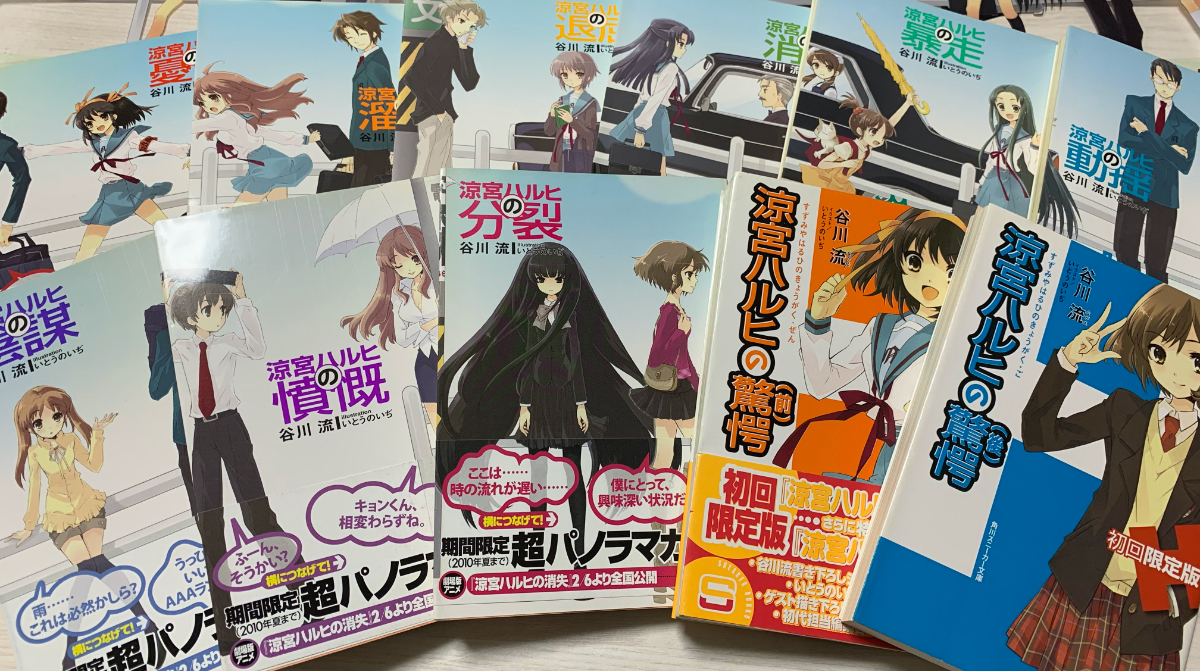
The short answer: the series runs from The Melancholy of Haruhi Suzumiya on 6 June 2003 to The Theater of Haruhi Suzumiya on 29 November 2024, twelve works in total. Only The Surprise is split across two books, which makes thirteen volumes from Kadokawa Sneaker Bunko.
| # | Title | Japanese release | Format |
|---|---|---|---|
| 1 | The Melancholy of Haruhi Suzumiya | 6 June 2003 | Novel |
| 2 | The Sigh of Haruhi Suzumiya | 30 September 2003 | Novel |
| 3 | The Boredom of Haruhi Suzumiya | 27 December 2003 | Short stories |
| 4 | The Disappearance of Haruhi Suzumiya | 31 July 2004 | Novel |
| 5 | The Rampage of Haruhi Suzumiya | 30 September 2004 | Short stories |
| 6 | The Wavering of Haruhi Suzumiya | 31 March 2005 | Short stories |
| 7 | The Intrigues of Haruhi Suzumiya | 31 August 2005 | Novel, 440 pages |
| 8 | The Indignation of Haruhi Suzumiya | 1 May 2006 | Short stories |
| 9 | The Dissociation of Haruhi Suzumiya | 31 March 2007 | Novel, continues |
| 10 | The Surprise of Haruhi Suzumiya (parts 1 and 2) | 25 May 2011 | Novel, two books at once |
| 11 | The Intuition of Haruhi Suzumiya | 25 November 2020 | Short stories |
| 12 | The Theater of Haruhi Suzumiya | 29 November 2024 | Linked novellas |
The gaps between books are extreme, and that is part of the series’ character. Nine and a half years separate The Surprise from The Intuition, and four more before The Theater. Starting now, you read straight through none of that waiting.
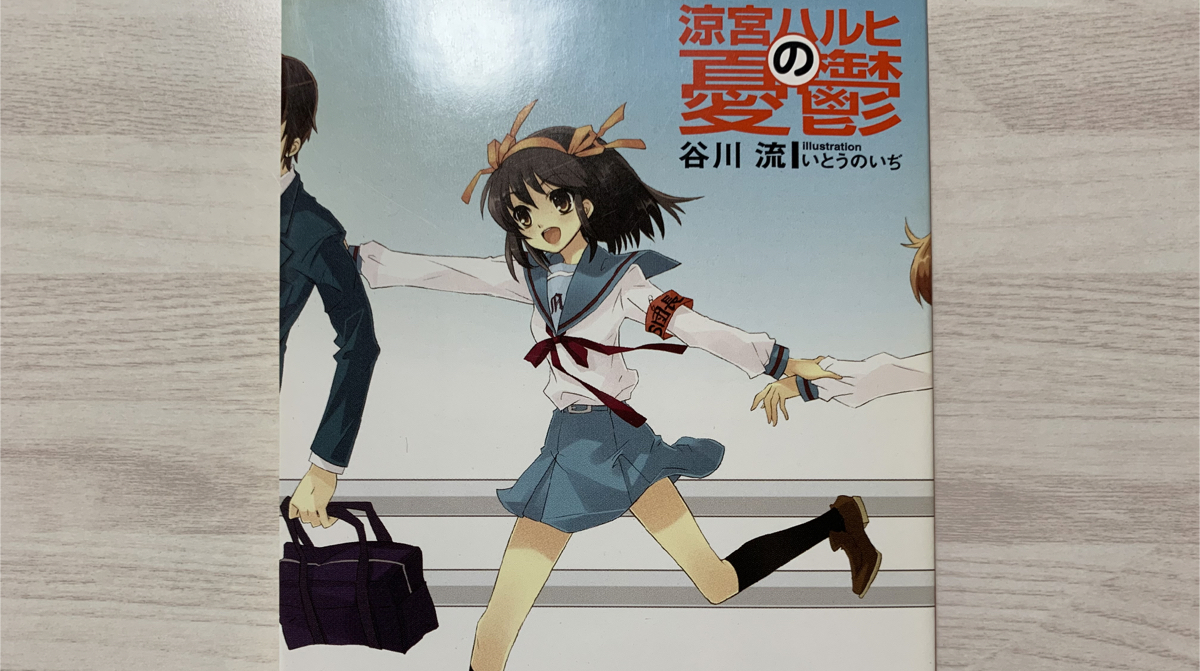
1. The Melancholy of Haruhi Suzumiya: Meeting Haruhi
The series opens with a moment that instantly tells you this isn’t going to be a “normal” school story. Haruhi’s self-introduction is basically a declaration of war on ordinary life: she isn’t interested in regular humans—she wants aliens, time travelers, and espers.
That first impression matters, because the novels don’t treat Haruhi as “quirky.” She’s intense. She’s bored with normality in a way that feels almost physical, and she refuses to behave politely just to fit in. The result is that she stands out immediately: her actions are strange, loud, and impossible to ignore.
The key trigger is simple: Kyon—our narrator—speaks to her. Not as a grand decision, not as a heroic act. It’s almost accidental. And that one step becomes the entry point into the SOS Brigade, a club Haruhi forms with a ridiculous name and an even more ridiculous purpose: to find extraordinary beings and have fun with them.
What makes this volume work for me is how slowly the “sci-fi outline” sharpens. The early vibe can feel like a school romantic comedy with an aggressive heroine and a deadpan guy stuck reacting to her. But the story keeps tightening the screws. New members are pulled into the club—Yuki Nagato, Mikuru Asahina, Itsuki Koizumi—and it becomes clear they aren’t just colorful classmates.
I didn’t feel the non-ordinary arrive as a single explosion. It blends into daily life, and that’s what gave the book its texture. More than Haruhi’s chaos, I kept noticing Kyon’s narration: cool-headed, sarcastic, and slightly resigned. He doesn’t romanticize what’s happening. He reacts like someone trying to keep his life from becoming unlivable—and that makes the whole world feel surprisingly grounded.
Sponsored
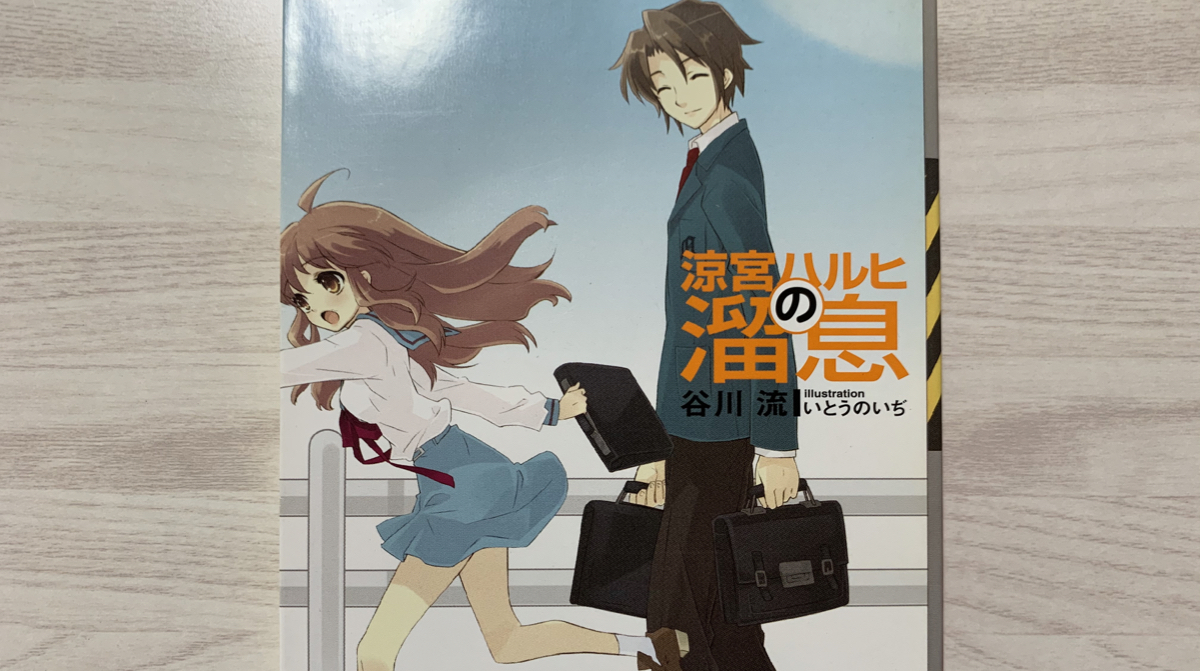
2. The Sigh of Haruhi Suzumiya: A Turning Point for the Cast
The Sigh of Haruhi Suzumiya centers on a school festival project—making a movie—except it never feels like a harmless school activity. The atmosphere is restless in a way I could feel while reading. I kept thinking, “Is this going to end normally? Is that even possible?”
Haruhi is still Haruhi: decisive, forceful, and perfectly comfortable dragging everyone else into her plan. But this volume is where I strongly felt the series crossing a line. The club isn’t just dealing with “Haruhi being difficult.” The consequences of her impulses start to feel bigger, like the world itself is becoming vulnerable around her.
What stayed with me was the tension of maintaining balance. The characters are effectively trying to complete the project without upsetting Haruhi—because upsetting her isn’t merely socially awkward. It risks becoming structural. The story creates a pressure cooker out of what should have been a fun festival arc, and that mismatch is pure Haruhi.
On a personal note, this is also a volume where Nagato’s presence feels especially symbolic. Sometimes the smallest detail—her look, her calmness—changes the emotional lighting of a scene. To me, this book is where the “non-ordinary” stops hiding in the background and steps into the foreground.
3. The Boredom of Haruhi Suzumiya: Short Stories That Expand the World
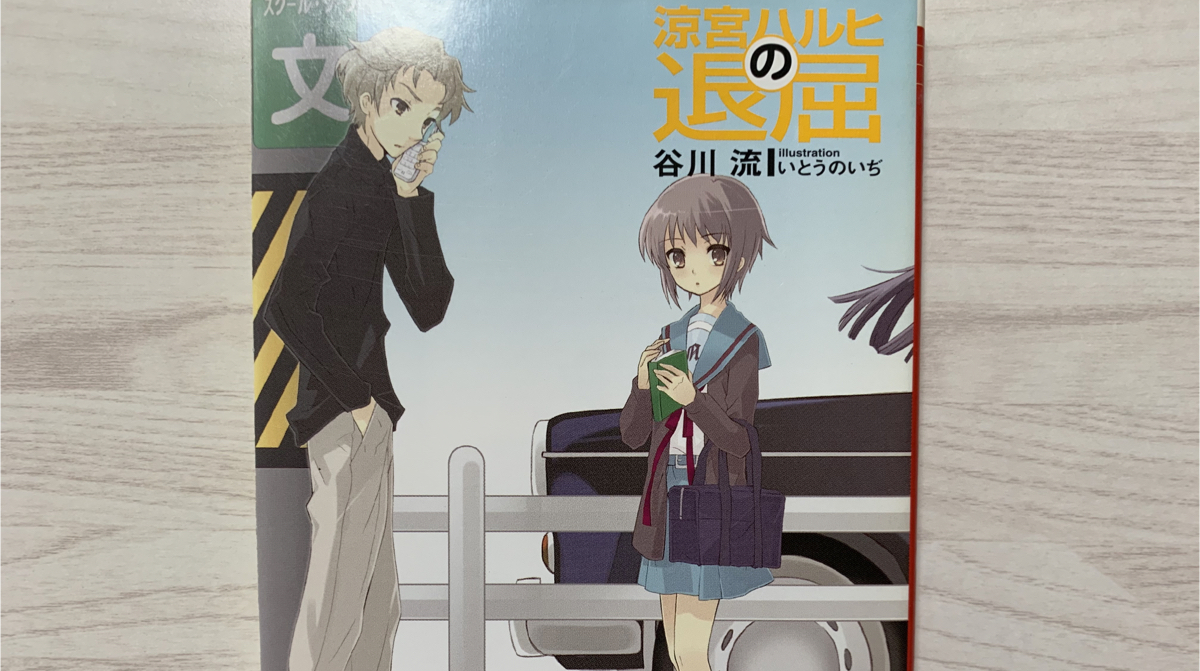
The Boredom of Haruhi Suzumiya is the first short story collection (four episodes), and it works as a reset in the best way. After the heavier momentum of the earlier volumes, it felt like taking a breath and realizing: this series can be playful without losing its strange edge.
The value of short stories here isn’t “filler.” Each episode shifts the spotlight and lets different characters define the tone. Asahina, Nagato, and Koizumi become more than roles in Haruhi’s orbit; you start seeing how their perspectives and specialties change the shape of an incident.
What I took away is that the engine of the series isn’t just “Haruhi causes trouble.” It’s the relationship system of the SOS Brigade. Even when the events are smaller and closer to everyday life, the story still refuses to sit perfectly still. That low-grade instability is one of the series’ signatures, and this volume made it easier to recognize.
Sponsored
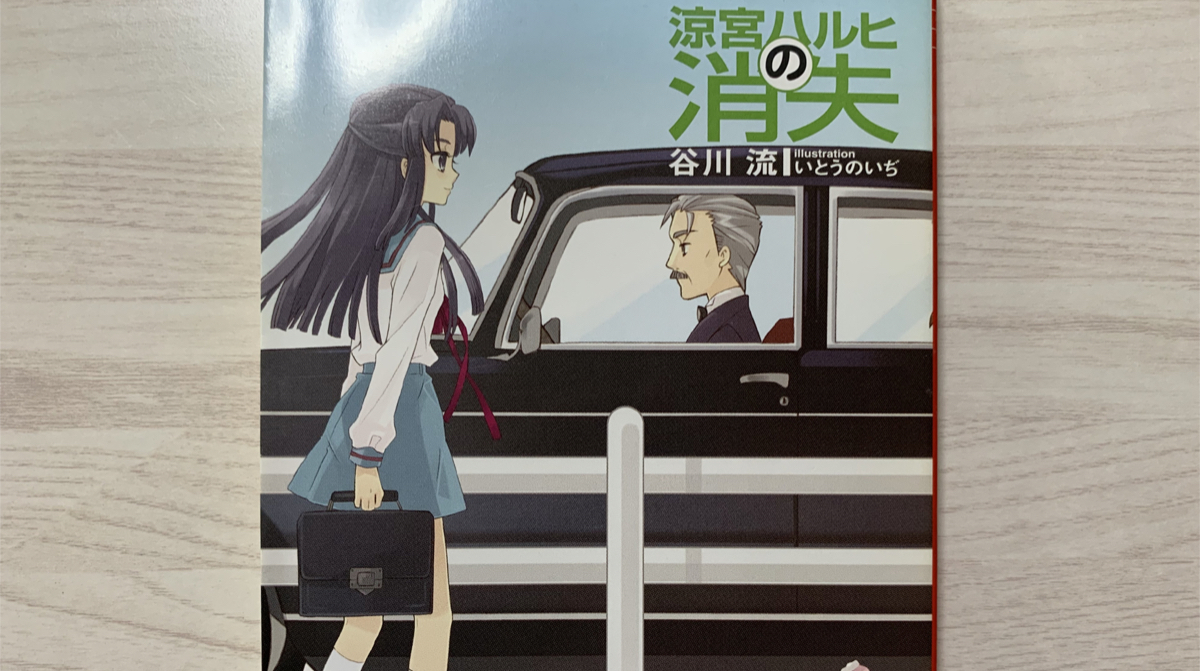
4. The Disappearance of Haruhi Suzumiya: The Series’ Emotional Peak
The Disappearance of Haruhi Suzumiya is one of the most famous entries—adapted into a highly regarded film—and after reading it, I understood why. The kind of emotion it leaves behind is clearly different from what came before.
This volume shifts the center of gravity toward Yuki Nagato, and the overall mood becomes quieter and colder. Even when something dramatic is happening, the book doesn’t aim for hype. It aims for tension you feel under your skin. The contrast—between what should be “big” and how silently it’s handled—made the experience sharper.
I especially felt the ache in how the story frames “normal.” The idea of someone who has always been positioned as not normal appearing in an unexpectedly ordinary way hits hard. At the same time, Kyon’s internal stance starts to change. He isn’t just reacting anymore—he’s realizing he’s already attached, already involved, already unable to treat this as a joke.
Haruhi herself being less forward in this book has an interesting effect: it makes the world where Haruhi does exist feel more unsettling by comparison. If you’re going to read the series seriously, this is a major summit.
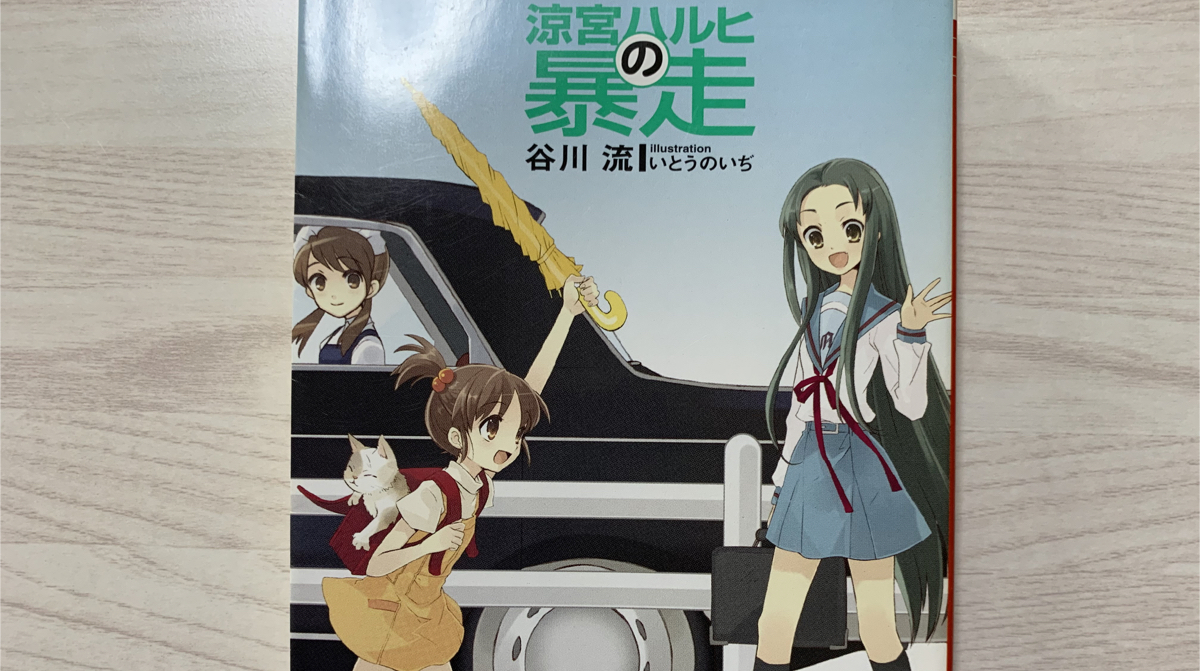
5. The Rampage of Haruhi Suzumiya: Short Stories With Maximum Range
The Rampage of Haruhi Suzumiya is the second short story collection (three episodes), and it’s dense in a way that surprised me. It feels “short,” but the reading experience is full.
What stood out is the range: time-related oddness, a competitive showdown with the computer club, and a snowbound scenario that flirts with mystery flavor. The series proves it can swing genres without breaking its voice. It’s still Haruhi. It’s still Kyon. But the situations have enough variety to keep the world from shrinking into repetition.
I also appreciated that the spotlight occasionally widens beyond the core four. When other characters get meaningful space, the setting feels less like a stage built only for the SOS Brigade and more like a real school ecosystem.
As a collection, this volume feels polished. It lifts the series’ momentum while still giving you separate, memorable “entry points” if you like episodic reading.
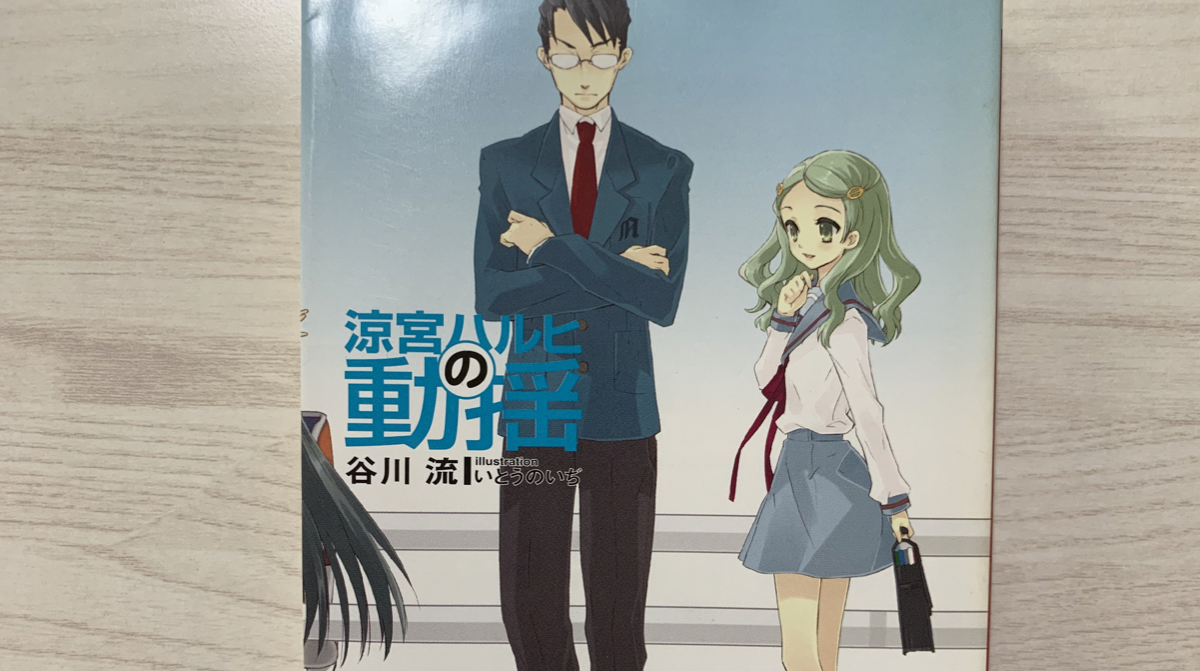
6. The Wavering of Haruhi Suzumiya: A Softer Face in a Loud Series
The Wavering of Haruhi Suzumiya is the third short story collection (five episodes). The events are fun, but what stuck with me is how often the characters feel slightly more human—less like fixed archetypes.
Some stories connect strongly with earlier volumes (especially the film project thread), and I love when series do that: separate dots turning into one line. The world feels consistent without feeling repetitive.
There’s also a subtle shift in Haruhi’s presentation. She’s still the unstoppable force, but you catch glimpses of her being shaken—just enough to make her feel more dimensional. Those “wait, did she just…” moments are part of why this series keeps people talking: it hides emotion inside comedy and hides vulnerability inside noise.
Even as a lively short story book, it leaves a quiet aftertaste.
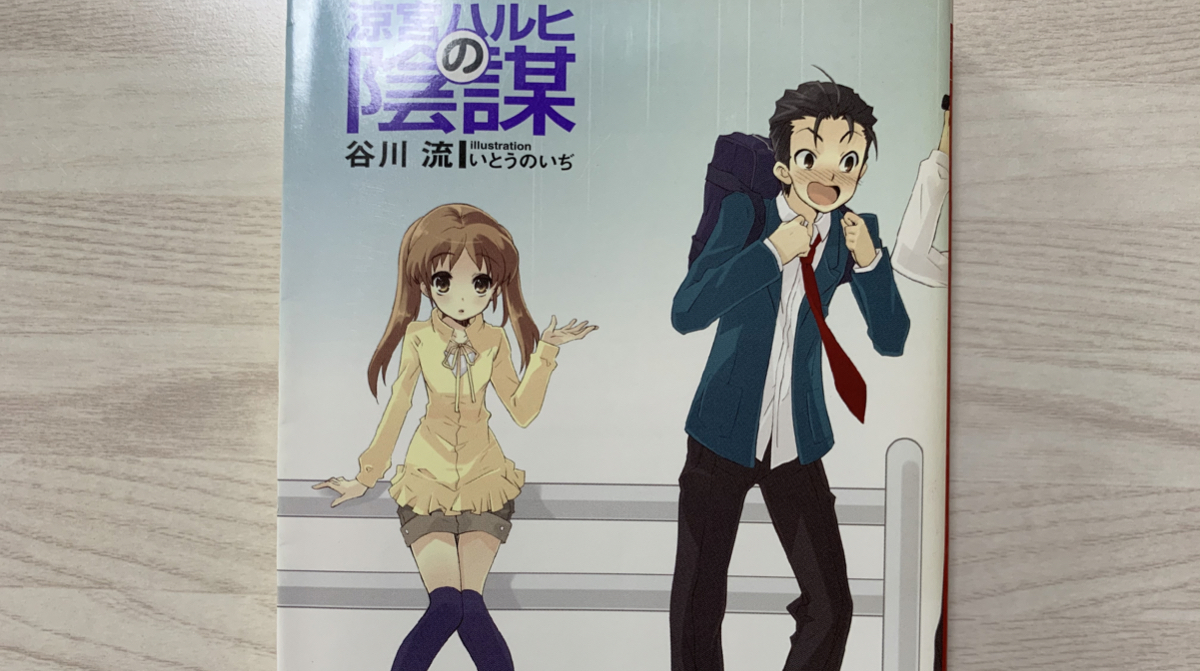
7. The Intrigues of Haruhi Suzumiya: A Long Novel With Real Drive
The Intrigues of Haruhi Suzumiya is one of the thicker entries, and I had the exact reaction you’d expect: “This looks like a commitment.” But once I started, it moved faster than I anticipated.
A defining feature is how it runs two tracks at once: the SOS Brigade’s “normal” days and a parallel thread of non-ordinary complications. Mikuru Asahina becomes more central here, and that changes the flavor. She isn’t only a cute presence or a source of awkwardness; the story gives her a kind of narrative weight that feels fresh inside this universe.
I also liked how the title’s promise pays off. When the “intrigue” becomes legible, the resolution feels satisfyingly Haruhi—clean enough to close the book with momentum, but still uneasy enough to remind you this world never stabilizes completely.
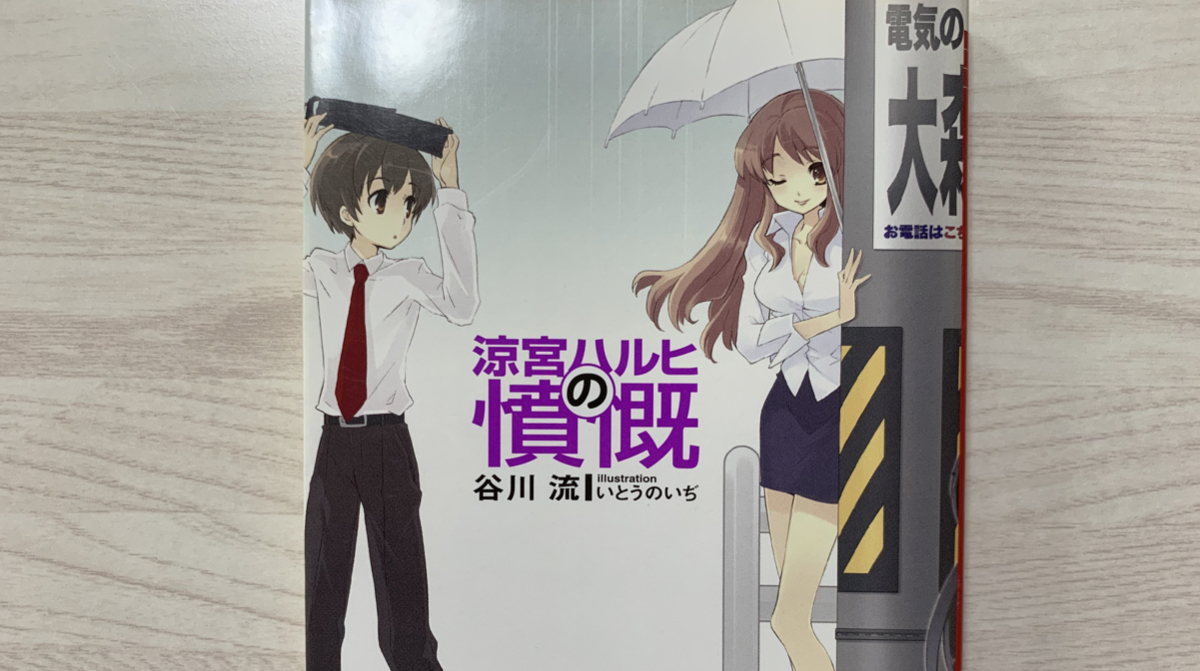
8. The Indignation of Haruhi Suzumiya: A Breather That Still Moves Pieces
The Indignation of Haruhi Suzumiya is the fourth short story collection, and it functions like a deep breath. The series’ big arcs pause, and the SOS Brigade’s everyday weirdness comes back to the front.
One story experiments with form and tone in a way that feels intentionally off-center, while another brings back a “classic Haruhi” vibe—like the series reminding you of its default shape. As a pair, it works: playful variety without losing identity.
What made it meaningful for me is that even lighter volumes show small shifts. Nagato’s atmosphere, Kyon’s internal commentary, the group’s rhythm—tiny changes accumulate. This collection doesn’t try to be the loudest entry. It tries to keep the world alive.
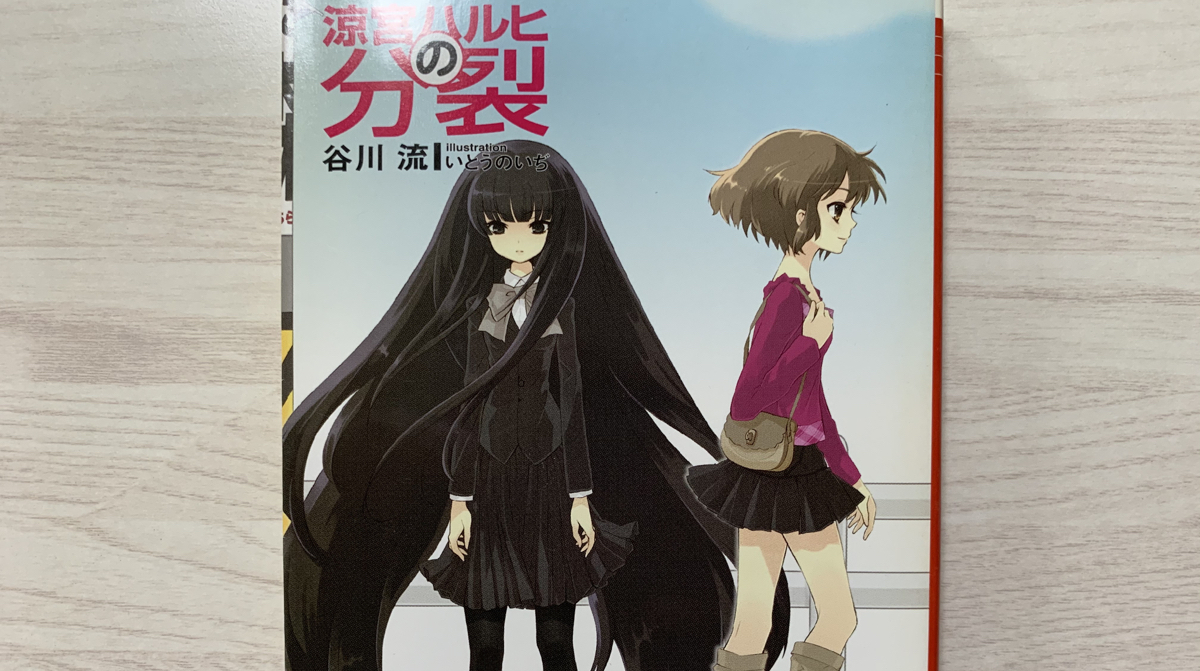
9. The Dissociation of Haruhi Suzumiya: The Long Arc Starts for Real
From The Dissociation of Haruhi Suzumiya, the air changes again. Earlier volumes often leaned into character exploration and school-life texture, but here the sci-fi conflict side steps forward.
Opposition becomes clearer. New characters enter with real narrative force. It feels like the series moving into its “next stage,” not just repeating the old formula.
The title matters: the story splits into two flows partway through. One track is relatively calm; the other is visibly unstable and threatening. That structure creates an excellent tension: you keep comparing the two, wondering what the split means and what kind of convergence will be possible.
This is also where I personally felt, “Okay, this isn’t a casual short-story ride anymore.” The pull toward the sequel is strong, and the sense of scale increases.
10. The Surprise of Haruhi Suzumiya: Convergence and Payoff
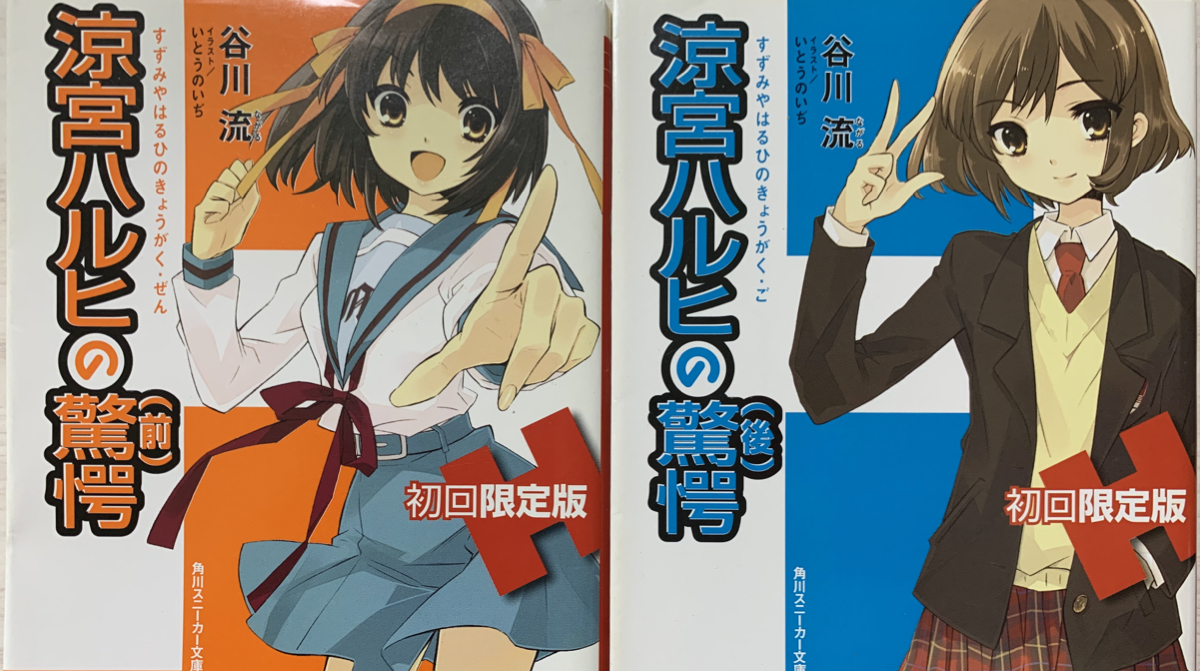
The Surprise of Haruhi Suzumiya continues directly from Dissociation and drives the split narrative toward convergence. It’s packed with characters—many familiar faces return—and that density creates a feeling of “everything is here.”
What I enjoyed most was the sustained suspense. One track stays more peaceful; the other stays dangerously tense. Reading becomes a constant question: why did the split happen, what does it change, and what does it mean when the two flows touch?
As the story tightens, the series delivers the kind of long-arc payoff that makes the whole journey feel worth it. At times, the scale feels so big you could mistake it for a finale. The momentum through the last stretch is the kind that makes you keep flipping pages even when you planned to stop.
11. The Intuition of Haruhi Suzumiya: The Return After Nine and a Half Years
The Intuition of Haruhi Suzumiya arrived nine and a half years after Surprise, and just seeing a new Haruhi volume exist again carries emotional weight. My honest reaction wasn’t analytical—it was relief. It felt like saying, “Welcome back.”
This is a short story collection with three pieces (short, mid-length, and long). Some material had been published before, but I didn’t care as much as I expected. The bigger point is that the series returns with its identity intact.
What makes this volume stand out for me is how it uses mystery flavor without reducing itself to “trick + solution.” The series keeps doing what it does best: letting character voice and group dynamics become part of the answer. Kyon’s sharp narration, Nagato’s unusual moments, Mikuru’s charm, Koizumi’s discussions, Tsuruya’s unshakable presence—these aren’t decorations. They feel structurally important to the reading pleasure.
The aftertaste is unmistakably Haruhi. That alone made the book special.
12. The Theater of Haruhi Suzumiya: stepping outside the main story
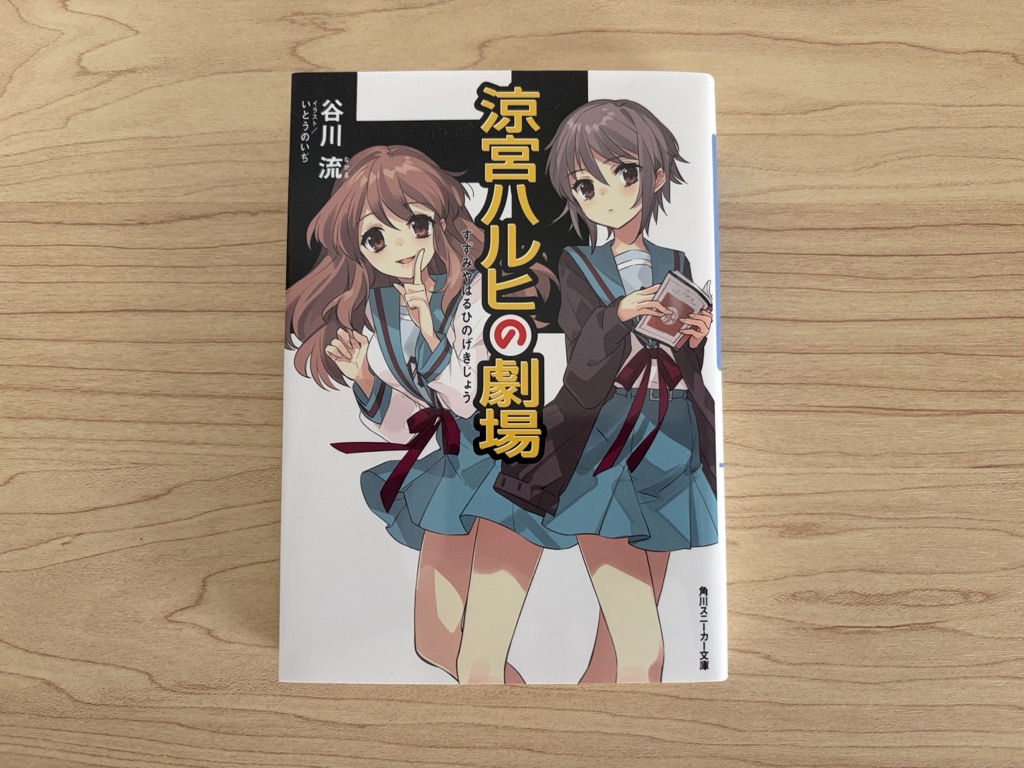
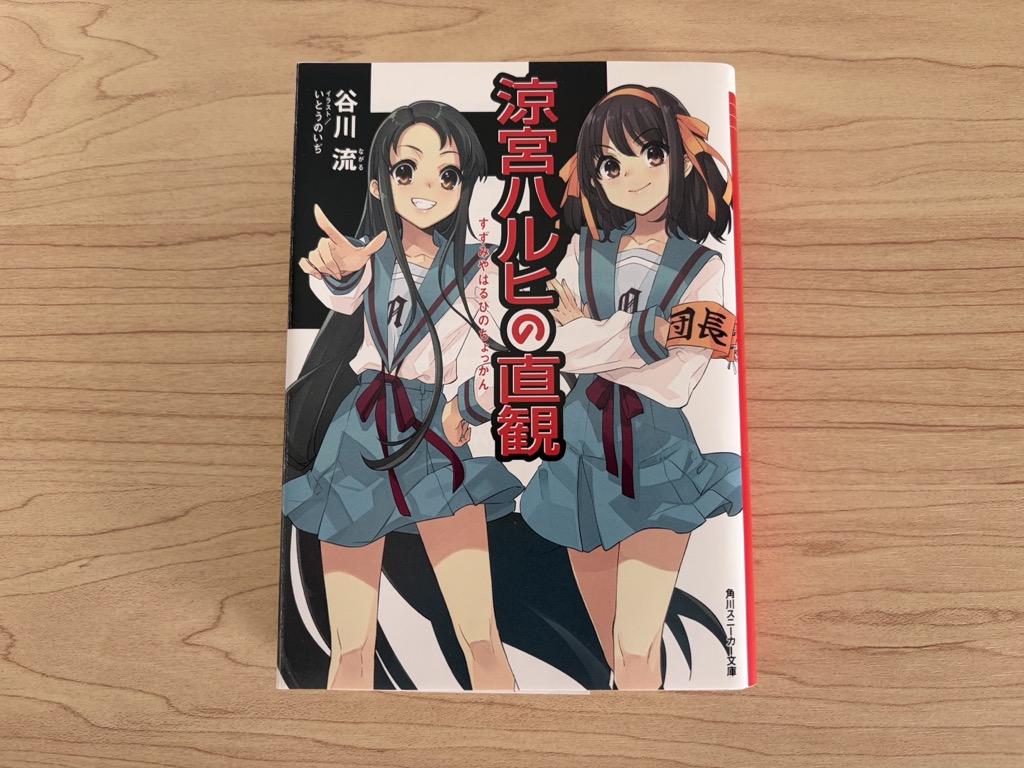
The short answer: published 29 November 2024, 328 pages in four chapters, and it does not advance the main story at all. It arrived four years after The Intuition.
This volume is plainly different in character from the eleven before it. It is a continuation of “Haruhi Suzumiya Theater,” a strand that recasts the SOS Brigade into other worlds rather than moving their own timeline forward.
Chapters one and two are reprints from the magazine The Sneaker: “Haruhi Suzumiya Theater: Fantasy” from 2004 and “Haruhi Suzumiya Theater Returns” from 2006. Chapters three and four are new.
The premise is that Kyon lands inside a fantasy RPG world, with Haruhi Suzumiya as the hero, Yuki Nagato as the thief, Mikuru Asahina as the mage and Itsuki Koizumi as the bard. The setting then moves through a western, Prohibition-era America, pirates and the Trojan War.
Read it expecting the next chapter of the main story and you will be let down. Nothing shifts between the characters here and no groundwork gets paid off. I knew that going in, and the thought “so the main story is not moving” still surfaced.
Taken on its own terms, though, the book exists to show what happens when this specific cast is handed roles. Haruhi Suzumiya as a hero, Yuki Nagato as a thief: the casting is funny precisely because it fits, and it lands hardest for readers who have been with the series a long time. The joke only works when the characters are already fixed in your head.
The later chapters lean on world history and physics, which slows the reading down. It is less a light side story than a book that takes its own game seriously.
| Likely to enjoy it | Likely to be frustrated |
|---|---|
| Readers who just want to spend time with the SOS Brigade | Readers who want the main story continued |
| Readers who enjoy parody and role-swapping | Readers waiting on unresolved threads |
| Readers who have finished the series and know the cast | Readers new to the series or partway through |
Reading it last is fine. The casting is funnier once the main series is behind you.
Conclusion
The Haruhi Suzumiya series is famous for a reason, but it isn’t “universally safe.” If you want constant clean catharsis or a straightforward power fantasy, this may not be your ideal fit.
If, however, you like stories where the extraordinary contaminates the ordinary—where a school setting becomes unstable without losing its everyday voice—this series still works. Its strength isn’t just the sci-fi setup. It’s the narrative temperature: Kyon’s grounded voice, Haruhi’s relentless pressure against normality, and the way the group’s relationships keep the world from feeling like pure gimmick.
My recommendation is simple: start with The Melancholy of Haruhi Suzumiya. If you like the vibe—the mix of comedy, discomfort, and slow-creeping non-ordinary—you’ll likely want to keep going through the rest of the series.