A school festival mixes real fun with moments that are oddly exhausting.
The short answer: Kudryavka’s Order (クドリャフカの順番) scoops up both the giddy heat and the grit that settles in your stomach, and delivers them in the shape of a mystery. The case is a run of petty thefts inside a school, and what stays afterwards is not the culprit but the temperature of the people and the distortion the festival creates.
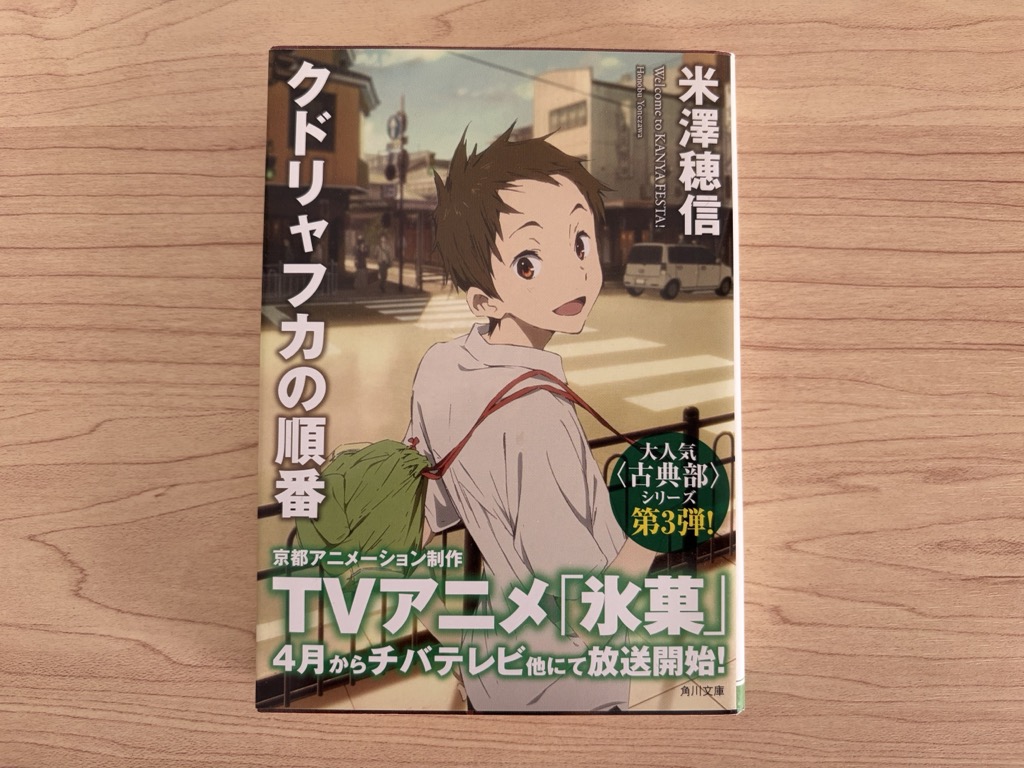
This is the third book in Honobu Yonezawa’s Classic Literature Club series, published by Kadokawa Shoten on 30 June 2005. The hardback was titled Kudryavka’s Order: The “Jumonji” Case, and the Kadokawa Bunko edition followed on 25 May 2008. In the Hyouka anime it covers episodes 12 to 17.
I do not touch the central solution here.
Sponsored
1. What kind of story is Kudryavka’s Order?
The short answer: the Classic Literature Club prints 200 copies of its anthology by mistake and has to sell them, while a thief calling himself “Jumonji” works through the school.
The setting is the three days of the Kanya Festival at Kamiyama High School. My first reaction to the overprinting was not “ah, youth” but the tightening in the stomach that anyone who has run a school stall will recognise.
A festival wears the face of enjoyment while the list of things you are obliged to do keeps growing. The surplus anthology delivers that fact immediately.
The stolen items are go stones, tarot cards, water guns. Because nothing serious is taken, the incidents spread as rumour rather than fear. The thief leaves a calling card each time, so the crimes turn into part of the festival’s entertainment.
The four club members do not treat this as frightening. They start seeing it as a hook that might help them shift copies. That is the point where I understood the book was less a school mystery and more an examination of how cruel collective enthusiasm can be.
2. How does the festival structure shape the mystery?
The short answer: all four club members narrate this volume, and that is the biggest change in the series so far.
The first two books, Hyouka and The Credit Roll of the Fool, ran entirely in Houtarou Oreki’s first person. Here the viewpoint rotates while a single case is followed.
The pleasure is not a big twist. It is that the structure of the festival itself becomes the structure of the mystery.
- Three fixed days, so time is strictly divided
- Constant movement between clubroom, classrooms, exhibits and the school broadcast
- Each member pinned to a different post
That scattering supplies the clues and simultaneously becomes the distance between the characters. Four people live through the same festival and experience something completely different, and the rotating viewpoint delivers that directly.
Oreki being stuck on the stall quietly matters
The short answer: he cannot move freely, so his reasoning is constrained by obligation throughout.
Oreki’s energy-saving philosophy does not fit a festival, and he spends long stretches minding the book stall. The tension between wanting to chase the case and being unable to leave is the engine of his sections.
I liked this immobilised Oreki. Rather than a detective who ranges anywhere at will, he is made to think inside the social logistics of the event. Even when the deductions land, they never feel purely satisfying, and that unease is the flavour of the volume.
Sponsored
3. What happens when everyone’s good intentions stop lining up?
The short answer: nobody is malicious, and the relationships still grind.
- Eru Chitanda simply moves, running to sell copies
- Satoshi Fukube swims through the festival on information and contacts
- Mayaka Ibara carries her manga club duties and her own unresolved feelings
- Oreki intends to stay detached and gets pulled into the heat anyway
Selling the anthology, the Jumonji case, each person’s own post. As those goals tangle, the result is “I understand how you feel, and it is still wearing me down.”
“Let’s make this fun” leaves someone behind
The short answer: the more entertaining the Jumonji case becomes, the more visibly someone is left out of it.
School events accelerate for the people who enjoy them, and the people who cannot keep up go quiet. This novel does not paint over that with the glow of youth, and I trust it for that.
For the same sensation of being the only one who cannot ride along with a group, Convenience Store Woman by Sayaka Murata left me somewhere similar.
4. Why does solving it not feel like winning?
The short answer: the mechanism and the meaning of the “order” resolve cleanly, and the feelings do not.
As a puzzle it works. The structure of the thefts and the significance of their sequence are properly prepared, and you can read it as a fair whodunnit.
What was left in me at the end was not “the case is closed” but the aftertaste of the festival. It does not feel like a victory. The reasoning holds, and people’s feelings do not fall into line. That failure to settle is what makes this volume itself.
The aftertaste is slightly bitter and hard to forget, close to the feeling when a festival ends on schedule and only the tiredness remains. For a comparable grit after finishing a book, Hakobune by Haruo Yuki sits in the same place.
What the title drags in with it
The short answer: Kudryavka was the original name of the dog sent into orbit aboard Sputnik 2 on 3 November 1957.
The name means “little curly” in Russian. She became known to the world as Laika, and there was never a plan to bring her back; re-entry technology did not exist yet.
I will not claim to know the author’s intent. Knowing that background and rereading changed the texture of the title for me. Read as a story about someone sent off carrying other people’s expectations, the weight each of the four is carrying takes on a different meaning.
Sponsored
5. Who is this book for?
The short answer: it suits readers who want the sensation of having been there, not readers who want to feel clever at the end.
| Likely to land | Likely to miss |
|---|---|
| Values atmosphere over incident in a school mystery | Wants spectacle and pace |
| Remembers the part of school events that was not fun | Wants to finish feeling refreshed |
| Finds friction between good intentions painful but interesting | Finds four rotating viewpoints stressful |
| Likes the small everyday distortions of this series | New to the series and reluctant to start with an ensemble piece |
If you have not read the series, starting from Hyouka makes the shifting distances between the four much easier to follow.
6. Is it worth reading?
The short answer: yes, strongly, for readers who can take the bitterness along with the intelligence.
The case is genuinely interesting. What outlasts it is how a festival moves people around and knocks them out of alignment. I finished slightly drained and oddly convinced.
“Enjoyable, but not all of it is enjoyable.” Once that feeling has been drawn this carefully in the shape of a mystery, it is not easy to forget. If you want a school mystery to recreate the sensation of being there rather than the satisfaction of solving something, this volume fits well.