Mancala on this page is the Kalah form of the game — six pits a side, four seeds a pit — and it runs free in a browser with no account and no install. Kalah(6,4) is a solved game: with perfect play on both sides the first player wins by 8, which is 28 seeds to 20. This version closes that gap the way Go closes it, by putting a komi (コミ) of three seeds into the second player’s store before the first seed is sown. A game takes about five minutes. Open Mancala, a free sowing board game with a CPU opponent and you can start straight away. This article is written by the person who built it, so it covers the rules, the solved result the komi is answering, and the self-play numbers that settled on three seeds rather than any other number.
Sponsored
What Is Mancala? A Family of Sowing Games, Not One Product
Mancala is not a product name but the family name for sowing games, in which players scoop the seeds or pebbles out of one pit, drop them around the board one at a time, and compete to gather the most in their own store. Africa, the Middle East and Asia carry an uncountable number of games of this shape, and the rules differ from region to region. No single origin can honestly be pointed at.
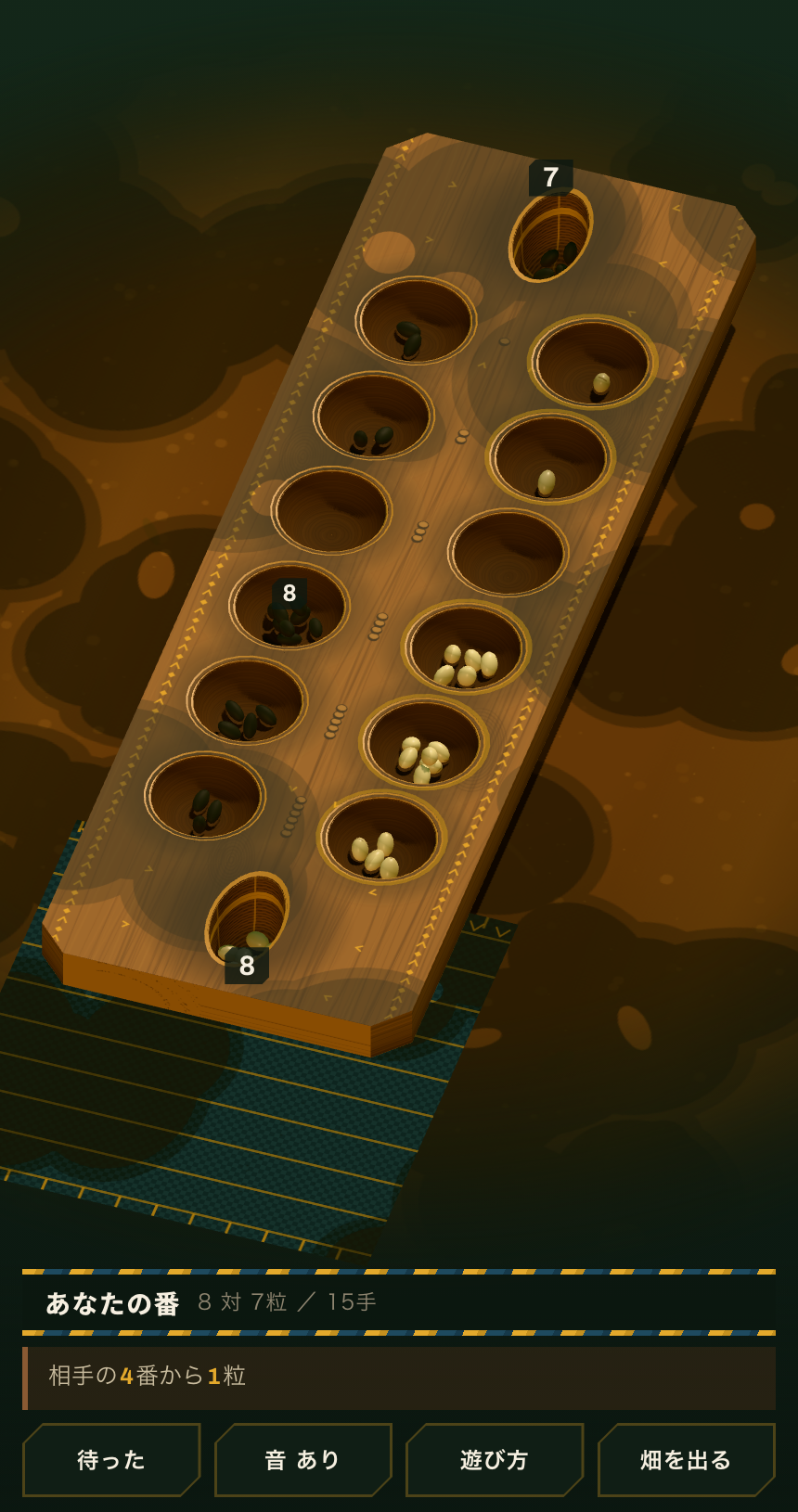
The version on rinblog.org is one of the most widely played shapes in that family: Kalah, with six pits a side and four seeds in each pit, so 48 seeds on the board. You take the right-hand row and the bottom store, and the CPU takes the left-hand row and the top store. Seeds that land in your field become round, glossy white seeds and seeds in your opponent’s field become long black ones, so you can see which side holds what without counting anything.
- Price: free, with no account, no login and no install
- Players: one, against the CPU. Three strength levels, and you choose whether to sow first or second
- Length: about five minutes per game
- Ages: anyone who can count from one to six, so roughly six and up
- Runs on: mobile browsers on iPhone and Android, and desktop browsers
- Interface language: Japanese (an English glossary of every menu option is further down this article)
How Do You Play Kalah? Scoop, Sow, Free Turn, Capture
Kalah asks you to remember two things — drop one seed at a time, and watch where the last seed lands — and they open out into four steps.
- Pick one pit in your own row and scoop out every seed in it. An empty pit cannot be picked
- Drop one seed into each pit from the next one onward. Your own store is included in the circuit; your opponent’s store is skipped. A large handful goes right around the board and comes back into your own pits
- If the last seed lands exactly in your store, you move again. There is no limit to how many times this can chain
- If the last seed lands in a pit in your own row that was empty, you capture every seed in the facing pit opposite and put it in your store along with that last seed
The game ends the moment either row is completely empty. The seeds still on the board go into the store of the side that owns the row they are sitting in. A position repeating for the third time, and a combined total of 200 moves, both end the game as a draw or a cut-off, with the remaining seeds collected and the totals compared.
Sowing runs in one direction only, called counterclockwise in traditional mancala; here it flows down the screen toward your store. Because the opponent’s store is skipped, the circuit from your point of view is 13 places: your six pits, your store, and your opponent’s six pits. Thirteen seeds go exactly once around and land back in the pit they came from, and the fourteenth begins a second lap. That is why seeds you meant to hand to the opponent’s side come back to you, and why a big handful has to be counted against 13 before you move it, or your reading will be off by a lap.
When Does a Capture Happen in Mancala?
A capture in mancala happens only when the last seed lands in a pit in your own row that was empty before that seed arrived. That last seed and every seed in the facing pit opposite both go into your store. Three conditions have to hold at once, and if any one of them fails, nothing happens.
- The seed landed in a pit in your own row, not in the opponent’s row
- That pit was empty before the seed landed, so the last seed is the first seed in it
- The facing pit opposite contains seeds. If it is empty, nothing is captured
A capture does not give you another turn. Your own empty pits are the doorway a capture comes through, so leaving them open rather than filling them is one of the basic habits in Kalah. This third condition also decides which solved figure applies to the game, which the next section goes into.
Sponsored
Does the First Player Win at Mancala? Kalah(6,4) Is Solved
Yes, and by a known margin. Kalah with six pits a side and four seeds a pit is a solved game, and under the standard rules it is a proven win by 8 for the first player — 28 seeds against 20, out of the 48 on the board. Mark Rawlings quantified every opening move in 2015 using endgame databases covering all 38,902,940,896 positions of 34 seeds or fewer, as recorded in the Wikipedia article on Kalah. There are no dice and no hidden cards, so moving first converts straight into the score.
Two different margins circulate for this game, and they are not a contradiction. The standard rules give a win by 8. The “empty capture” variant — where the last seed landing in your empty pit is captured even when the facing pit is empty — is a win by 10, or 29 to 19, proved by Geoffrey Irving and Jeroen Donkers in 2000. The 29–19 figure is the one quoted most often online, including in the FairKalah course materials from Gettysburg College, which attach it to the standard opening rather than to the variant. Following the split Wikipedia draws, the capture rule on this page is the standard one — the facing pit has to contain seeds — so win by 8 is the figure to check this page against.
The first player’s edge starts on move one. At the opening position, exactly one of the six available pits gives a free turn, and that is pit 3. The pits are numbered 1 to 6 with pit 6 sitting next to your store, so the four seeds in pit 3 fall into pits 4, 5 and 6 and then the store, and the turn comes straight back. Playing all six opening moves one at a time confirms it: pit 3 is the only one that reaches the store. The first player chains from there, and the second player starts from a board where that turn has already been spent. Reading a two-player game that has no luck in it at all is taken up from a different angle in Ultimate Tic Tac Toe: Rules and How to Actually Win.
How Do You Fix the First Player Advantage? A 3-Seed Komi, Not the Pie Rule
This version starts with three seeds already sitting in the store of whoever sows second. It is the komi (コミ) idea borrowed from Go, where the player who moves second receives compensation points, and it changes no rule of Kalah whatsoever. The advantage of the turn is levelled with a starting balance instead of with a different way of sowing.
The fixes usually recommended in English are different ones, and it is worth saying which they are. The pie rule lets the second player, after seeing the first move, either accept it or swap sides, which forces the opener to play something neither too strong nor too weak. Wikipedia also records a variant in which the second player may move one seed from any pit to any other before play begins, giving 133 different games, and Todd W. Neller’s FairKalah at Gettysburg College takes a third route with 254 initial positions that are provably fair. The pie rule does not work against a computer, because a swap needs two people. You pick your own side on the setup screen before anything is on the board, so there is nobody to offer the swap to. A fixed handicap, measured rather than guessed, was the option left. The pie rule’s own history runs through this family: Wikipedia’s article on the pie rule notes that the first reported use, in 1909, was for a game in the mancala family.
Searching in English in September 2026 for mancala first player advantage, mancala pie rule and mancala handicap rule returned explanation pages almost exclusively — Wikipedia, the Mancala World wiki, Neller’s course materials. The playable mancala pages that fill the results for mancala online free are numerous and do not mention the imbalance at all. Those are the queries this page was built against, and what it adds is a board where the handicap is already applied and the number behind it is published.
The value of three seeds came from letting this game’s own CPU play itself. The CPU is a negamax search with alpha-beta pruning and iterative deepening, and the difficulty levels are separated by how far it reads: easy is 2 ply, normal is 6 ply, strong is 12 ply. The search runs in a Web Worker, so the screen never freezes while it thinks. Setting a game’s numbers from self-play results instead of from the builder’s instinct is the same method used in the turn-based tower defense where you assign three dice every turn instead of building towers, whose starting sap for each difficulty was fixed from clear rates over 1,000 games apiece.
The komi was varied one seed at a time from 0 to 11, with 100 self-play games at each value. The target was simple: keep the first player’s win rate near 50%.
| Komi | First player win rate, normal (6 ply) | First player win rate, strong (12 ply) |
|---|---|---|
| 0 seeds (no handicap) | 58.0% | 64.0% |
| 3 seeds (adopted) | 48.0% | 56.0% |
| 9 seeds | 32.0% | 30.0% |
Everything from 7 to 11 seeds landed between 24% and 36%, which is the second player winning too often. Three seeds was the value that straddled 50%, so the search stopped there.
Why the First Four Moves Are Played at Random
In the komi measurements, the first four moves of every self-play game are drawn uniformly at random from the legal moves, and real search only begins at move five. The reason is that the standard rules carry no marks on the board and therefore have exactly one opening position. Left alone, self-play replays one identical game forever. Reading 6 ply gave a first player win rate of 10% and reading 8 ply gave 100% — two runs of the same single game, not a sample of anything. Randomising only the opening produces 100 different entrances into the same unchanged rules.
The ±0.10 Seed Jitter That Stops Every Game Being Identical
The games you play needed the same treatment. The CPU’s evaluation carries a jitter of ±0.10 of a seed, derived only from that game’s seed value and the arrangement of the board. Against 51 seeds that is under 0.2%, too small to turn a win into a loss, but without it every game at the same settings retraces the same moves. Before the jitter, 20 games against the strong CPU produced only four distinct lines of play. Adding ±0.10 raised that to eight.
Sponsored
26 of 51 Seeds Decide It: What to Count in the Endgame
A mancala game is decided by the number of seeds in the stores and nothing else. Because this version adds the komi to the 48 seeds on the board, the number you are counting toward is not the one you would get from the board alone.
| Rules | Seeds on the board | Komi | Total | Seeds that win |
|---|---|---|---|---|
| Standard (default) | 48 | 3 | 51 | 26 |
| With Field’s Blessing on | 48 | 9 | 57 | 29 |
So that you never have to do that arithmetic mid-game, a gold thread is woven into the inside of the store basket at the height of 26 seeds. Once your seeds pass the gold line, the opponent cannot reach you even by taking everything left. Shallow notches every ten seeds let the basket work as a gauge without reading a number.
How fast seeds reach your store depends on how many free turns you can manufacture. Pit 6, the one next to the store, gives you another turn whenever you sow it holding exactly one seed. Keeping it at one rather than filling it means you can add a turn at the moment you need one. When you want a long chain, move the pits far from the store first; sowing the near pits first collapses the pits that would have landed exactly in the store later.
The endgame turns on emptying rows. Emptying your own row ends the game, and every seed left on the board goes to your opponent. The reverse is just as true: if your row is still full when the opponent’s row empties, all of those seeds are yours. So the last few moves come down to one judgement — close the game quickly when you are ahead, and when you are behind, keep seeds in your own row and starve the other side out.
What Does “Field’s Blessing” (畑の恵み) Add? Two Marks, and a Bigger Komi
Field’s Blessing (畑の恵み, hatake no megumi) is an extra rule that exists only in this version of mancala, and it is off by default. Leave it alone and you are playing plain Kalah. Switch it on and two kinds of mark appear on the board, in new places every game.
| Mark | Romaji | How it looks | When the last seed lands there |
|---|---|---|---|
| 水路 | suiro, waterway | An indigo wave line around the rim of the pit | You move again, the same as landing in your store. No capture happens |
| 石 | ishi, stone | A pebble in the centre of the pit | That one seed alone goes into your store, and the turn passes to the opponent |
The marks are placed in pairs, on the same-numbered pit on both sides of the board, so neither player is handed an advantage by where they fall. Their positions change every game, which is what keeps the openings from repeating.
More marks mean more branches, and more branches mean a larger first-player edge, so Field’s Blessing switches the komi to 9 seeds. Measured again under this setting, a game with no komi at all pushed the first player’s win rate to 75.5% on normal over 100 games. With 9 seeds and 300 games at each level, it came back to 47.3% on normal, 54.3% on strong and 35.7% on easy. Reusing the 3 seeds from the standard rules would not have balanced anything, so the two values are stored separately.
How Is “Today’s Harvest” Generated? Only One First Move Reaches the Maximum
Today’s Harvest (今日の収穫, kyō no shūkaku) is a one-turn solo puzzle that changes at midnight, and everyone who opens it that day gets the same problem. The opponent never moves. The whole puzzle is how many seeds a single turn’s chain can carry into your store, and the target printed on it is the true maximum, found by exhausting every sequence of up to ten moves within one turn.
The position is built from a seed derived from the date, and only positions that satisfy all four conditions below are used. When one fails, the seed advances and a new position is built, up to 400 attempts.
- The maximum harvest is 5 seeds or more, since 3 or 4 gives you nothing to work out
- Exactly one first move reaches that maximum, so guessing cannot clear it
- The best line is a chain of 2 moves or more
- The game does not end partway through the best line
To see how tight those conditions are, 90 days of puzzles starting from 20 October 2026 were generated and counted. Building 90 days took 321 candidate positions, of which 90 were accepted — 28.04%. The 231 rejections break down as 124 whose harvest fell short of 5 seeds (53.7%), 48 whose board shape fell outside the conditions (20.8%), 40 with more than one first move reaching the maximum (17.3%), 17 whose chain was too short (7.4%) and 2 where the game ended partway through (0.9%).
Across those 90 days the targets spread from 5 seeds to 15, averaging 8.07 with a median of 7. The correct chains ran from 3 moves to 10, averaging 5.59, so a single turn often means sowing five or six times in a row — a longer sequence than the board looks like it is hiding. Generating daily problems by machine so that guessing cannot clear them is the same principle used in 7 Advanced Sudoku Techniques After X-Wing, Ranked by Real Use, where 6,000 puzzles were solved to rank the techniques. Among the games on this site, the daily salvage in Goofspiel-Style Bidding Game, Free: All 9 Prizes Face Up is built the same way, exhausting every line and only publishing the days where the optimal line wins.
The Interface Is in Japanese: What Each Menu Option Says
The interface of this mancala is Japanese only, with no English toggle. The board itself needs no reading — pits, seeds and stores are the same everywhere, the pit numbers are shallow dimples carved into the central ridge rather than digits, and the gold line inside the store is a gauge you read by eye. Japanese is only needed on the setup screen and the menus, and the table below covers all of it.
| On screen | Romaji | What it does |
|---|---|---|
| 畑に出る | hatake ni deru | Start a game against the CPU (“go out to the field”) |
| 今日の収穫 | kyō no shūkaku | Today’s Harvest, the daily one-turn puzzle |
| 戦績 | senseki | Your record: wins, losses and daily clear streak |
| 畑のしたく | hatake no shitaku | The setup screen, shown before every game |
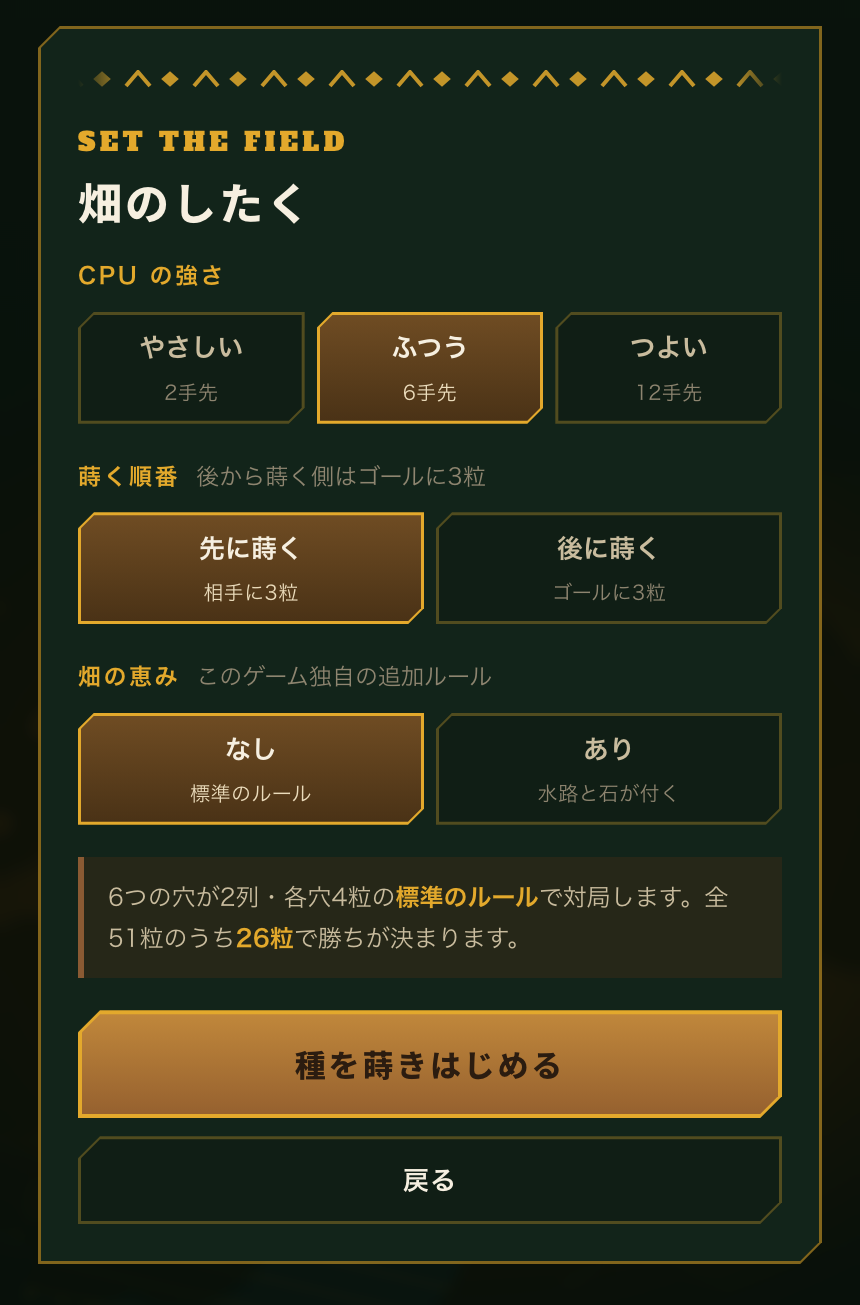
| CPU の強さ | CPU no tsuyosa | CPU strength. The three buttons carry digits — 2手先 / 6手先 / 12手先 — meaning 2, 6 and 12 ply, so you can choose by the number alone |
| やさしい / ふつう / つよい | yasashii / futsū / tsuyoi | Easy / Normal / Strong |
| 蒔く順番 | maku junban | Sowing order, which is where the komi is set |
| 先に蒔く(相手に3粒) | saki ni maku | You sow first, so the CPU receives the 3-seed komi |
| 後に蒔く(ゴールに3粒) | ato ni maku | You sow second, so your own store starts with 3 seeds |
| 畑の恵み: なし / あり | hatake no megumi: nashi / ari | Field’s Blessing off (default) or on. On switches the komi to 9 seeds |
| 種を蒔きはじめる | tane o maki-hajimeru | Start the game with these settings |
| 案内を見る / スキップして対局へ | annai o miru / sukippu shite taikyoku e | Take the five-move guided tour, or skip straight to the game |
| 待った | matta | Undo. Rewinds your move and the CPU’s reply as one pair, with no limit on how often |
| やり直し | yarinaoshi | Restart today’s puzzle from the beginning |
| 畑を出る | hatake o deru | Leave the game and return to the title screen |
| 音 あり / 音 なし | oto ari / oto nashi | Sound on / sound off |
| 豊作 / 不作 / 同じ実り | hōsaku / fusaku / onaji minori | The three results: win (“bumper crop”), loss (“poor crop”), draw (“equal yield”) |
| もう一局 / 盤を見る / タイトルへ | mō ikkyoku / ban o miru / taitoru e | Play again / look back at the final board / return to the title |
One thing worth knowing before you open the mancala page: the how-to-play and FAQ sections written below the board are in Japanese as well, and there is no English version of them. Everything in them that matters is in this article instead.
How to Play Mancala Here: Price, Saves and Where It Runs
This mancala opens in a browser and starts immediately. Nothing is charged, and there is no account to create and nothing to install.
- Price: free. One advertisement sits in the text below the board, kept away from the controls
- Where to play: Mancala, a free sowing board game against the CPU
- Saves: your record and settings are stored only in your own browser and are never sent to a server
- Undo: the 待った button rewinds your move and the CPU’s reply as one pair, with no limit on how many times
- Other games on this site: the full list of games and apps on rinblog.org
The board’s look was drawn from the carved wooden boards played in courtyards in West Africa and assembled as a shaded courtyard on a warm afternoon. It is not a reproduction of any real regional board or motif. The pit numbers are not written in Arabic numerals either; they are shown as the count of shallow dimples carved into the ridge down the middle of the board, because real boards do not have numbers carved on them.
One limit is worth stating plainly. The 3-seed komi is a value measured from CPU self-play, not from human games. People choose different moves from a 6-ply search, so whether three seeds is the right handicap between two human players is a separate question this page has not answered. If it turns out to be off in practice, that is the material for measuring it again.