Minecraft Dungeons II was released on 29 September 2026. The single biggest difference from the original Minecraft Dungeons is that you can finally play online with people you do not already know.
I put several dozen hours into the original and stopped about halfway through the story. Not because it was too hard — because the game gave me no way to find people to play with. This article looks at what the sequel fixes, and what it does not, from that specific vantage point.
▼ Minecraft Dungeons II articles
✅ 4 Armor Slots and the New Talismans
✅ What Changed from the Original
▼ Guides for the original Minecraft Dungeons
✅ Beginner Guide: What to Do First
✅ How to Level Gear Without Grinding
✅ How to Pick Weapons, Armor and Artifacts
✅ How Enchantments Work and Where to Spend
✅ Farming Emeralds and Using the Merchants
✅ Difficulty Levels and When to Move Up
Sponsored
What is the biggest difference between Minecraft Dungeons II and the original?
The short answer: matchmaking and party codes. The original never had either.
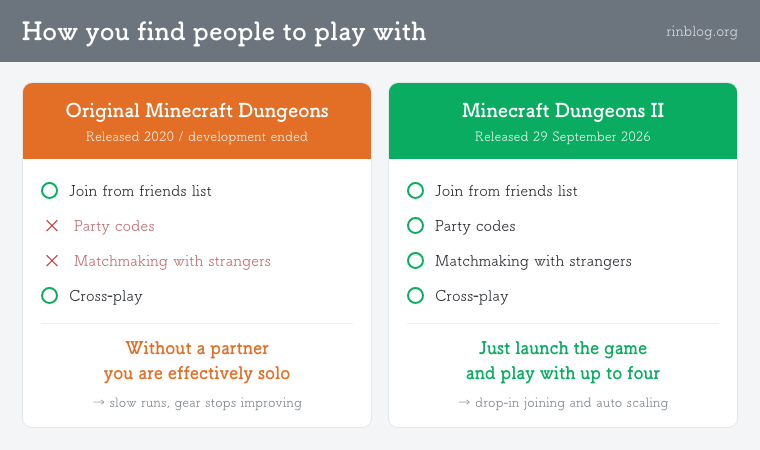
Online multiplayer in the first Minecraft Dungeons worked one way only: joining the session of someone on your friends list. The developers openly described the game as built for playing with friends, and matchmaking with strangers was never added between the 26 May 2020 release and the 28 September 2023 announcement that development had ended.
Minecraft Dungeons II ships with the full set: friends list, matchmaking, party codes, cross-play, and same-screen couch co-op. Launching the game and looking for people — ordinary in Splatoon 3 or Monster Hunter — is finally possible here.
Why did the original stall for me?
The reason is specific: I could only ever play with one other person, and at that size a single stage took far too long.
Two players was not enough to make grinding realistic
This is a looter-slasher, so the intended loop is re-running stages at rising difficulty and filtering gear. With two players each stage took long enough that running it repeatedly was impractical. My gear stopped improving, and without better gear I could not move up a difficulty — a full stop.
The “best weapons” from YouTube never dropped
Guide videos cover plenty of strong weapon and artifact combinations. But without fast repeat runs, that gear does not drop in the first place. The information was available; the precondition for acting on it — grinding speed — was not. That mismatch was the hardest part of the original.
One session with a stronger player changed everything
I once recruited through an open chat group and played alongside a much stronger player. The pace was on another level. Stages went faster, and powerful weapons, armor and artifacts arrived noticeably more often. Which says it plainly: having no in-game way to find people was itself the wall.
That is why the sequel’s matchmaking reads to me less like a new feature and more like a correction to a precondition.
Sponsored
What changed about multiplayer in the sequel?
The answer: not just more ways to find people — the small frictions of playing in a group were cleaned up as well.
- Couch inventory — press up on the d-pad and everyone opens their inventory at once. No more waiting while one player sorts their loadout
- Colour-coded loot — you can see at a glance which items are meant for you
- Teleport to player — click the right stick to jump to another player’s position. Regrouping is fast
- Automatic difficulty scaling and drop-in joining — difficulty adjusts to the party size, and players can join a session in progress
- Multi-player revives — several players reviving together brings someone back faster
Mixed parties of couch co-op and online players are supported too, so “two of us on one screen, two more online” is a valid setup.
How did the gear system change?
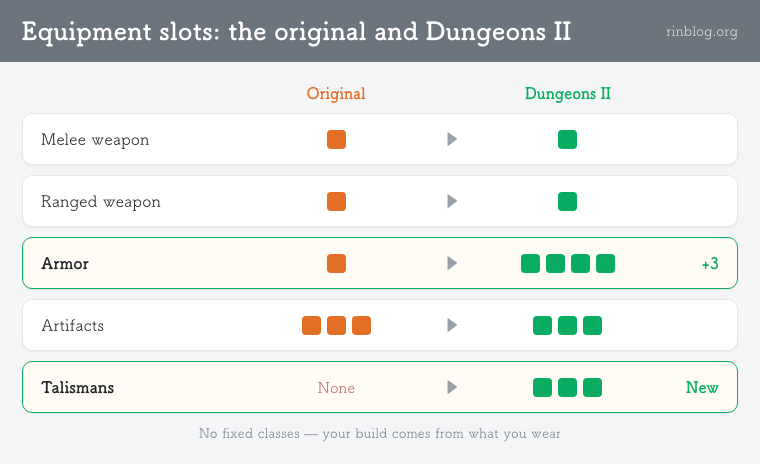
The answer: there is still no fixed class system — your build comes from what you wear — but the range of combinations is clearly wider.
The original gave you one melee weapon, one ranged weapon, one armor slot and three artifacts. In the sequel, armor expands to four slots and three talisman slots are added. The developers describe this as “You are what you wear.”
Talismans are unique passive items that level up based on how long you keep them equipped, obtained from special quests and hidden locations. The Bone of Tastiness, for example, summons a wolf companion and grants an automatic revive. Enchantments carry over as well, allowing customisations such as “defeated enemies leave a healing pool on the ground.”
Item rarity has more tiers than before, so there is more room for filtering gear. Ability descriptions are now readable in detail on the equipment screen, which answers one of the original’s clearer usability complaints.
Sponsored
How is the world structured now?
The answer: the mission-select structure is gone, replaced by one connected world you explore.
The original sent you out from a hub map, one mission at a time. The sequel mixes handcrafted and procedurally generated areas that connect seamlessly — deliberate design on a first visit, fresh variation on a return.
A new biome, the Deep Dark, is entered through a portal in an ancient city. For navigation there is a detailed minimap and world map, and clicking the left stick calls up the familiar Guiding Light to show you the way.
The big addition on the action side is jumping. The original had none; movement was entirely flat. The sequel also assigns a jump attack to the Y button, adding vertical routes and a different combat rhythm.
Can you enjoy the sequel without playing the original?
The answer: yes. Finishing the original is not a prerequisite.
It is a sequel, but the systems underneath have been swapped out. Stage select is gone, armor and talisman slots have multiplied, jumping is new, and the multiplayer flow is a different thing entirely. Not much of what you learned in the original carries over directly.
If anything, players who put serious time into the original need a period of adjustment to differences like the absence of mission select and the presence of jumping. Based on what has been made public, there is nothing that puts a newcomer at a disadvantage.
Who should play the original first, and who should not bother?
The answer: only players who already have someone lined up to play with.
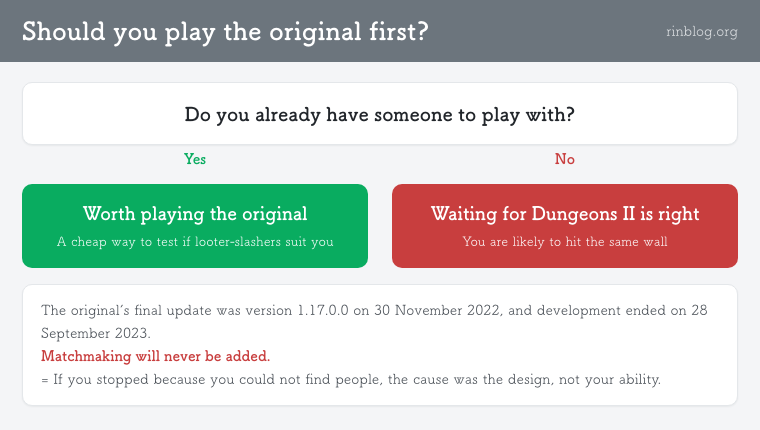
Worth playing first if you
- Have a friend or family member available to play with regularly, two or more of you
- Want a cheap way to test whether looter-slashers suit you
- Want to see the world and lore that the Deep Dark and ancient cities draw on
Not worth it if you
- Play solo, or have no regular partner — this was exactly my situation, and I stopped partway. You are likely to hit the same wall
- Are likely to start it and abandon it partway
- Are hoping for the main Minecraft experience of building and survival — this is a completely different genre
To be clear about my position: I recommend the sequel most strongly to the people who quit the original because they could not play with strangers. If what stopped you was the design rather than your ability, the design is what changed.
Release date, price and platforms
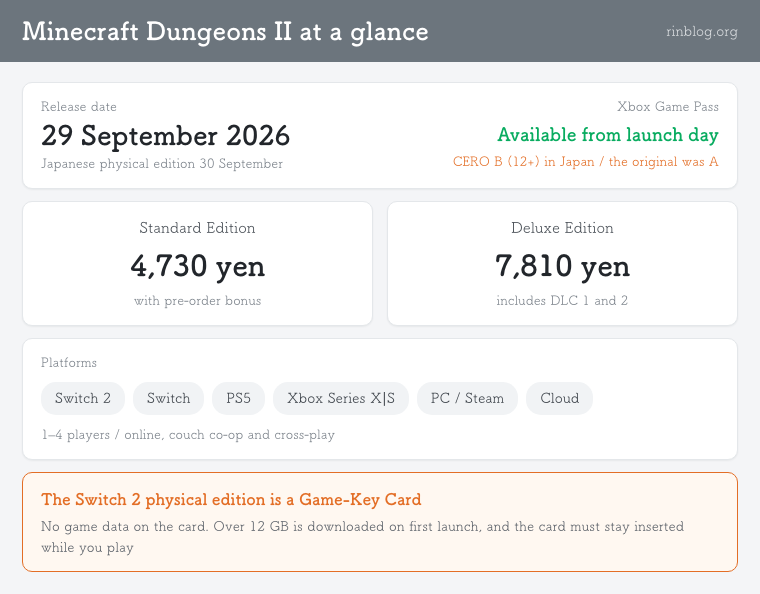
The answer: released 29 September 2026, 4,730 yen for the standard edition, and on Xbox Game Pass from day one.
| Item | Details |
|---|---|
| Release date | 29 September 2026 (Japanese physical edition 30 September) |
| Developer | Mojang Studios / Double Eleven |
| Platforms | Windows 10 and 11, Xbox Series X|S, PlayStation 5, Nintendo Switch, Nintendo Switch 2, Steam, Xbox Cloud Gaming |
| Price | Standard Edition 4,730 yen / Deluxe Edition 7,810 yen (Steam listing) |
| Deluxe extras | Soul Cape, Blob pet, four hero skins, upcoming DLC 1 and 2 |
| Pre-order bonus | Two hero skins, Twisted Cape, Twisted Chicken pet |
| Game Pass | Available from launch day |
| Players | 1–4 (online / couch co-op / cross-play) |
| Rating | CERO B, ages 12 and up in Japan (the original was CERO A, all ages) |
| Switch 2 physical | Game-Key Card — no game data on the card. Over 12 GB must be downloaded on first launch |
If you only want to try it, Game Pass is the cheapest way in. If you plan to stay with it and follow the DLC, the Deluxe Edition becomes a candidate. When in doubt, the standard edition is fine.
For reference, the game was announced at Minecraft LIVE on 22 March 2026, with detailed gameplay shown at the Xbox Games Showcase in June of the same year.
A warning about the Switch 2 physical edition
If you are choosing the Switch 2 physical release, be aware: there is no game data on the card. First launch requires an internet connection and a download of more than 12 GB. It works offline after that, but the key card has to stay in the console while you play.
If your internal storage is short, you will also need a microSD Express card. If you are buying this as a gift for a child, it is worth knowing that opening the box does not mean being able to play straight away. On the other hand, physical copies sometimes sell below digital — as of August 2026 some Japanese retailers listed it in the low 4,000-yen range.
Summary
▶ The biggest difference in II is matchmaking – the original never received it before development ended
▶ What stalls players in the original is not skill but the absence of matchmaking
▶ Gear moves from one armour slot to four, plus talismans, widening how builds are assembled
▶ The map changes from mission select to a continuous world
▶ Playing the original first is not required; no story knowledge is assumed
▶ The original is only worth playing if you already have someone to play it with
▶ Release is September 29, 2026, and the CERO rating moves from A to B
Frequently asked questions
Can you still play the original Minecraft Dungeons?
Yes. Note, though, that version 1.17.0.0 on 30 November 2022 was the final update, and the end of development was officially announced on 28 September 2023 (25 million players cumulatively at that point). No new content is coming.
Could matchmaking still be added to the original?
No. Development has ended, so the design will not change. If playing with strangers is what you want, the sequel is the only option.
Is it suitable for children on their own?
Two changes deserve more care than the original required. The first is the rating: the original was CERO A (all ages) in Japan, while the sequel is listed by retailers as CERO B (12 and up); internationally it is ESRB E10+ and PEGI 7. The second is matchmaking, which creates a new path to connecting with strangers.
The controls themselves are simple and difficulty scales automatically with party size, so the game itself is as child-friendly as the original. That said, set up parental controls for online communication on your platform before handing it over.
Does it run on the original Nintendo Switch?
Both Switch and Switch 2 are listed as supported platforms. The original had performance dips in places, so if smoothness matters to you, Switch 2, PS5 or PC are the safer choices.
Can you carry over save data or gear from the original?
Nothing has been announced about carrying anything over. Given that the equipment framework itself has changed, it is best not to count on it.