Salvage Bell (サルベージ・ベル) is a free browser game in the Goofspiel family, released in September 2026. You and the computer each hold nine lead weights numbered 1 to 9, drop one face down every round, and whichever weight sinks deeper hauls up the cargo lying on the sea floor. Two things separate it from Goofspiel (GOPS): the whole manifest of nine cargoes is face up before the first drop, so you allocate all nine weights from move one, and once per game you can ring the bell to drop two weights at once, paying for it by going empty-handed on the next dive. One game is nine dives and runs three to five minutes. No account, no install, nothing to buy — open Salvage Bell, a free simultaneous bidding game in the browser and the first dive starts. This article is written by the person who built it, so it covers the rules, the comparison with GOPS, and the self-play numbers behind the CPU.
Sponsored
What Is Salvage Bell? A Simultaneous Bidding Game With the Whole Manifest Face Up
Salvage Bell is a free browser game for one player against the computer, in which both sides hold nine lead weights stamped 1 to 9 and drop one face down each round. The number on a weight is how deep it sinks, and the side that sinks deeper hauls up that round’s cargo. There are nine cargoes worth 1 to 5 points each, totalling 25 to 29 points per game. After nine dives, the higher score wins.
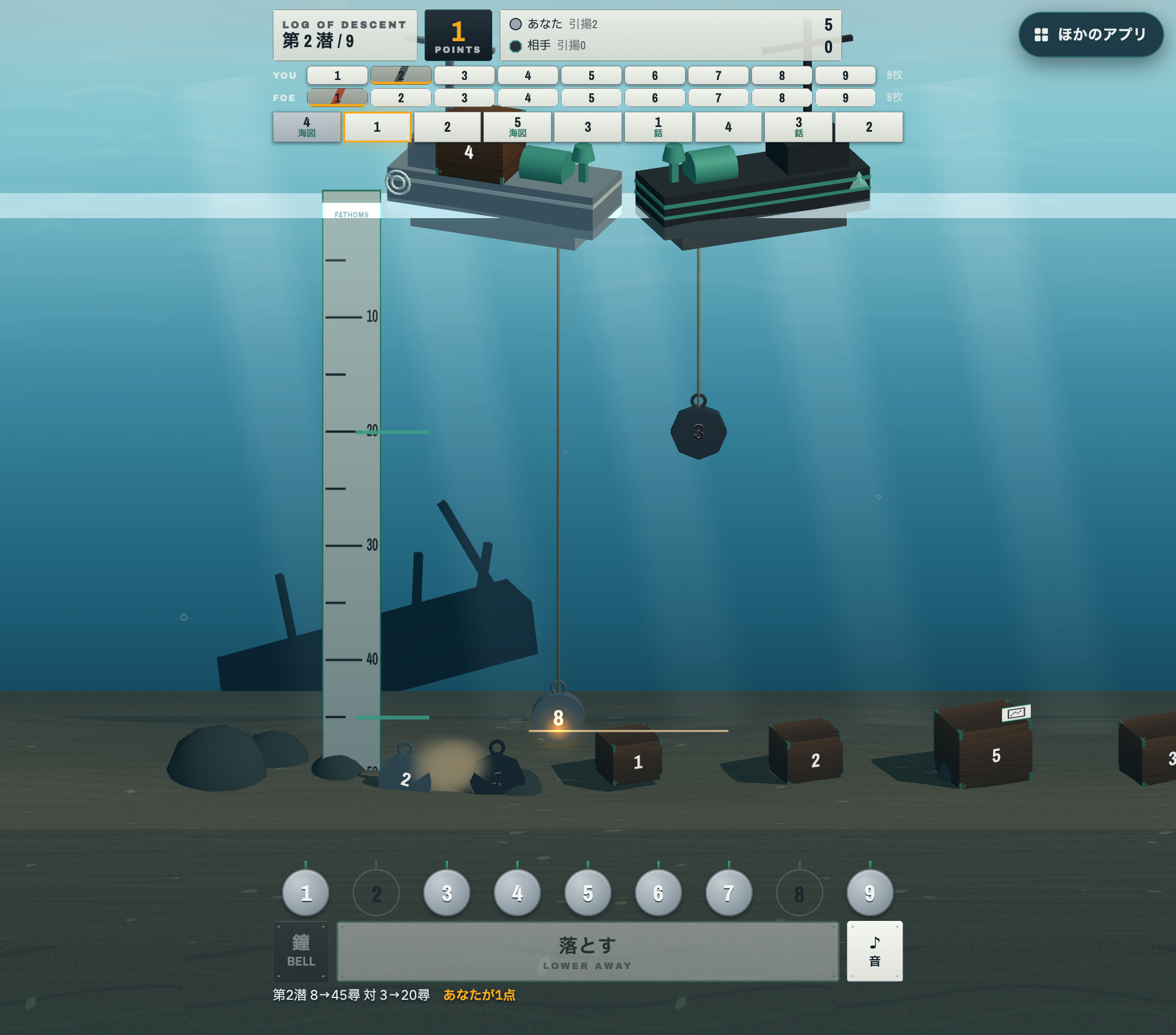
Depth in Salvage Bell is directly proportional to weight. A weight of 1 stops at 10 fathoms (尋, hiro), a weight of 9 hits the sand at exactly 50 fathoms, and one tick on the depth gauge is 5 fathoms, or one step of weight. Both weights sink at the same speed of 38 fathoms per second, so the lighter one stops first and the heavier one keeps going. You see which is deeper before you read either number.
Spent weights sink and never come back. Nine weights match nine cargoes exactly in Salvage Bell, so the game is an allocation problem: which cargo do you write off, and which one do you spend a heavy weight on. Winning a 1-point cargo with your 9 means that 9 is gone when the 5-point cargo comes up later.
- Price: free, with no account, no login and no install
- Players: solo, against a CPU with three difficulty levels
- Length: nine dives per game, three to five minutes
- Runs on: mobile browsers on iPhone and Android, and desktop browsers
- Released: September 2026
- Interface language: Japanese (an English glossary of every button is further down this article)
How Do You Play? Nine Weights, Nine Cargoes, One Drop at a Time
Salvage Bell has four rules: both sides drop one weight face down at the same time, the heavier weight takes the cargo, a tie fails and rolls the cargo into the next one, and spent weights never return. A single dive runs like this.
- Read the manifest. The log sheet at the top of the screen lists all nine cargoes, their points and their effects, from the very start. Nothing about the order is hidden, so you can plan all nine weights before the first drop
- Pick one weight and place it face down. The computer places its weight at the same time. Its choice is locked in before you commit, so it never sees your pick first
- Drop together. Both weights sink at the same speed, and the lighter one stops first. Whichever sinks deepest takes that cargo’s points and its effect
- Repeat nine times. The higher score wins. On a tied score, the player who hauled up more cargoes wins; if that is level too, it is a draw
Cargoes can carry effects. In Salvage Bell three or four of the nine cargoes carry one, and the same effect appears at most twice in a game. The ninth and final cargo never carries an effect. Every effect applies to “the next dive”, and there is no dive after the ninth, so an effect there would do nothing.
What Happens When Both Players Drop the Same Weight?
Dropping the same weight in Salvage Bell makes the two weights collide at the same depth and bounce apart, and the salvage fails. That cargo stays on the sea floor and the next cargo comes down on top of it. The points add together and both effects go to whoever hauls up the stack. Both players still lose their weights, so a run of ties piles a large score into one late dive.
A tie is not purely an accident to avoid. You can match the opponent’s weight deliberately on a cheap cargo to push the pile later, then take the whole stack while you still hold heavy weights. The opponent is aiming at the same pile, so the real question is who ends up sending and who ends up collecting. The one exception is a tie on the final cargo: that cargo goes to nobody.
Sponsored
What Do the Four Effects Do? Two Change Weight, Two Change What You Can Read
Salvage Bell has four effects, split into two jobs. The chain and the buoy move a weight by ±2; the chart and the harpoon change what you can read and how a tie is settled, not how deep anything sinks. An effect goes to whoever hauled up the cargo and applies to the next dive.
| Effect | Romaji | What happens | Lasts for |
|---|---|---|---|
| 鎖 (chain) | kusari | Your weight counts as +2. Two links are added above the weight and it sinks two ticks (10 fathoms) deeper | The next dive |
| 浮標 (buoy) | fuhyō | The opponent’s weight counts as −2. A buoy is clipped to their line and lifts it two ticks. Weight never drops below 0 | The next dive |
| 海図 (chart) | kaizu | Narrows the opponent’s face-down weight to two possibilities. Two markers appear on the depth gauge and one of them is real | The next dive |
| 銛 (harpoon) | mori | The next time a tie happens, that cargo becomes yours | Until the next tie |
Two copies of the same effect stack: two chains make +4 and sink four ticks deeper. Effects held by both players at once cancel instead. If both sides hold a harpoon when a tie happens, both harpoons snap and the salvage still fails. If both sides hold a chart on the same dive, the two charts disagree and neither player can read anything. The point is that an effect should not decide the round on its own — it should be a state that the opponent can see you are in.
The dive after you win a chain is the dive where a weight two lighter than the opponent’s still wins, which is the best chance in the game to break their read. The buoy works the other way round: take it just before a high-value cargo where the opponent is likely to spend something heavy. Because effects are printed on the manifest from the start, the allocation problem includes deciding which cargo’s effect you want and which cargo you intend to spend it on.
When Should You Ring the Bell? Two Weights Now, Empty Hands Next
The bell in Salvage Bell is a move you get once per game: drop two weights at the same time and compete with their combined value. The cost is that your next dive is empty-handed and you drop no weight at all. Bell weights bite past the sand into the sea bed, so they sink below the 50-fathom line on the gauge. The floor is 59 fathoms and nothing goes deeper.
The bell can only be rung up to the seventh dive. If it were allowed on the eighth or ninth, the empty-handed dive would fall outside the game and the two-weight drop would cost nothing. Capping it at the seventh dive guarantees the cost lands inside the game. Ring it or not, 2 + 0 + 7 still spends nine weights across nine dives, so the final cargo is always contested with both players holding a weight.
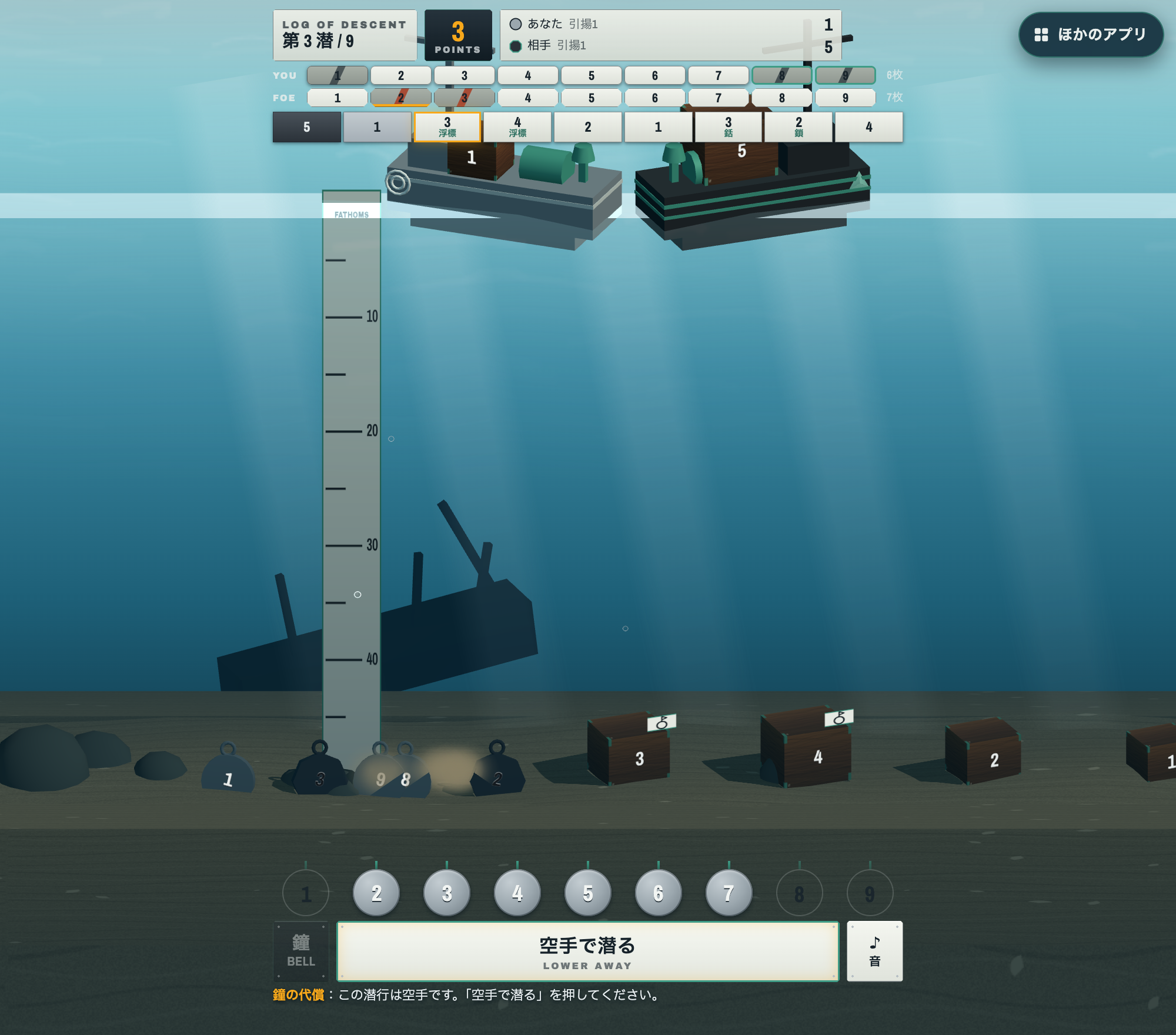
The place to ring the bell is a dive where ties have stacked two or three cargoes into one pile. A combined weight beats anything a single weight can reach, so a swollen pile is close to guaranteed. Ringing early wastes two weights on a cheap cargo and hands the opponent the following dive as well. Whether the empty-handed dive lands on a cheap cargo is something you can check on the manifest in advance.
Sponsored
How Is Salvage Bell Different From Goofspiel (GOPS)?
The closest published relative of Salvage Bell is Goofspiel, also known as GOPS, The Game of Pure Strategy and Psychological Jujitsu. The structural difference is when you learn the prize order: Goofspiel shuffles the prize suit and turns up one card at a time, while Salvage Bell puts all nine cargoes on the manifest before the first drop. That single change turns a round-by-round read into a nine-weight allocation you can build on move one.
| Goofspiel (GOPS) | Salvage Bell | |
|---|---|---|
| Prize order | Prize suit is shuffled; one card is turned up per round | All nine cargoes, their points and their effects are listed from the start |
| Bidding cards | One suit, usually 13 cards | Nine weights, 1 to 9 |
| Ties | Rules vary: discard the prize, split it, or roll it over to the next round | Always rolls over; points and effects accumulate onto the next cargo |
| Bidding two cards at once | Not in the rules or the variants listed on Wikipedia | The bell: once per game, up to dive seven, at the cost of an empty-handed dive |
| Modifiers | None in the rules or the variants listed on Wikipedia | Four effects — chain, buoy, chart, harpoon — on three or four of the nine cargoes |
The rollover-on-a-tie rule is not new, and Salvage Bell does not claim it. The Goofspiel article on Wikipedia lists it as one of the standard tie variants, and the free browser version at Coppercod offers it as a “play for cards” option. What Salvage Bell does is make it the only tie rule instead of one setting among several, so every tie is a deliberate way to move points down the manifest rather than a discard.
References for the comparison: Goofspiel on Wikipedia, which states that “the prizes are shuffled and placed between the players with one card turned up”, and the free GOPS implementation at Coppercod, which runs in a browser against an AI opponent with no sign-up.
Why Nothing Is Hidden Except the Bid You Are Making Right Now
Salvage Bell treats every spent weight as public information for both sides and leaves the numbers on screen. The two trays at the top of the display hold each player’s 1 to 9, and used numbers are struck through. Sunken weights also pile up on the sea floor with their numbers facing up. The only thing face down at any moment is the weight being dropped this dive.
That decision has a reason. A simultaneous bidding game only becomes a read once you know what the opponent has left. Beat the heaviest weight in their hand by one and that cargo is certain. Making that calculation is the whole game — but hide the spent weights and it stops being a calculation and becomes a test of whether you memorised nine numbers. I did not want to build a memory test, so public information is shown as public.
The same reasoning is why Salvage Bell has no undo. If you could see the opponent’s weight and then redo your own, dropping face down at the same time would mean nothing. Instead you can change your pick as many times as you like before pressing the drop button, and the results screen offers a replay of the identical manifest. “How should I have taken that 5-point cargo” is answered by playing it again, not by rewinding.
Designing a game where both players see everything came up in the same form in Ultimate Tic Tac Toe: rules and how to actually win. There the board is fully visible, so the read is about which small board your move sends the opponent to. Salvage Bell moves that visible information into “what the opponent has left in the tray”.
How Were the CPU and Today’s Salvage Built? 900 Rollouts and 90 Days Measured
Salvage Bell is simultaneous, so you commit without seeing the opponent’s move and no search tree of the chess or shogi kind is available. The CPU is built on mixed strategies instead. The “strong” level is Monte Carlo: it models the opponent as “allocation proportional to cargo points, plus noise”, plays the remaining dives out to the end, and picks the move with the highest expected score difference, running 900 rollouts in the shipped build.
Always taking the highest-expected-value move is punished in a simultaneous game — it gets read and produces nothing but ties. The move is therefore sampled with a probability that follows the size of the expected-value gap. To confirm the three levels really are three levels, each pairing was self-played 200 games. Strong beat normal 174–25–1, normal beat easy 142–56–2, and strong beat easy 190–9–1. Every step up is a measured improvement, not an assumed one.
The solo “Today’s Salvage” mode is a daily puzzle that rotates at midnight Japan time. Everyone gets the same manifest that day, and the opponent is one of five “captains of the day” whose habit is printed on screen — the discard-rope captain, for instance, spends its three lightest weights on the first three dives and then plays heaviest-first for the rest of the game. Captains use no randomness, so a line planned across all nine dives can produce a large margin. The maximum score difference for each day is solved here in advance, and only days where the optimal line wins are published.
The star thresholds are three stars at 85% of that maximum, two stars at 55%, and one star for any win. The 0.85 and 0.55 came from measuring 90 days. Because the captains’ habits are on screen, the measurement used programs in place of people: one that plays by reading the printed habit, and one that also looks one dive ahead.
- Reads the printed habit: median achievement 0.75. Across 90 days, 1 day at no star, 26 at one star, 43 at two stars, 20 at three stars
- Also looks one dive ahead: median achievement 0.78. Across 90 days, 0 days at no star, 10 at one star, 48 at two stars, 32 at three stars
- Tested at 0.90 / 0.55 instead: three stars fell to 18 days and 22 days, which did not separate the two levels of play, so the top threshold came down to 0.85
Publishing only puzzles that are known to be solvable is the same approach used in Root Hollow, a turn-based tower defense where you cannot build towers: there a solver confirms the day is clearable before it ships, and here only days where the optimal line wins are accepted. Both exist so that guessing never gets you there and correct planning always does. Measuring a design decision by running it over dozens of generated puzzles is the same method used to rank the techniques in 7 advanced sudoku techniques after X-Wing, ranked by real use.
Why I Built It: Japanese Search Had Nowhere to Play This, English Search Did
Searching in Japanese for a place to play a simultaneous face-down bidding game solo in a browser returned nothing that named the format itself. The queries were the Japanese equivalents of “number bidding, simultaneous reveal, card game, browser, free, single player”. What came back was portal-site listings of free card games, not a page that said “both players reveal a number at the same time, and matching numbers cost you both”.
English search is a different picture, and it is worth saying so plainly. The format has an English name — Goofspiel, or GOPS — with a Wikipedia article, and Coppercod runs a free browser version against an AI with no sign-up, alongside mobile apps. So the empty shelf I built for was the Japanese one, not the English one. What came out of building it — a full manifest visible from the first drop, and the bell as a once-per-game double bid with a real cost — is not in either the Wikipedia rules or the Coppercod options.
That is also why Salvage Bell does not lean on its invented name. The pages and headings say what the thing is: a simultaneous bidding game where you drop a weight face down. The games published on this site get visitors when they are named by the general term that the specialist portals have not claimed, not by a coined title nobody searches for.
The Interface Is in Japanese, but the Game Is Digits
Salvage Bell’s interface is Japanese only, with no English toggle. The game asks you for exactly one decision per dive — pick a number between 1 and 9 — and the numbers, the depths in fathoms and the cargo points are all digits, so the table below plus the four effects above is enough to play a full game. Several labels are already in Latin script on screen: LOG OF DESCENT, POINTS, YOU, FOE, BELL and LOWER AWAY.
| On screen | Romaji | What it does |
|---|---|---|
| 引き揚げを始める | hikiage o hajimeru | Start a normal game against the CPU |
| 今日の引き揚げ | kyō no hikiage | Start Today’s Salvage, the daily puzzle |
| やさしい / ふつう / つよい | yasashii / futsū / tsuyoi | The three CPU levels: easy, normal, strong |
| 落とす | otosu | Drop the weight you selected (also labelled LOWER AWAY) |
| 鐘 | kane | Ring the bell and drop two weights this dive (also labelled BELL) |
| 空手で潜る | karate de moguru | Dive empty-handed — the button that replaces “drop” after the bell |
| 錘を1枚選んでください。 | omori o ichimai erande kudasai | “Pick one weight.” The prompt shown before you choose |
| 第 1 潜 / 9 | dai issen / 9 | Dive 1 of 9, the round counter |
| 引揚0 | hikiage 0 | How many cargoes that side has hauled up so far |
| 音 | oto | Sound on and off |
| はじめての方はこちら | hajimete no kata wa kochira | Open the four-step tutorial |
| ルールを読む | rūru o yomu | Open the in-game rules |
| 同じ積荷でもう一度 | onaji tsumini de mō ichido | Replay the identical manifest |
| 別の積荷でもう一度 | betsu no tsumini de mō ichido | Play again with a new manifest |
| タイトルへ戻る | taitoru e modoru | Back to the title screen |
The longer written material is Japanese only as well. The Salvage Bell app page carries a “how to play” section with the procedure, the four effects, tips and an FAQ, and that section is in Japanese with no English version.
How to Play Salvage Bell: Price, Saves and Where It Runs
Salvage Bell is completely free and needs no account and no installation. Open the Salvage Bell app page and the first dive starts on the spot. It runs in mobile browsers on iPhone and Android as well as on desktop browsers.
- Price: free. There is nothing to buy inside the game
- Account: none. Results and win streaks stay only in the browser on the device you played on
- Length: nine dives, three to five minutes. Each dive animates for roughly 3.7 to 4.9 seconds, dropping to about 2.3 seconds once the result of the game is already decided
- Full rules: the app page carries a Japanese “how to play” section with the procedure, the four effects, tips and an FAQ
- Another browser game on this site: play 3D chinchirorin in your browser, a dice game built with Three.js
The “strong” CPU in Salvage Bell reads the game by assuming the opponent allocates proportionally to cargo points, plus noise. That is a model, not a recording of how people actually allocate. If human play is more lopsided than that, the assumption is wrong. If the opponent’s reading feels monotonous in real games, that is the material for rebuilding the model.