Root Hollow (ルート・ホロウ) is a free turn-based tower defense you play in a browser, released in September 2026. Three dice drop into a mine shaft each turn, and you deal them across four pods to stop foragers climbing down to the sprout at the bottom. In most tower defense games you bank money and build towers wherever you like. Root Hollow never lets you build one: the four pods are fixed to four levels, and the only thing that arrives each turn is three dice. One game runs five to eight minutes. No account, no install, nothing to buy — open Root Hollow, a free turn-based tower defense in the browser and it starts on the spot. This article is written by the person who built it, so it covers the rules, the five pods and five foragers, and the self-play numbers behind the difficulty.
Sponsored
What Is Root Hollow? A Turn-Based Tower Defense With No Towers to Build
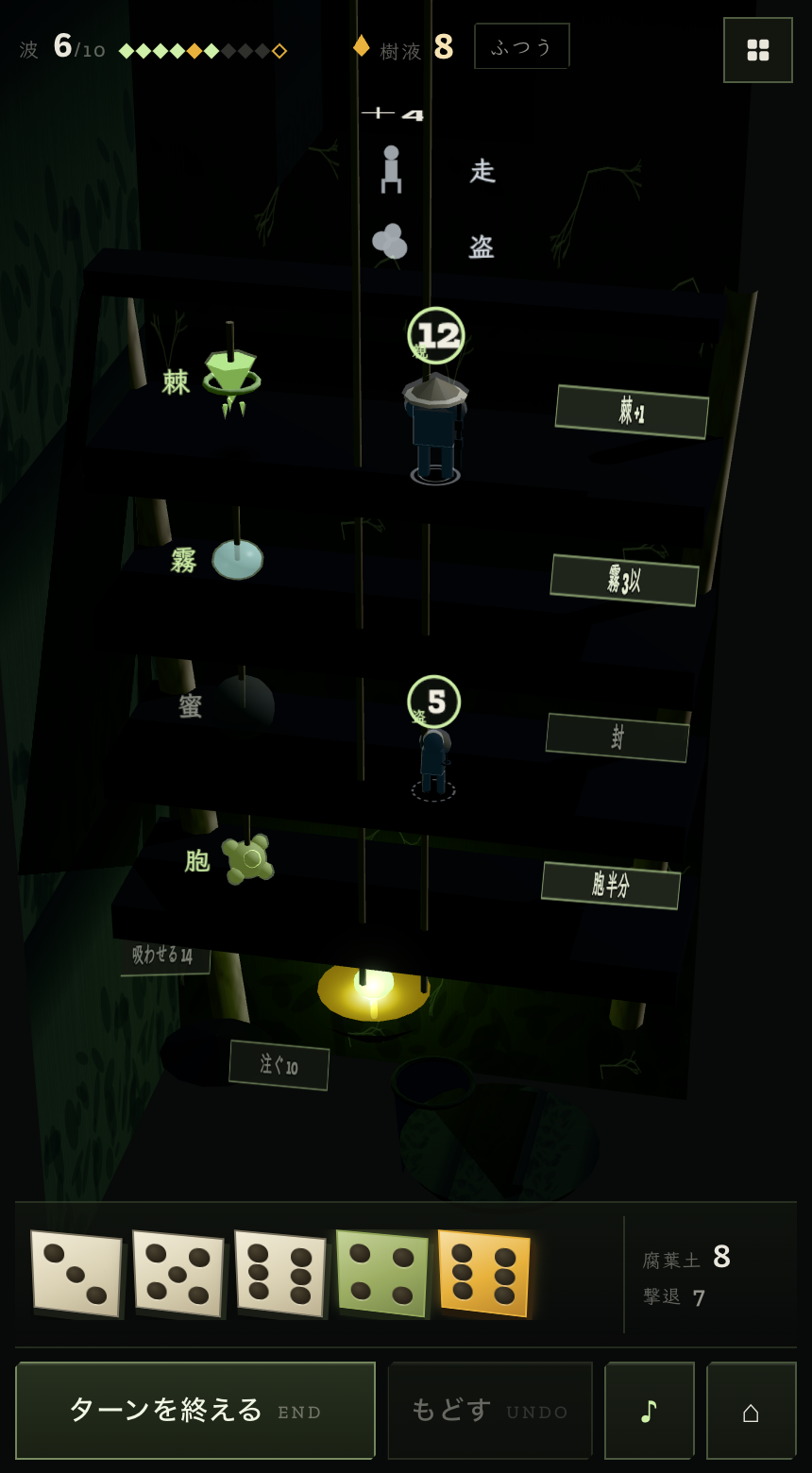
Root Hollow is a free solo tower defense set in a limestone mine shaft cut open into four vertical levels. Each turn three seeds — dice showing 1 to 6 — fall from the mouth of the shaft, and you deal them to the pods hanging one per level. Foragers come down on ropes and drop one level per turn. A forager that drops off the bottom level reaches the sprout and drains sap. Clear 10 waves of them (12 on hard) and you win; sap reaching 0 loses.
What separates Root Hollow from other tower defense games is that you never build a tower. The four pods are fixed to the four levels of the shaft and cannot be added to or moved. The only growing resource is the three dice per turn. A 6 dealt to a Thorn pod is 6 damage, but the same 6 dealt to Mist stuns for a turn (Mist needs 3 or more), to Rootbind pulls a forager up one level (Rootbind needs 4 or more), and to Nectar is stored as an 8 for next turn. Because the same number is worth different things in different places, the decision is not where to build but how to deal out the numbers in your hand.
- Price: free, with no account, no login and no install
- Players: solo. There is no opponent — you survive 10 waves
- Length: five to eight minutes per game
- Runs on: mobile browsers on iPhone and Android, and desktop browsers
- Released: September 2026
- Interface language: Japanese (an English glossary of every button and every wall readout is further down this article)
How Do You Play Root Hollow? Three Seeds, Four Pods, One Turn
Root Hollow has three rules: deal three seeds across four pods, end the turn so every forager drops one level, and spend the leaf mould you earn. A turn runs like this.
- Three seeds fall. Pick a seed on the tray at the bottom of the screen, then press the level you want it on. Two seeds on the same pod is allowed
- Read the result before you commit. Selecting a seed carves the outcome for all four levels into the wall on the right — readouts such as “-5 残1” (5 damage, 1 hit point left), “止 1” (stunned for a turn), “押 上” (pulled up a level) and “空” (nobody there)
- End the turn. Every forager drops one level, and if the mouth of the shaft is clear the next one comes down. Of the seeds you did not use, only the highest survives into the next turn as moss (苔); any others rot away
- Sap drains when a forager reaches the sprout. Dropping off the fourth level costs 2 sap, or 5 for the Foreman, and 0 sap loses the game. Sap starts at 10 on easy, 8 on normal and 6 on hard
- Every third kill triggers a bloom. You take one of the four pods and either change it to a different kind or upgrade it
The Five Pods Are Told Apart by Shape, Not Colour
Root Hollow has five kinds of pod, and they are distinguished by silhouette rather than colour: Thorn (棘, toge) is a downward cone, Mist (霧, kiri) a rippling membrane, Nectar (蜜, mitsu) a hexagonal sac, Rootbind (根縛り, neshibari) a square shackle and Spore (胞子, hōshi) a grainy sphere. Learning those five shapes is enough to play without reading the names, which matters if you do not read Japanese. A game opens with Thorn on level 1, Mist on level 2, Nectar on level 3 and Thorn on level 4; Rootbind and Spore only become available when you pick them at a bloom.
| Pod | Shape | Effect | Upgraded |
|---|---|---|---|
| Thorn (棘) | downward cone | Damage equal to the roll, to the forager on that level | roll +1 |
| Mist (霧) | rippling membrane | A roll of 3 or more stuns that level’s forager for one turn | works from 2 |
| Nectar (蜜) | hexagonal sac | Stores the roll +2 for next turn (one seed held, capped at 8) | +3 instead |
| Rootbind (根縛り) | square shackle | A roll of 4 or more pulls that level’s forager up one level | works from 3 |
| Spore (胞子) | grainy sphere | Half the roll, rounded up, to the levels above and below | half +1 |
The same forager can be stunned only once on any given level. That rule stops you from freezing the descent forever, and together with the turn cap — waves × 8, so 80 turns on normal — it guarantees every game reaches a result.
How Does Scoring Work? An Exact Kill Pays More
Root Hollow scores in leaf mould (腐葉土, fuyōdo), paid out for each forager you repel: 3 for the Digger, 3 for the Swiftfoot, 4 for the Pilferer, 5 for the Armoured Guard and 10 for the Foreman. Killing a forager with damage exactly equal to its remaining hit points pays +2, and damage wasted past the kill costs up to −3. Winning adds twice your remaining sap. Repelling everything is not the whole of it — repelling everything on the nose is where the score comes from.
Sponsored
What Makes the Five Foragers Different? The Level They Stop On
The five foragers in Root Hollow are separated by which levels they stop on and which rolls they blunt, not by how much health they carry. Their numbers are below.
| Forager | Hit points | Leaf mould | Trait |
|---|---|---|---|
| Digger (掘り手) | 4 | 3 | none |
| Armoured Guard (鎧の衛士) | 6 | 5 | halves damage from odd rolls |
| Swiftfoot (早足) | 3 | 3 | drops two levels per turn |
| Pilferer (盗掘者) | 5 | 4 | seals the pod on the level it lands on for one turn |
| Foreman (親方) | 12 | 10 | +1 hit point for every two levels dropped. Arrives on waves 5 and 10, and on wave 8 as well on hard |
Those traits turn into concrete consequences on the board. The Swiftfoot drops two levels a turn, so it only ever stops on levels 1 and 3; rolls you prepared on levels 2 and 4 never touch it, and the reliable answer is to kill it on level 1 as it enters. The Armoured Guard halves odd rolls, so a 5 gets 2 through. The Foreman has 12 hit points (10 on easy, 14 on hard) and recovers 1 for every two levels it drops, so chipping at it does not work and it has to be dropped in one go on a lower level.
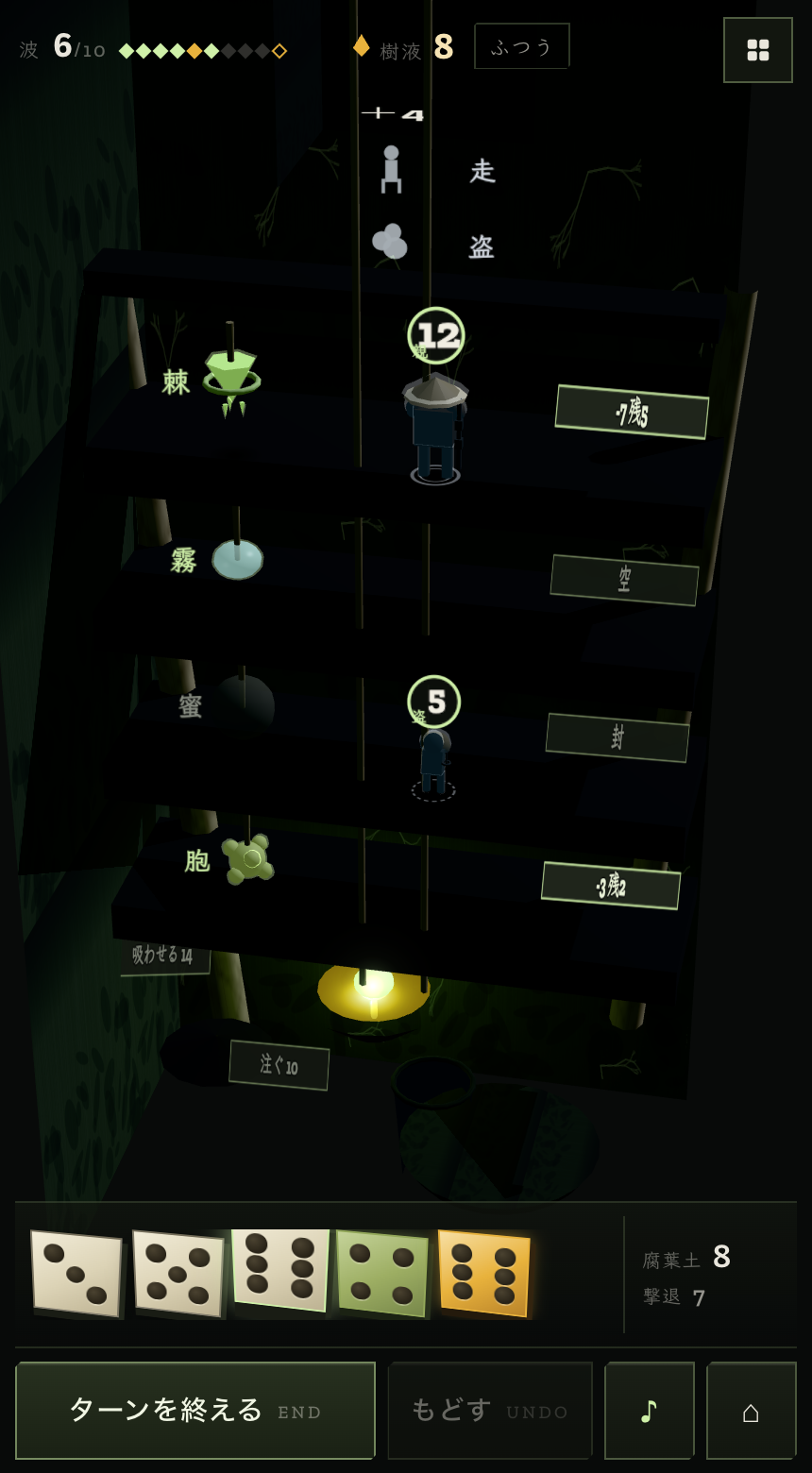
The wall readouts exist so you do not have to run that arithmetic by hand every turn. In the screen below, selecting a single 6 carves four outcomes at once: level 1 reads “-7 残5” (an upgraded Thorn takes 7 off and the Foreman has 5 left), level 2 reads “空” (nobody there), level 3 reads “封” (the pod is sealed by a Pilferer) and level 4 reads “-3 残2” (Spore hits the Pilferer on the level above for 3).
What Can You Spend Leaf Mould On? Sap Now, or Growth Later
Leaf mould has exactly two uses in Root Hollow. The slate beside the basin at the bottom, marked 注ぐ (“pour”), costs 10 + 3 × the number of times you have poured and returns 1 sap. The slate at the foot of the thick root on the wall, marked 吸わせる (“feed the root”), costs 14 + 6 × the number of times you have fed it and grants one extra bloom. Both prices climb with use, so a single game supports about three or four purchases in total.
Splitting the currency in two forces a choice between not dying now and being stronger later. Pouring costs 10, then 13, then 16, so one early pour buys you one extra forager’s worth of slack when the Foreman wave arrives. Scoring counts the leaf mould you have earned in total, not what is left in the basin, so spending never costs you points. Counting stock instead of total would make hoarding optimal and kill the choice outright.
Sponsored
How Was the Difficulty Set? Why Sap Dropped From 12/10/8 to 10/8/6
Starting sap was built at 12 on easy, 10 on normal and 8 on hard, then cut by 2 across the board to 10, 8 and 6. Adding the ability to pour leaf mould back into the sprout meant the opening allowance had to come down, and self-play measured how far.
The measurement uses a deliberately naive policy built into the game: deal from the highest roll downwards, always onto the level holding the forager nearest the sprout. The same policy is what checks whether a Today’s Hollow puzzle is hard enough to publish. Running it 1,000 games per difficulty, with the random sequence held identical and only the sap value changed, gave the table below.
| Difficulty | Clear rate at sap 12/10/8 | Clear rate at sap 10/8/6 (shipped) |
|---|---|---|
| Easy | 96.2% | 84.5% |
| Normal | 70.6% | 50.6% |
| Hard | 53.9% | 31.7% |
A policy that does nothing but throw the biggest number at the nearest target was clearing normal 70% of the time and hard more than half the time, which makes three difficulty settings a matter of naming rather than difficulty. The target was “normal should clear about half the time when you place carelessly”, and 10/8/6 is where that landed. An earlier run during design gave 96.5% / 75.0% / 55.0% for the old values, so the re-measurement reproduced the same pattern. In raw counting terms, normal sends 22 foragers across its 10 waves with a combined 114.8 hit points on average, while the three new rolls you receive each turn sum to 10.5 on average. Every roll you waste turns directly into lost sap.
How Is “Today’s Hollow” Generated? Solvable, but Not by a Naive Player
Today’s Hollow (今日の洞, kyō no hora) is a daily puzzle that rotates at midnight Japan time, and everyone who opens it gets the same line-up and the same rolls. Nothing is random once it is generated, so leaf mould scores are directly comparable between players. A day is only published if a beam-search solver can clear it and the naive policy cannot. The board is built from a seed derived from the date, and a seed that fails either test is advanced and the board rebuilt.
Regenerating 30 days locally, all 30 met the “naive policy fails, solver succeeds” condition, and each day took an average of 2.2 rebuilds to find. Generating one day costs 52.9 to 186.3 milliseconds, with a median of 113.6. The browser runs this inside a Worker, so the screen keeps moving while the shaft is being assembled.
The star thresholds sit at 0.80 and 0.60 of the solver’s best score for that day. To place them, 45 days of hollows were solved by three arms with beam widths of 3, 8 and 20 — call them poor, intermediate and advanced — and the score-over-ceiling distribution was measured. The intermediate arm landed on one star 18% of the time, two stars 55% and three stars 27%; the advanced arm gave 11%, 44% and 44%. Two stars is reachable if you play the line through, and three stars eludes the advanced arm more than half the time. Building a daily puzzle so that learning the lines actually raises your score is the same reasoning behind 7 advanced sudoku techniques after X-Wing, ranked by real use.
Why I Built It: What Japanese and English Search Each Returned
I built Root Hollow because the Japanese searches I ran for a browser tower defense returned real-time games only. The queries were 「タワーディフェンス ブラウザ 無料 日本語 インストール不要」 (tower defense, browser, free, Japanese, no install) and 「1人用 防衛ゲーム ブラウザ ターン制 サイコロ 出目 割り振る」 (solo defense game, browser, turn-based, dice, allocating rolls). What came back was portal listings of real-time titles, and the dice-based defense game people name in Japanese is a real-time competitive one. Nothing turn-based where you allocate rolls came back.
English search is a different picture, and it is worth saying so plainly. Searching “dice tower defense game assign dice rolls to towers” returns several titles hosted on itch.io — Dice Rollers Tower, TDD Tower Dice Defense, Dice Defence, Dice Tower and Dicey TD among them — and a physical board game, Epic Dice Tower Defense, is catalogued on BoardGameGeek. Dice and tower defense have been put together in English before, so the empty shelf I built for was the Japanese one. The narrower query “turn-based tower defense browser game where you cannot build towers” returned tag listings and blog posts rather than something to play, and that narrower shape is what Root Hollow is: four pods fixed to four levels, three dice a turn, and no way to add a fifth pod or move one that already hangs there.
The decision to name it in plain terms rested on an earlier result on this site: a 3D chinchirorin dice game built in the browser with Three.js and Ammo.js. That game draws its traffic from generic searches — dice game, free, browser, rules — rather than from its own name. When a generic name is not already occupied by a dedicated studio, something an individual built can still be found. Root Hollow follows the same reasoning, which is why it does not lean on the invented word “Root Hollow” and calls itself a turn-based tower defense in plain terms.
The Interface Is in Japanese: Every Button and Wall Readout
Root Hollow’s interface is Japanese only, with no English toggle. The game asks for very few decisions and they always sit in the same places, so the two tables below cover a complete game. The bigger help is that the five pods are told apart by shape rather than by name, so once you know the cone, the membrane, the sac, the shackle and the grainy sphere, you can play the board without reading it.
| On screen | Romaji | What it does |
|---|---|---|
| 洞へ下りる | hora e oriru | Start a free game. The first time, a five-move tutorial runs on the real board |
| 今日の洞 | kyō no hora | Open Today’s Hollow, the daily puzzle |
| 挑む | idomu | Start today’s puzzle |
| 遊び方 | asobikata | Open the rules, tips and FAQ |
| やさしい / ふつう / つよい | yasashii / futsū / tsuyoi | Easy / normal / hard: sap 10, 8 or 6, and hard runs 12 waves instead of 10 |
| ターンを終える | tān o oeru | End the turn — every forager drops a level |
| もどす | modosu | Undo the last seed you placed (three times per day in Today’s Hollow) |
| 注ぐ | sosogu | Pour leaf mould into the sprout: +1 sap, for 10 + 3 × previous pours |
| 吸わせる | suwaseru | Feed the root: +1 bloom, for 14 + 6 × previous feeds |
| 丈を伸ばす | take o nobasu | At a bloom, upgrade the pod you picked |
| ◯◯に変える | … ni kaeru | At a bloom, change the pod you picked to Thorn, Mist, Nectar, Rootbind or Spore |
| もう一度 | mō ichido | Play again |
| タイトル | taitoru | Back to the title screen |
| 結果を X に共有 | kekka o X ni kyōyū | Share the result on X (the solution and the rolls are not included) |
The second table is the one you read during play. Selecting a seed carves a short verdict for every level into the wall on the right, so you can compare all four placements before committing to one. Most of these are one- or two-character abbreviations, and the romaji below gives the reading of the word each is shortened from.
| On the wall | Romaji | What it means |
|---|---|---|
| 倒 +5 | tō +5 | This seed kills the forager and pays 5 leaf mould |
| 倒2 +8 | tō 2 +8 | Kills two foragers at once — only Spore, which hits two levels |
| -5 残1 | -5 nokori 1 | 5 damage; 1 hit point left |
| 半-2 残4 | han -2 nokori 4 | Halved by the Armoured Guard: 2 damage gets through, 4 left |
| 止 1 | tome 1 | Stunned for one turn |
| 押 上 | oshi ue | Pulled up one level by Rootbind |
| +4 蜜 | +4 mitsu | Held in the Nectar pod as a 4 for next turn |
| 空 | kara | Nobody on that level; the seed is wasted |
| 弱 | jaku | The roll is below what Mist or Rootbind needs |
| 済 | zumi | That forager has already been stunned on this level |
| 満 | man | The Nectar pod is already holding a seed |
| 塞 | fusagari | Rootbind fired, but the level above is occupied |
| 封 | fū | A Pilferer has sealed this pod for a turn |
The Root Hollow app page also carries a Japanese “how to play” section under 遊び方・解説, with the full procedure, pod-by-pod advice and an FAQ. Everything in it that a player needs is covered in English above.
How to Play Root Hollow: Price, Saves and Where It Runs
Root Hollow is completely free and needs no account and no installation. Open the Root Hollow app page and the game starts in the browser. If it is your first time, pressing 洞へ下りる (“descend into the hollow”) runs a five-move tutorial on the real board rather than a separate screen.
- Price: free. There is nothing to buy inside the game
- Account: none. Your record and your clear streak stay only on the device you played on
- Undo: the last seed you placed can be taken back, one move only. Ending a turn cannot be undone, and Today’s Hollow allows three undos a day
- Runs on: mobile browsers on iPhone and Android, and desktop browsers. The board is drawn with WebGL
- Another browser game on this site: Ultimate Tic Tac Toe rules and how to actually win
The difficulty numbers were set from 1,000 games per setting played by a deliberately naive policy, and human players will not necessarily reproduce those clear rates. If normal feels punishing or hard feels thin in real play, that is the material the next adjustment gets made from.