If you are moving to Okinawa without a car, the realistic approach is to narrow your search to places next to a Yui Rail station.
The short answer: my first recommendation is Oroku and Kanagusuku, then Omoromachi, and Makishi if you keep late hours.
The Yui Rail (Okinawa Urban Monorail) runs about 17km across 19 stations from Naha Airport to Tedako-Uranishi, reaching into Urasoe city since the October 2019 extension. Okinawa is described as a car society, and along this line you can still run a normal life without one.
I lived in Okinawa for 20 years. This article picks three areas based on what actually living there felt like, assuming you will not own a car.
Sponsored
What does living car-free in Okinawa require?

The short answer: it comes down to two things, the distance to a monorail station and whether a supermarket is within walking distance.
The areas here all meet these conditions.
- No car
- A monorail station nearby
- Buses also usable
- A supermarket or convenience store close by
- Something extra beyond the basics
Monorail plus bus, not bus alone
The short answer: living on buses alone is not something I would recommend. Bus stops, home, the supermarket and the city office rarely line up, and every transfer costs you time.
The Yui Rail runs from Naha Airport through Kokusai-dori and Omoromachi, past Shuri, and out to Tedako-Uranishi in Urasoe. Shopping, cinemas, going out for a drink: the monorail alone covers a large share of it. It also stops at Kencho-mae, the station for Naha City Hall, which matters more than it sounds.
Add buses on top and central and northern Okinawa open up. It is the combination that makes not owning a car painless.
A supermarket within walking distance decides everything
The short answer: the best case is a supermarket attached to your nearest station so you can shop and walk straight home.
Without a car, shopping is limited to what you can carry that day. A ten-minute walk from station to supermarket turns punishing on rainy days and heavy days. Rain in Okinawa arrives hard and suddenly, so this is not a detail to wave off.
Area 1: Oroku and Kanagusuku

The short answer: if you are not having a car, Oroku and Kanagusuku is my clear first choice. If I moved back to Okinawa, I would live near Oroku Station.
- Oroku Station connects directly to AEON Naha by walkway
- There is a bus stop at the monorail station
- Cheap rental properties exist
- Two or three minutes from the station it goes quiet
- Naha Airport is close
Oroku Station connects straight into AEON Naha
The short answer: a second-floor walkway links Oroku Station to AEON Naha. It was built for the station’s opening on 10 August 2003, and it means you get from shopping to home without going out in the rain.
Living without a car, quality of life is largely “can I finish this errand on foot”. AEON Naha has a large food floor plus a Starbucks, a liquor shop and general goods, which covers daily shopping completely.
It reads as a place to do the shopping rather than a place to go out, so it stays comparatively calm. The Starbucks there is roomy and easy to get a seat in, which I liked.
There is also a bus stop at Oroku Station. Catching both the monorail and a bus from the same spot cuts out more transfer friction than you would expect.
Live on the Kanagusuku side, which is quieter
The short answer: when actually renting, I would look at Kanagusuku, the side behind AEON. Less traffic, an easy walk home with shopping, and quiet. The cheaper rentals are around here too.
The Oroku side is not bad, but it sits across a main road from AEON, so you finish shopping and then have to cross that road or climb the monorail overpass. On a day with bags, that extra step tells.
Kanagusuku has the Naha City General Welfare Center, and the Naha City Council of Social Welfare is on its second floor. Having somewhere to ask for help within walking distance is reassuring, particularly in your first months after moving.
Where the monorail gets you
The short answer: from Oroku, nearly everything daily life in Naha needs is one ride away.
- Cinemas (Kencho-mae, Makishi, Omoromachi)
- Naha City Hall (Kencho-mae Station)
- Naha’s drinking districts (Makishi, Omoromachi, Asato)
- Kokusai-dori (Makishi Station)
- Naha Airport (Naha Airport Station)
- Shuri and Urasoe (as far as Tedako-Uranishi)
Cinemas
The short answer: three cinemas sit on the line, and they are different in character.
- Cinema Q: about 8 minutes on foot from Omoromachi Station. A nine-screen multiplex with around 1,900 seats on the second floor of San-A Naha Main Place. This is where the big releases are
- Sakurazaka Gekijo: about 8 minutes on foot from Makishi Station. A three-screen arthouse cinema that also runs live music and talk events
- Cinema Palette: right outside Kencho-mae Station, inside Palette Kumoji. The closest to a station on the whole line
Blockbusters through to arthouse, without getting a car out. If you watch a lot of films, that alone is a reason to live on this line.
Naha City Hall
The short answer: Oroku and Kanagusuku are in Naha, so your city hall is at Kencho-mae Station. One ride, no changes.
Many other city halls in Okinawa are awkward to reach without a bus, and every registration or renewal costs you an afternoon. Living on the monorail inside Naha removes that entirely.
Drinking districts
Three worth knowing, all walkable from a station.
- Makishi Station: Kokusai-dori
- Omoromachi Station: Naha Shintoshin Omoromachi
- Asato Station: Sakaemachi Market
Because they are walkable from stations, you can drink and still take the monorail home.
Sponsored
Area 2: Omoromachi
The short answer: Omoromachi finishes shopping, cinema and eating out entirely on foot. It is a redevelopment area known as Naha Shintoshin, so the streets are new and easy to walk.
- A large shopping mall
- A cinema
- A monorail station
- Plenty of bus routes
- Quiet pockets to live in
- A lot of restaurants and bars
San-A Naha Main Place and Cinema Q
The short answer: a large mall and a large multiplex share one building, and you can live within walking distance of it. That combination is rare in Okinawa.
San-A Naha Main Place covers food, clothing, general goods, cafes and a food court, so daily shopping ends there. Cinema Q is on its second floor, which means you can catch a late show after work and walk home without watching the clock.
More bus routes than the other two
The short answer: Omoromachi has notably heavy bus coverage for this line. As one of Naha’s main districts, routes converge here.
Places the monorail does not reach, in central Okinawa, open up by changing to a bus. If you want the widest range without a car, this beats Oroku.
There are quiet places to live
The short answer: step one street back from the main roads and it becomes a quiet residential area. The narrow streets near Shintoshin Park were where I found the calmest walking.
Around the mall, though, traffic is heavy and there are fewer places suited to living alone. The area near Max Valu, slightly further out, balances rent and quiet better. Omoromachi is large to cross on foot, so the trick is picking a spot with both the station and a supermarket in range.
Restaurants and bars within walking distance
The short answer: areas in Okinawa where restaurants and bars line up within walking distance can be counted on one hand. This is one of them.
Normally in Okinawa you drive to go drinking and call a designated driver to get home. Being able to walk both ways is a straightforward financial difference if you drink regularly.
Area 3: Makishi
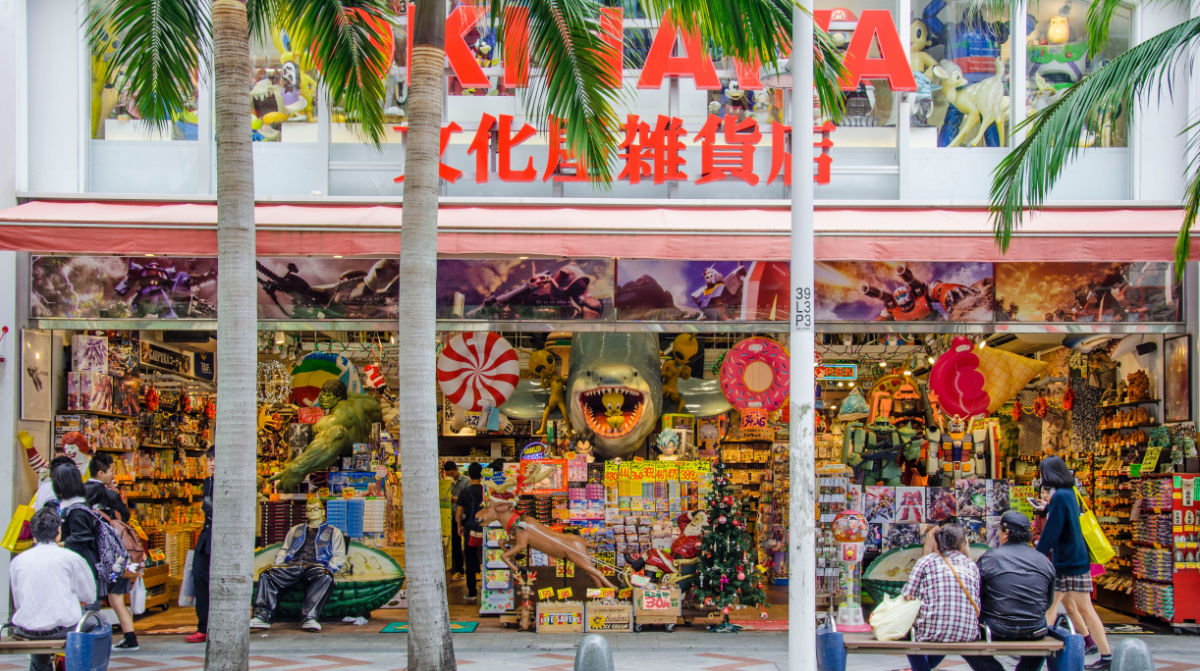
The short answer: Makishi suits people who want to use the late hours. Step out of Makishi Station and Kokusai-dori is in front of you, with places open until late all within walking distance.
Kokusai-dori out front does not make it unliveable
The short answer: despite the tourist reputation, plenty of restaurants and bars there serve locals and stay open late. Some are lively, some are quiet enough to drink in.
It looks like a difficult place to live, and going from Max Valu Makishi towards Tomari the atmosphere changes into a quiet residential area. One street off the main road decides how it feels to live there.
A 24-hour supermarket and convenience stores
The short answer: Max Valu Makishi is open 24 hours. There is a drugstore on its second floor, so late-night necessities are covered.
Several 24-hour chains and convenience stores sit around Makishi Station too. Base yourself here and you can use the night without worrying about the last monorail or bus. The trade-off is that it is not the choice if quiet comes first.
Sponsored
How do the three compare?
The short answer: Oroku and Kanagusuku for ease of living, Omoromachi for convenience, Makishi for a nocturnal schedule.
| Item | Oroku / Kanagusuku | Omoromachi | Makishi |
|---|---|---|---|
| Station to supermarket | Connected (AEON Naha) | Walking distance (San-A and others) | Walking distance (Max Valu) |
| Cheap rent | Best | Weakest | Middle |
| Quiet | Best | Depends on the street | Weakest |
| Bus coverage | Good | Best | Good |
| Late-night convenience | Weakest | Good | Best |
| Airport access | Best (two stops) | Weakest | Good |
Which should you choose?
The short answer: start by looking at Oroku and Kanagusuku. A supermarket connected to the station, a quiet residential area and cheap rent all in one place happens nowhere else on this line.
If you are willing to drop the monorail requirement and want a larger place somewhere quiet, buying a car and looking at central or northern Okinawa will make you happier. Off the Yui Rail, places like Ishigufu Ramen Shima Branch in Urasoe are exactly the sort of place you can only reach with a car.
Decide the car question first and the list of places to live narrows on its own. For the food side of Okinawa, everyday and special Okinawan cooking at Saiya gives a sense of what you would be eating.