This guide is for Minecraft Dungeons players whose gear has stopped improving because they cannot put in long grinding sessions.
The “best weapons” you see in guides and videos never seem to drop for you. That is not a skill problem — it is how the game is built. Below is how to raise your gear without increasing the number of runs, and what to do in the minute before you launch a mission. It applies the same way whether you play solo or with one other person.
▼ Minecraft Dungeons guides on this site
✅ Beginner Guide: What to Do First
✅ How to Level Gear Without Grinding
✅ How to Pick Weapons, Armor and Artifacts
✅ How Enchantments Work and Where to Spend
✅ Farming Emeralds and Using the Merchants
✅ Difficulty Levels and When to Move Up
✅ Multiplayer and Why There Is No Matchmaking
✅ All 6 DLC Packs and What to Buy First
▼ Minecraft Dungeons II articles
Sponsored
Why do the best weapons never drop for you?
Here is the short version: the power level of the gear that drops is set by your own power level at the moment you enter the mission. Keep launching in weak gear and you will keep getting weak gear, no matter how many runs you do.
I put several dozen hours into this game and stalled at roughly the halfway point of the story. I knew exactly which gear combinations the guide videos recommended — that gear simply never dropped for me. This mechanic is the reason for that mismatch.
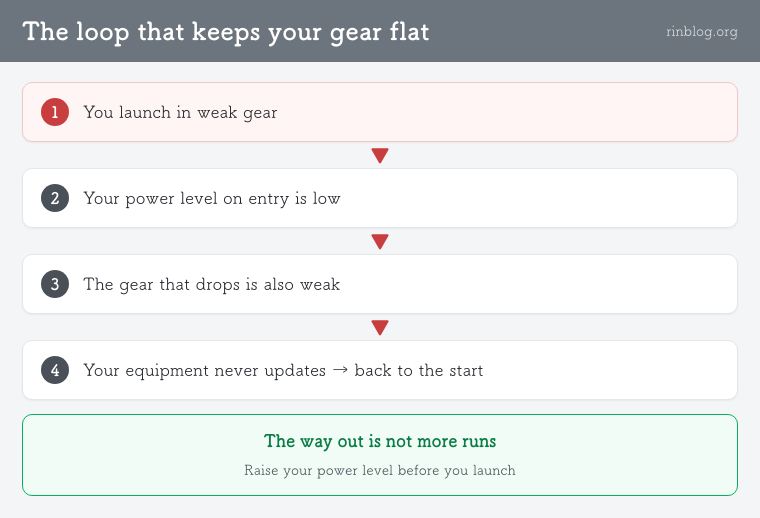
▼ The loop that keeps your gear flat
You launch in weak gear
▶ Your power on entry is low
▶ The gear that drops is also weak
▶ Your equipment never updates
▶ Back to the start
More runs will break the loop, but that option is not available if you do not have the time. If you cannot add runs, raise the quality of each one. That is the whole answer for time-limited players.
How is your power level actually calculated?
Your power level is not your character level or your skill. It is the average of the six items you have equipped.
▼ The six slots that count
① Melee weapon
② Ranged weapon
③ Armor
④⑤⑥ Artifacts × 3
This is the part that matters: because it is an average, a single empty slot or one low-power item pulls the whole thing down.
Keeping a favourite but weak sword lowers your average, which lowers the quality of what drops. Running with only two artifacts equipped does the same thing.
▼ What to do about it
Set aside the question of what you like using, and fill all six slots with the highest power numbers you own before you launch. Numbers first, comfort second. If something feels bad to fight with, swap back once you are inside the mission.
Sponsored
Does raising your player level help?
This is the common misunderstanding. Player level does not add a single point of power level.
Levelling up grants enchantment points and nothing else. If you approach this like a normal RPG where levels make you stronger, this is exactly where you get stuck. The only route to strength is raising the power of your gear.
What three things should you do before every launch?
These maximise what a single run gives you, which matters most when you cannot do many runs.
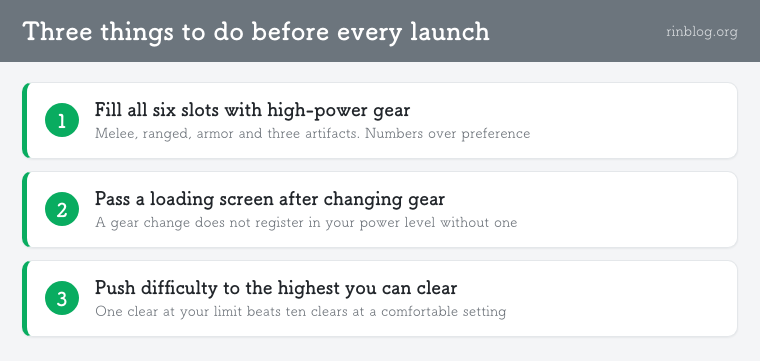
▼ 1. Fill all six slots with your highest-power gear
It does not matter whether you intend to use it. Pick by the number. Leaving no slot empty is the single most important part.
▼ 2. Pass through a loading screen after changing gear
A gear change only registers in your power level after a loading screen. Once you have sorted your loadout at camp, switch screens before heading out rather than launching straight away.
▼ 3. Push the difficulty slider to the highest level you can still clear
Raising the mission difficulty applies an upward bonus to the power of your drops. One clear at a difficulty you can barely handle beats ten clears at a comfortable one.
If you are dying repeatedly, drop it one step. The correct setting is the highest one you can finish.
Sponsored
Should you save your enchantment points?
The answer: no. Salvaging an enchanted item refunds every point you spent, plus a small amount of emeralds.
Plenty of players sit on their points “in case something better drops”. There is no need. Put everything into the gear you have now. Stronger current gear lets you raise the difficulty; a higher difficulty improves your drops. That runs the loop above in reverse.
Do note that salvaging destroys the item. The points return, the gear does not, so confirm before you commit.
What can you do if you genuinely cannot grind?
The answer: the camp merchants work as a substitute for running missions.
Paying emeralds to the Blacksmith gives you a random weapon or piece of armor; the Wandering Trader gives you a random artifact. And their stock is also scaled to your current power level.
Mechanically, then, pulling gear from a merchant and pulling gear from a mission are the same operation. For anyone short on time, the merchant is the more realistic one.
▼ Getting the most out of the merchants
▶ Merchants unlock by clearing Pumpkin Pastures (any difficulty works, so lower it if needed)
▶ Equip your highest-power gear in all six slots and pass a loading screen before you buy — it changes what you can pull
▶ Emeralds come from missions, and salvaging unwanted gear adds more over time
Do you get better gear playing solo or with a friend?
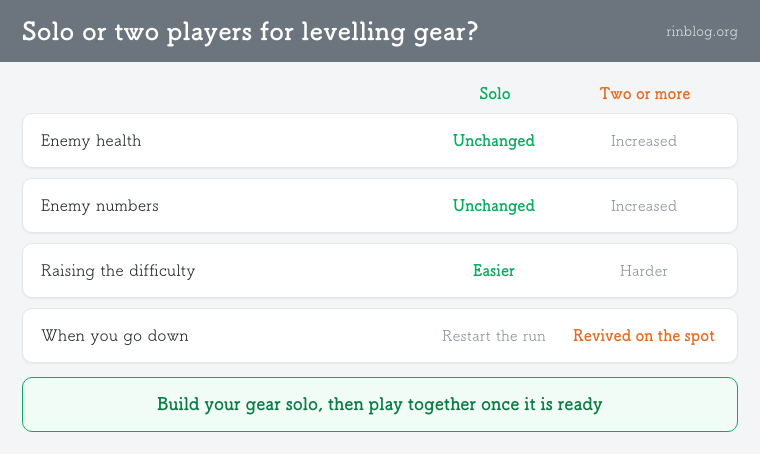
The answer: if the goal is levelling your gear, solo is usually the stronger option.
In multiplayer, enemies gain health and spawn in greater numbers. Adding players does not make the game easier — it makes it harder. The reason a single stage took me so long in two-player was this mechanic, not my ability.
So when you want to raise the difficulty slider to improve drops, solo is where you can push it furthest. Build your gear alone, then play together once it is ready. That split works well in practice.
▼ Two-player still has one real advantage
As long as one player is alive, they can revive you on the spot. A single mistake that would restart a solo run is survivable with two. When you are pushing into a difficulty above your level, that safety net matters.
What problem can none of this fix?
Everything above will raise your gear, but the original game has one wall you cannot work around: there is no matchmaking for playing with strangers.
I did once recruit through an open chat group and played alongside a much stronger player. The pace was completely different, and powerful weapons, armor and artifacts came in noticeably faster. Which is the point: the absence of any in-game way to find people was itself the biggest reason my gear stayed flat.
The sequel, Minecraft Dungeons II, addresses this directly with matchmaking and party codes.
Summary
▶ Drop power is set by your power level on entry
▶ Power level is the average of six equipped slots. Empty slots and low-power items hold it down
▶ Levelling up does not raise power. It only grants enchantment points
▶ Pass a loading screen after changing gear, before you launch
▶ Push the difficulty to the highest you can still clear. One hard run beats ten easy ones
▶ Enchantment points are fully refunded on salvage, so spend them on current gear
▶ If you cannot grind, pour emeralds into the merchants. It is the same mechanic
▶ Solo makes it easier to raise the difficulty while you build gear
Reading a best-weapons list will not raise your gear. The minute you spend before launching will.