Tower Gate (タワーゲート) is a free build-and-climb board game you can play in a browser, released in September 2026. You move a worker one square, build one level beside it, and win by standing on a tower three levels high. In build-and-climb games the levels you stack belong to nobody. In Tower Gate every level keeps the colour of whoever built it, and a tower two or more levels high admits only the player who owns more of its levels. A game runs about five minutes. No account, no install, nothing to buy — open Tower Gate, a free build-and-climb board game against the computer and the first move starts. This article is written by the person who built it, so it covers the rules, the tactic the computer will use on you in the opening, and the self-play numbers that say the four blessings are not yet balanced.
Sponsored
What Is Tower Gate? A Build-and-Climb Game Where the Levels Have an Owner
Tower Gate is a two-player abstract strategy game on a 5-by-5 grid, where each side has two workers and the first player to stand on a level-3 tower wins. There are no dice and no cards, so nothing in the game is random. On this page the opponent is the computer.
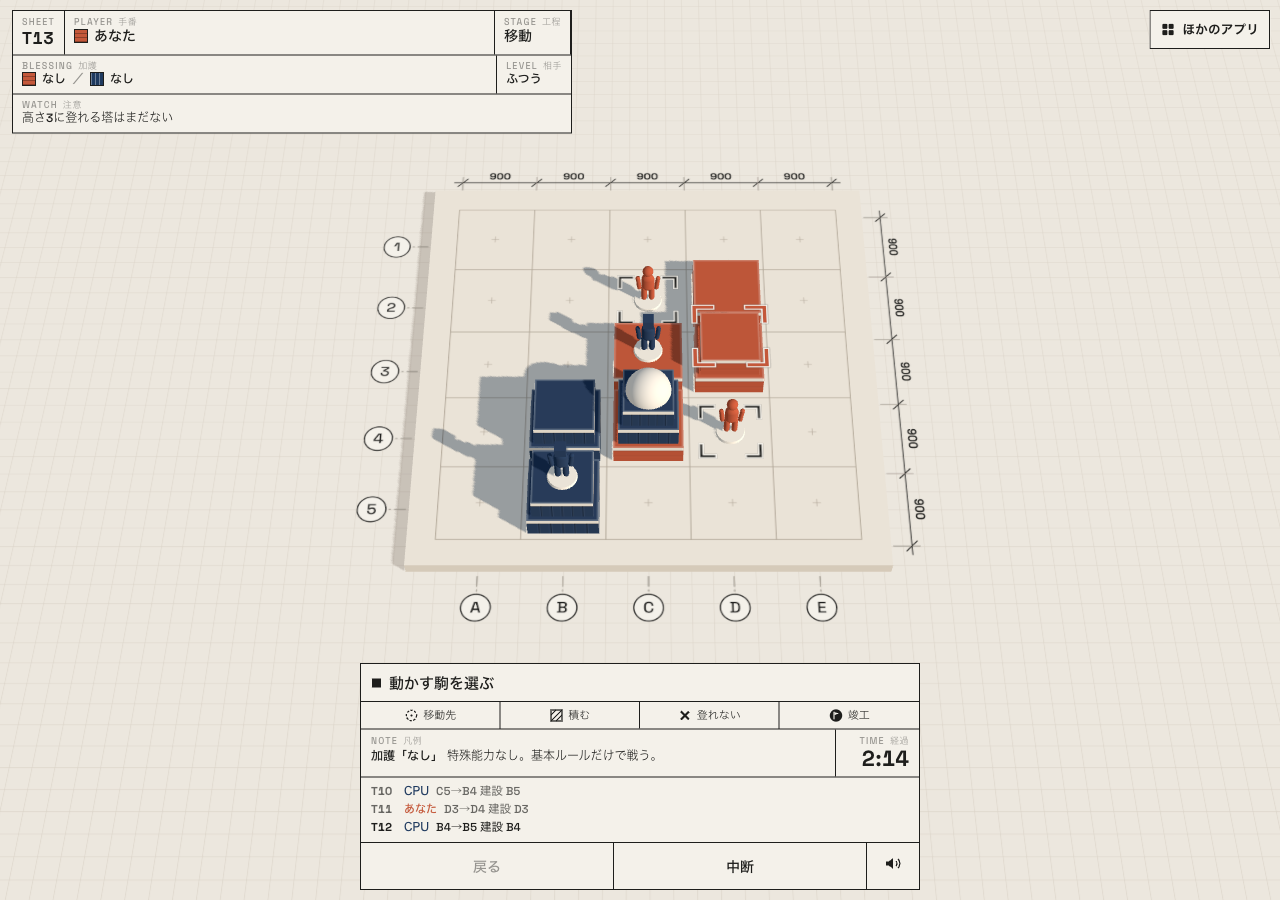
A turn is two actions rather than one. Move one of your workers one square in any of the eight directions, then build one level on any of the eight squares around the square it landed on. That much is shared with every build-and-climb game. What Tower Gate changes is who owns the level. A level you build takes your colour, and a square at height 2 or higher admits you only when you own more of its levels than your opponent does. When the two colours are equal, neither player can enter.
- Price: free, with no account, no login and no install
- Players: solo against the computer, at three strength settings
- Length: about five minutes per game
- Runs on: mobile browsers on iPhone and Android, and desktop browsers
- Released: September 2026
- Interface language: Japanese (an English glossary of every button and board mark is further down this article)
How Do You Play Tower Gate? Move One Square, Build One Level, Climb to Three
Tower Gate has two actions in a turn and one way to win. Move a worker one square, build one level next to where it landed, and repeat until one of your workers is standing on a level-3 tower.
- Move. Move one of your two workers one square, diagonals included. You may climb at most one level in a single move, and you may drop any number of levels. You cannot enter a square holding another worker, or a square capped with a dome
- Build. Build one level on any of the eight squares around the worker you just moved, including the square it has just left. You cannot build on a square a worker is standing on
- Win. You win the instant a worker steps onto a level-3 square, and you skip the build on that turn. You also win if your opponent begins a turn with no legal move at all
The Colour Rule Depends Only on the Height
Whether you can enter a square in Tower Gate is decided by that square’s height and by nothing else. The order the levels were stacked in does not matter; only the count per colour does.
| Height of the square | Who may enter |
|---|---|
| Height 0 and height 1 | Anyone, whatever the colours are |
| Height 2 and height 3 | Only the player owning more levels than the other. Equal counts admit nobody |
| Height 4 (dome) | Nobody. Building on a level-3 square caps it with a dome |
Before play begins the workers are placed. You and the computer alternate, placing one worker at a time on an empty square, until all four are on the board. If you would rather not think about the opening, choose the fixed symmetric setup, which starts you on B4 and D4 and the computer on B2 and D2.
Draws exist in Tower Gate. If the two sides together reach 100 moves with no result, the game is drawn. That ceiling is there because two players both holding the Repaint blessing can recolour the same level back and forth forever. And since a player with no legal move loses, leaving a worker boxed in by the board edge and a ring of domes loses the game before any tower is finished.
Sponsored
How Do You Stop an Opponent’s Tower? Tie the Colours and Nobody Climbs
Build one level on a height-1 square carrying a single level of your opponent’s colour, and it becomes height 2 with the colours tied, which means neither of you can ever enter it. This is the sharpest tactic in Tower Gate, and on the board a tower killed this way is marked with an ×.
The computer uses it before you have learned it. Playing one game against the normal-strength computer from the fixed symmetric setup, I built a level on C4 with my first move, and the computer built on that same C4 with its second. C4 stood at height 2 with one level each — a dead tower before the game was five moves old. The same exchange happened again late in that game: I built on B1, and the computer answered by building on B1.
The counter runs the other way as well. If a height-3 tower in your opponent’s colour appears next to one of your workers, build on it to cap it with a dome at height 4, and it is sealed for both sides. On move 5 of that same game the computer took C4 up to height 3; I moved D4 to D3, built on C4, and turned it into a dome.
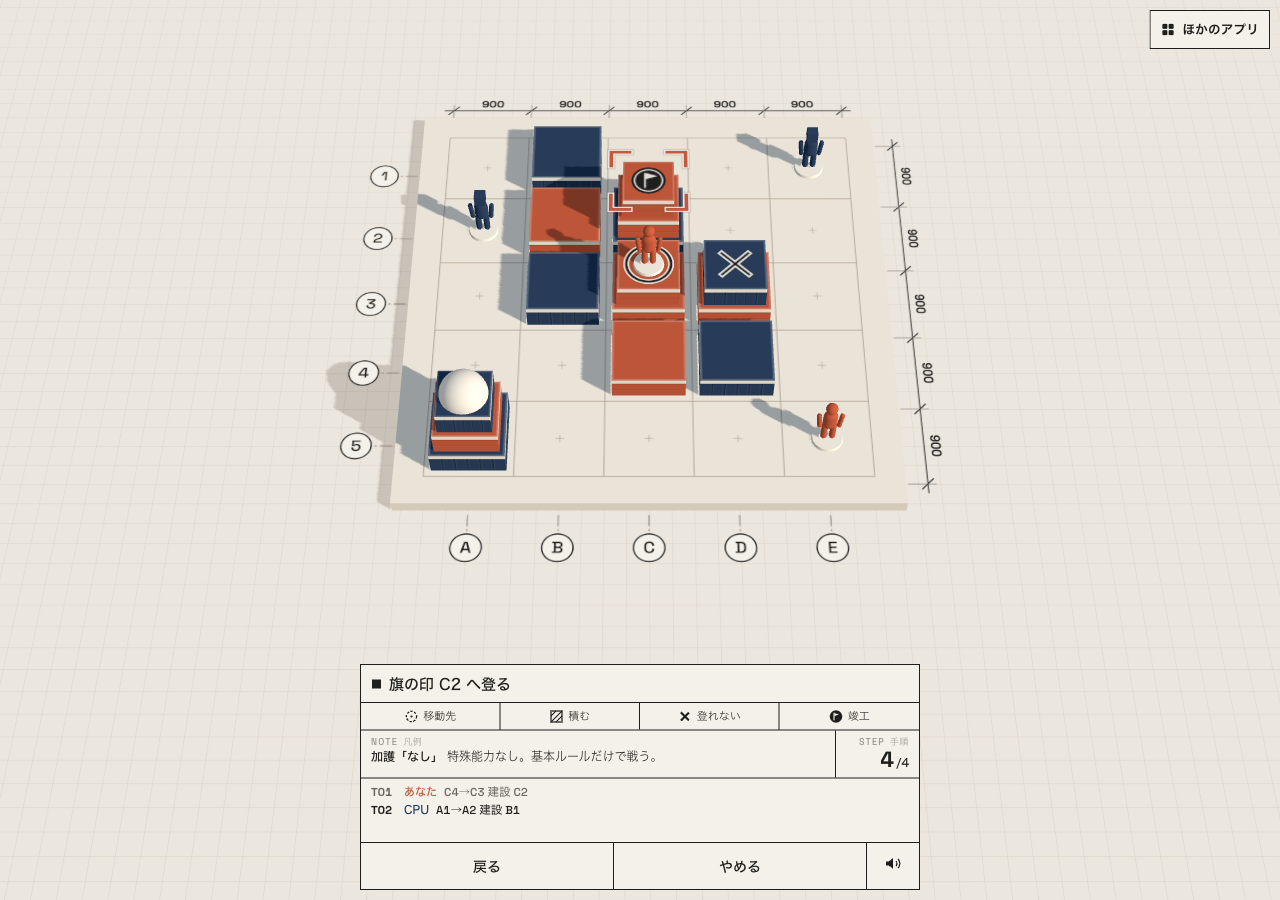
The surprise in that game came at the end. Three towers in my colour — D2, C3 and D3 — stood at height 3, and I could climb none of them. Climbing is limited to one level per move, so reaching height 3 needs a height-2 square to stand on first, and every time I made a height-2 foothold the computer added a level and pushed it to height 3. What runs out in Tower Gate is not height-3 towers but the height-2 footholds underneath them.
To stop a tower being tied against you, get your second level onto it while it is still at height 1. A height-2 tower holding two of your levels stays 2-to-1 in your favour after the opponent adds one, so you can still climb it when it reaches height 3. Going the other way, if your opponent is halfway to that shape and their worker is still at height 1 or below, add a level while the square is at height 2 and push it straight to height 3. Since climbing is limited to one level, they now have to build a fresh foothold to reach it. That is the demolition the computer ran on me.
How Is Tower Gate Different From Santorini?
The difference between Tower Gate and Santorini is that in Tower Gate the levels carry a colour. Santorini, designed by Gordon Hamilton in 1985 and republished by Roxley Games in 2016, runs on the same skeleton: a 5-by-5 grid, two workers per player, move one square and then build one level beside the moved worker, win by standing on the third level. Its building pieces are common property. A block one player places is exactly as climbable by the other, so building one level is an operation on height and on nothing else.
Giving a level an owner gives that single action a second job. Building on a square your opponent already has a level on does not raise a staircase for them; it locks the square for both of you at height 2. The same action that opens your own route closes theirs, and which of the two it does depends on whose colour is already sitting there. That is the one change Tower Gate makes, and the rest of the frame is the one this family of games has used for years.
Sponsored
What Can the Four Blessings Do? Wind, Mason, Repaint and Leap
Blessings in Tower Gate are optional powers chosen before the game starts, one for you and one for the computer, picked separately. With “none” on the list there are five options per side, so you can take Leap while the computer takes Mason.
| Blessing | On screen | What it does |
|---|---|---|
| Wind | 風 (kaze) | Move two squares in a straight line. Both the first and the second square must satisfy the climbing condition |
| Mason | 石工 (sekkō) | Once per game, build two of your levels at once instead of one. It will not pass the height-4 dome |
| Repaint | 塗替 (nurikae) | Instead of building, repaint the top level of an adjacent square in your own colour. The square must have no worker on it |
| Leap | 跳躍 (chōyaku) | Climb two levels in one move. Entering height 2 or above still requires owning more levels than your opponent |
Repaint is the odd one out because it stacks nothing. It leaves the height alone and changes only the count of colours, so it can take a tower that died at a tie and turn it back into yours, or steal the top level of a tower your opponent spent several moves growing.
Are the Four Blessings Balanced? No — Here Are the Numbers
The four blessings in Tower Gate are not balanced. Measured over 100 games each against an opponent holding no blessing, Wind wins 63.0%, Mason 59.0%, Repaint 75.0% and Leap 40.0%. Repaint is far out in front, and Leap is worse than taking nothing at all.
| Blessing | Win rate against an opponent with no blessing (100 games each) |
|---|---|
| Wind (風) | 63.0% |
| Mason (石工) | 59.0% |
| Repaint (塗替) | 75.0% |
| Leap (跳躍) | 40.0% |
Those figures come from computer-versus-computer self-play, with both sides searching three moves ahead, the opening placement left to the computer’s own placement logic, and first and second player swapped across the 100 games. Two of the blessings had already been cut back before that run, because the first version of each was plainly broken.
- Mason originally built +2 levels on every single turn. At that setting it beat a no-blessing opponent 99% of the time, so it was reduced to once per game
- Repaint originally worked on squares with a worker standing on them. That version averaged a 59% win rate, which was on the strong side, so it was restricted to unoccupied squares
Nothing wins 99% any more, but the four are still not level with each other. Repaint appears to be ahead because it flips ownership without touching height, which takes back a tower that was tied dead in a single move. The next adjustment would start with Repaint, most likely by capping the number of uses per game the way Mason is capped at one.
In a game with no randomness, one clearly strongest option pulls every player’s choice toward it, so powers bolted onto an abstract game have to be measured rather than argued about. A set that did come out level is the three army formations in Gunjin Shogi, Japanese military chess played solo with no referee, which landed between 49% and 52% across a 720-game round robin. Tower Gate’s four blessings are not that close yet.
How Long Does a Game Last? 15.80 Moves on Average Over 200 Games
The draw ceiling in Tower Gate is 100 moves counting both sides, but real games finish long before that. Across 200 self-play games with no blessings on either side, at the same three-move search the normal-strength computer uses, games ended after 15.80 moves on average, with a median of 16, a shortest of 11 and a longest of 22. None of the 200 reached 100 moves.
Short games do not mean few choices. Counted over those same 200 games, a player had 60.18 legal moves per turn on average, as few as 25 in the tightest positions and as many as 84 in the loosest. Each of your two workers has eight destinations, and each destination has eight squares to build on, so the multiplication gets there quickly. Searching all of it is expensive, so the computer reads only the 30 best-scoring moves at depth 3 and above, and up to 52 at depth 2.
| Computer strength | Search depth | Time limit per move | Behaviour |
|---|---|---|---|
| やさしい (yasashii, easy) | 2 moves ahead | 250 ms | Plays something other than the best move 35% of the time, but never a move that lets you win on your next turn |
| ふつう (futsū, normal) | 3 moves ahead | 550 ms | Iterative deepening with alpha-beta pruning |
| つよい (tsuyoi, strong) | 5 moves ahead | 1000 ms | The same search, going as deep as the time allows |
What the search cannot reach is filled in by scoring the shape of the board. The height a worker stands on is worth 0 points at height 0, 70 at height 1, 220 at height 2 and 20000 at height 3 — the last one is a different order of magnitude because standing on height 3 is the win itself. A further 900 points is added when a height-3 square sits one move away from that worker, which weights a position that wins next turn almost as heavily as a win.
The search runs in a Web Worker, so the board stays responsive while the computer thinks. Where a Worker cannot be created, the same code runs on the main thread, and the strong setting drops to depth 3 for that session.
The daily puzzle is a mate in two: win within two of your own moves. The position is generated from a seed made out of the date, and when a candidate turns out to be unusable the seed advances and the position is rebuilt, up to 600 times. Before a puzzle is published, every reply the opponent could make is checked to confirm that a level-3 square is still reachable on the move after it. Positions that already contain a height-3 tower are excluded, so no puzzle can end in a single move. Building a puzzle a day by hand does not scale, which is the same reason the technique ranking in 7 advanced sudoku techniques after X-Wing was produced by having a machine solve puzzles in bulk. In Tower Gate the machine decides whether a puzzle is fit to publish.
Why I Built Tower Gate: Giving “Build One Level” a Second Job
I built Tower Gate to make one action do two things at once. In the build-and-climb family the levels have no owner, so building is purely a change of height, and the whole decision is which height to change. Attaching a colour to the level means the same build is both a move that opens your own route and a move that closes your opponent’s, and which of the two it is depends on whose colour is already on that square.
On the board it did change the meaning of a single level. Adding one level to a square your opponent has a level on produces height 2 with the colours tied, and the tower is dead to both sides. Building became a way to kill a foothold, not only a way to raise one.
What I will not claim is an empty shelf. Searching in Japanese for a free browser abstract strategy game against a computer returned a first page of game-portal listings and round-up articles, with little room for a page made by one person. English search is no more open. playabstractgames.com and abstract-games.onrender.com carry hundreds of abstract games between them, and searching for a tower building game returns Coolmath Games’ Tower Builder and Poki’s Babel Tower, which are physical-stacking games in a different genre entirely. So Tower Gate is not aimed at those head terms. It is named for what it does, because plain descriptive names have worked here before: the chinchirorin page described in a 3D chinchirorin dice game built in the browser with Three.js and Ammo.js gets its traffic from generic searches — dice game, free, browser, rules — rather than from its own name. Here the generic terms are taken, so the phrase this game is aimed at is narrower: a build-and-climb board game where the levels have an owner.
The Interface Is in Japanese: What Each Button and Mark Means
Tower Gate’s interface is Japanese only, with no English toggle. Two things make it playable anyway. First, the rules are shown as marks rather than words: squares you may move to are ringed with a dotted circle, squares you may build on are hatched, a tower nobody can climb carries an ×, and a height-3 tower in your own colour carries a flag. Second, the drafting-sheet panels around the board are already labelled in Latin script — SHEET, PLAYER, STAGE, BLESSING, LEVEL, WATCH, NOTE and TIME — with the Japanese words set in small type beneath them. Squares are named the way a chessboard is, A to E across and 1 to 5 down, so a line of the move log reads T11 あなた D3→D4 建設 D3.
| On screen | Romaji | What it does |
|---|---|---|
| 対局を始める | taikyoku o hajimeru | Start a new game with the settings shown above the button |
| 本日の課題 | honjitsu no kadai | Today’s puzzle: win within two moves |
| チュートリアル | chūtoriaru | Tutorial, four guided actions long |
| 遊び方 | asobikata | Jump to the Japanese how-to-play section under the board |
| 相手:やさしい / ふつう / つよい | aite: yasashii / futsū / tsuyoi | Computer strength: easy, normal, strong |
| 加護:なし / 風 / 石工 / 塗替 / 跳躍 | kago: nashi / kaze / sekkō / nurikae / chōyaku | Blessing: none, Wind, Mason, Repaint, Leap |
| 配置:自分で置く / 対称の固定配置 | haichi: jibun de oku / taishō no kotei haichi | Setup: place the workers yourself, or use the fixed symmetric setup |
| 工程:移動 / 建設 | kōtei: idō / kensetsu | The stage of your turn: move first, then build |
| 動かす駒を選ぶ | ugokasu koma o erabu | Prompt: choose a worker to move |
| 移動先(点線の円)を選ぶ | idōsaki o erabu | Prompt: choose a destination, marked by a dotted circle |
| 積むマス(斜線)を選ぶ | tsumu masu o erabu | Prompt: choose a square to build on, marked by hatching |
| 通常 +1段 / 石工 +2段 / 塗替 | tsūjō / sekkō / nurikae | Build mode, shown when you hold Mason or Repaint: normal +1 level, Mason +2 levels, or repaint |
| 登れない | noborenai | Legend for the × mark: nobody can climb this tower |
| 竣工 | shunkō | Legend for the flag: climbing here completes a tower and wins |
| 戻る | modoru | Step back within the turn you are in the middle of |
| 中断 | chūdan | Leave the game and return to the title screen |
| やり直す | yarinaosu | Restart today’s puzzle from the beginning (daily puzzle only) |
| 竣工 / 差戻 / 引分 | shunkō / sashimodoshi / hikiwake | The result stamp: you won, you lost, the game was drawn |
One part of the interface does not translate. The screen reader speaks Japanese. A square is announced as “C4、高さ1(あなた1段・CPU0段)、あなたの駒、操作できる” — C4, height 1, one of your levels and none of the computer’s, your worker, selectable. Keyboard play itself is language-independent, since Tab moves into the board, the arrow keys move between squares and Enter confirms, but an English-language screen reader user will not get a usable reading of the board.
How to Play Tower Gate: Price, Saves and Where It Runs
Tower Gate is free and needs no account, no login and no installation. Open the Tower Gate app page in a browser and a game starts on the spot. It runs in mobile browsers on iPhone and Android as well as on desktop.
- Price: free. There is nothing to buy inside the game
- Account: none. Wins, losses, draws and your daily-puzzle streak are stored inside the browser you played in, and are not shared with another device or another browser
- Controls: tap a square and its height, plus the level count for each colour, appears at the bottom of the screen. On a keyboard, Tab moves into the board, the arrow keys move between squares and Enter confirms
- Full rules: the app page carries a Japanese how-to-play section covering the procedure, the blessings, the daily puzzle and an FAQ
- Other games on this site: the list of apps and games on rinblog
Finally, what has not been checked. Every blessing win rate above was measured at search depth 3, and there is no guarantee the order holds when the computer reads deeper. The balance between moving first and moving second is not settled either: across 200 games with placement left to the computer’s own logic, the second player won 155 and the first player 45. Evening out a turn-order imbalance with a points handicap is what was done in mancala, where a three-seed komi closes the first-player advantage, but Tower Gate has no score to add points to, so that fix does not transfer. What happens when a person places the workers by hand is still unmeasured. Anything that feels wrong in real play becomes material for the next adjustment.