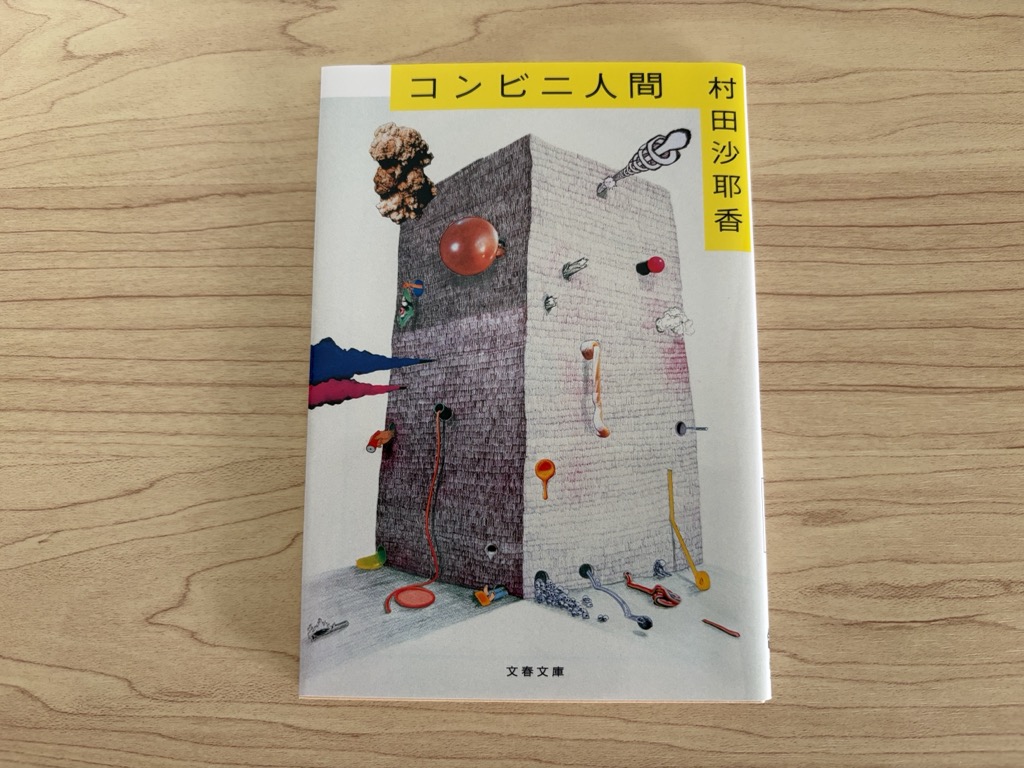
Convenience Store Woman (コンビニ人間) is a novel by Sayaka Murata (村田沙耶香), published in Japan by Bungeishunju on 27 July 2016. It won the 155th Akutagawa Prize and has sold over 1.5 million copies in Japan. Ginny Tapley Takemori’s English translation was published in 2018 by Grove Press and Portobello Books, and the book has since appeared in more than thirty languages.
The short answer: read it if you have ever felt uneasy about being “normal”, and skip it if you want a clear resolution. The novel does not resolve. What it leaves behind is a snag you cannot quite name.
After finishing Convenience Store Woman, I found myself hesitating to use the word “normal” so casually again.
This novel does not rely on shocking twists or dramatic plot turns. Instead, it places the reader inside an extremely ordinary setting—a convenience store—and repeats the same routines, phrases, and social expectations until a quiet but persistent sense of discomfort begins to build.
In this article, I reflect on my reading experience as someone who read the novel in full, focusing on what unsettled me during the reading and what stayed with me afterward.
If you are wondering what kind of novel this is, or whether it might suit your taste, this review is written to help you decide.
The perspectives guiding this review are shared standards often used in literary discussions worldwide:
-
narrative voice and prose style
-
characters’ behavior and social relationships
-
the lingering unease and aftertaste left once the book ends
All observations below are grounded in these criteria.
Sponsored
1. Narrative Voice and Prose: The Fear Hidden in Emotional Neutrality
The story is told entirely from the first-person perspective of Keiko Furukura, in a flat, matter-of-fact tone.
The prose itself is simple and restrained, rarely signaling emotional emphasis or psychological depth in the conventional sense.
What unsettled me was not what was said, but what was never explained. Keiko does not analyze her feelings or question her decisions. From childhood onward, she determines right and wrong not through personal judgment, but by identifying what appears to be the correct response in a given situation. When she acts, she does so without regret or self-reflection—only with the explanation that it was the appropriate thing to do.
As I read, I did not feel that she was emotionally cold. Instead, it seemed to me that her emotional circuitry simply operated on a different system. Because the narration never invites us fully inside her inner life, a steady distance remains between the reader and the protagonist. That distance prevented full empathy, yet made it difficult to look away.
2. Characters and Social Roles: A World Where “Explanation” Matters More Than Truth
What left the strongest impression on me was how characters evaluate one another not by personal qualities, but by recognizable social roles.
Keiko’s eighteen-year career as a part-time convenience store worker is treated by those around her as a problem that needs fixing. She is unmarried, not pursuing a conventional career path, and therefore becomes a source of concern. The repeated question is not whether she is content, but whether her life can be explained in socially acceptable terms.
This becomes especially clear in her relationship with Shiraha, a man introduced midway through the novel. He is portrayed as someone who cannot adapt to social norms. Rather than forming a bond based on trust or affection, Keiko treats him as a functional component—a way to appear “normal” and quiet the scrutiny of others.
Reading their interactions, I felt that the novel consistently prioritizes social legibility over moral correctness. What matters most is not whether a choice is right, but whether it fits into a recognizable pattern that society can accept.
Sponsored
3. The Aftertaste: Was There Salvation, or Just Resolution?
Note: This section touches on late-stage developments but avoids revealing the ending itself.
Toward the end of the novel, Keiko once again chooses a place where she belongs.
However, this choice does not resemble the conventional arc of growth or reintegration often found in fiction.
After closing the book, I found myself asking whether this could be considered a happy ending. Keiko appears calm and settled, yet the surrounding social values remain unchanged. Nothing about the broader world adapts to her.
To me, the ending felt neither purely hopeful nor purely bleak. What lingered most strongly was the fact that Keiko chooses without hesitation. That decisiveness gave me a sense of clarity—but also a quiet unease. It felt less like reassurance and more like a sharp, final acceptance.
4. Who This Novel Is (and Isn’t) For
This book may resonate with readers who:
-
have felt constrained by words like “normal” or “common sense”
-
are interested in observing a perspective they may not fully empathize with
-
prefer novels that avoid clear moral lessons or tidy conclusions
It may not suit readers who:
-
seek emotionally dramatic storytelling
-
want deep emotional immersion in characters
-
expect an uplifting or easily digestible ending
Sponsored
5. Final Verdict: Would I Recommend It?
I would not recommend Convenience Store Woman universally.
However, for anyone who has ever questioned whether they are living “correctly” by social standards, this novel leaves a strong and lasting impression.
I did not finish the book feeling refreshed or reassured. Instead, I found myself returning to specific scenes in my mind long after reading.
For readers who are open to having their assumptions quietly unsettled, I believe this novel is well worth picking up.
6. If This Book Worked for You
The same effect — a calm surface with something quietly wrong underneath — runs through Iruma Hitoma’s work. If the aftertaste of Convenience Store Woman suited you, these read at a similar distance.
My review of My Small Miracle covers a collection where ordinary days carry the same unease, and where the ending refuses to settle.
Time’s Lost Property works the same way: it builds a premise around time that can be dropped and picked up, then declines to hand you an answer.