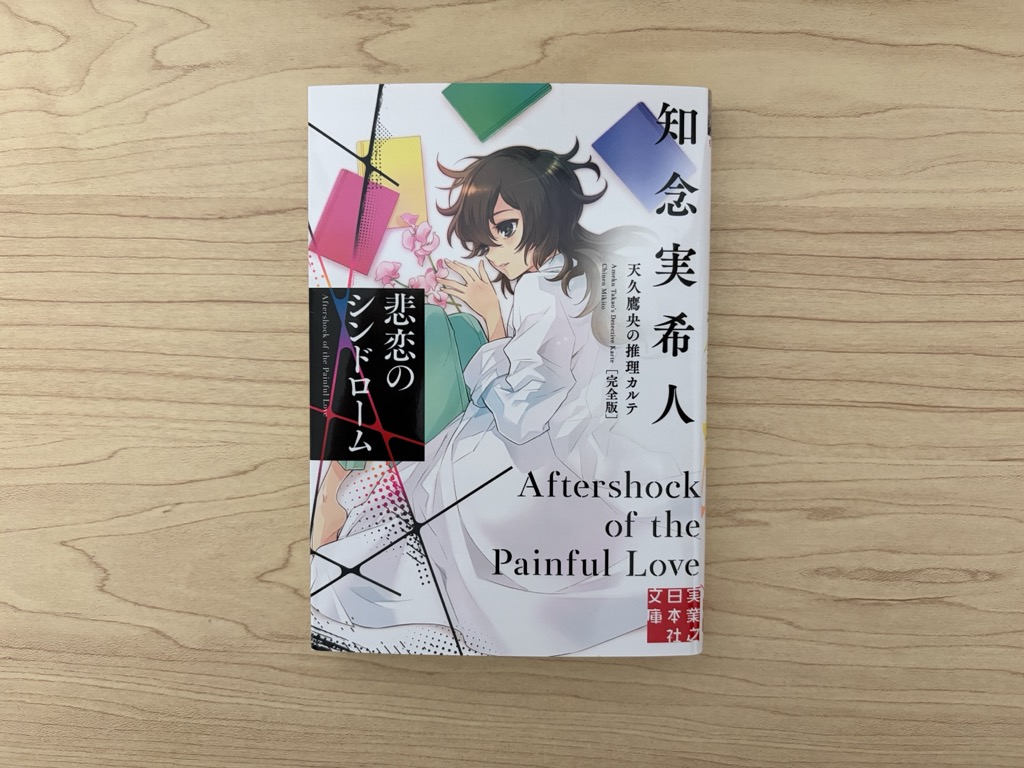
Short version: Hiren no Syndrome (“The Syndrome of Doomed Love”) is a volume where what was never said outweighs the mechanics of the case. Read it expecting brilliant deduction and the impression will be quite different.
Some time after finishing, what stayed was not the case but the distances between the characters.
Rather than dramatic scenes or a shocking truth, “what went unsaid” and “the actions not taken” are what work on you afterwards. Even while reading, I was less pulled along than stopped in places.
Sponsored
What kind of book is it?
The seventh volume of the Ameku Takao series, and a short story collection — magazine stories plus new material.
| Title | 悲恋のシンドローム 天久鷹央の推理カルテ 完全版 |
|---|---|
| Author | Mikito Chinen |
| Imprint | Jitsugyo no Nihon Sha Bunko |
| Released | January 13, 2024 |
| Format | Suiri Karute = Short story collection |
| Reading order | seventh by publication date (full reading order) |
“Suiri Karute” against “Jiken Karute”
The subtitle decides how a volume reads. Not knowing this makes the differences between volumes confusing.
| Subtitle | Format | How it reads |
|---|---|---|
| Suiri Karute | Short stories | Each case resolves in one story. Easy to read in short sittings |
| Jiken Karute | Novel | One case followed to the end. Sustained tension |
“Suiri Karute” volumes collect magazine stories with new material added; “Jiken Karute” volumes are novels written directly for paperback. They alternate, so reading in publication order alternates between short stories and novels.
Characters and setting
| Takao Ameku (27) | Deputy director and head of the General Diagnostics Department. She has Asperger’s syndrome and savant traits, and diagnoses through extraordinary recall and calculation |
|---|---|
| Yu Takanashi (29) | The narrator. A former surgeon reassigned to General Diagnostics as a trainee internist |
| Mai Konoike (25) | A resident who admires Takao |
| General Diagnostics | Founded by Takao’s father to resolve undiagnosable patients and inexplicable incidents through diagnosis. It occupies a single-storey red brick building on the hospital roof |
Narrating through Takanashi rather than Takao is what keeps the series readable. The reader watches Takao from Takanashi’s position, so her strangeness never lands directly.
The series had passed 3.9 million copies as of May 2026, and a TV anime aired from January 2 to April 3, 2025 (produced by project No.9). The author, Mikito Chinen, was born in Okinawa in 1978, trained as an internist at Jikei University School of Medicine, and has been nominated four times for the Japan Booksellers’ Award.
Emotion pushed forward inside a medical mystery
The setting is the familiar hospital, with Takao Ameku at the centre as always. The structure of cases built on medical knowledge, and symptoms tying into the puzzle, is shared across the series.
But as it progressed, my attention moved from the mechanics of the case to the emotional movement of the people involved.
I knew “doomed love” was in the title going in. Reading it, though, it is not an overwrought romance but emotions that failed to mesh, casting a shadow over the case as a result.
Sponsored
Why Takao’s view felt colder than usual
She is as rational as ever, prioritizing fact and logic over feeling. In this volume, though, that stance repeatedly surfaces as something “correct but not a rescue”.
It is not that she fails to understand the other person’s feelings; she does not step in. Or she has judged that stepping in is unnecessary.
I accepted the distance and still snagged on it. Nothing about it is wrong for solving the case, and there are moments where, in terms of how people feel, someone is being left behind.
“Doomed love” meant something different by the end
The relationships do not look tragic from the start. If anything, relationships that could perfectly well have worked drift, little by little, past the point of recovery. That process is drawn quietly.
“If they had chosen differently here” crossed my mind several times. Not out of blame — more like watching the accumulation of the judgments people actually make.
By the end, “doomed love” seemed to point not at romantic sadness but at the whole of “a possibility of understanding each other, lost”.
Sponsored
The case resolves; nothing tidies up
The case is organized and explained in the usual series manner. Reading those explanations, though, my feelings had not caught up.
The puzzle is solved. The facts are established. And the emotional part alone is left with nowhere to sit.
That aftertaste is not dissatisfaction but the kind that makes you think “no, that does not resolve so easily”.
Would I recommend it?
| A good fit | Expect a different impression |
|---|---|
| Readers who want Takao from another angle | Readers here for brilliant deduction |
| Readers who want something that snags afterwards | Readers who want a clean finish |
| Readers who like reading misalignment between people | Readers who find emotional weight tiring |
Coming for logical diagnosis and sharp reasoning, this volume reads differently. Emotion and relationships come forward, and the book is correspondingly heavier.
I could not say “that was good” immediately on finishing — and it is one I have gone back to in my head several times since.
Summary
- Hiren no Syndrome is the seventh volume, a short story collection (January 13, 2024)
- What went unsaid outweighs the mechanics of the case
- Takao’s rationality surfaces here as “correct but not a rescue”
- “Doomed love” points at a lost possibility of understanding, not romantic sadness
- The puzzle resolves; the emotion has nowhere to sit
- Expecting sharp deduction gives a very different impression
- Hard to call good immediately — and hard to stop returning to
Around this volume
- Previously read: 密室のパラノイア
- Read next: 神秘のセラピスト
- First in the series: Ameku Takao no Suiri Karute, Complete Edition