7 Advanced Sudoku Techniques After X-Wing, Ranked by Real Use
In 7 Sudoku Techniques and the Order to Learn Them, I covered techniques up to X-Wing. Hard puzzles still stall after those seven. To decide which technique to learn next, I had a program solve thousands of puzzles and counted what actually helped.
The short answer: after X-Wing, learn 2-String Kite, W-Wing, Simple Coloring and Skyscraper first. In 6,000 puzzles I generated, each with a unique solution, 2-String Kite worked in 47.3% of the positions where the first seven techniques got stuck. Swordfish, often named as the next step, worked in only 1.8%.
This article explains seven techniques, numbered 8 to 14, with a diagram of a real position for each.
- Which Sudoku technique should you learn after X-Wing?
- What is a strong link in Sudoku?
- Technique 8: How does Skyscraper work?
- Technique 9: How does 2-String Kite work?
- Technique 10: How does Simple Coloring work?
- Technique 11: How does XY-Wing work?
- Technique 12: How does W-Wing work?
- Technique 13: How does XYZ-Wing work?
- Technique 14: How does Unique Rectangle work?
- Why can Swordfish wait?
- Where can you practice these techniques?
- Related articles
- Summary
Which Sudoku technique should you learn after X-Wing?
The techniques that worked most often in stuck positions were 2-String Kite (47.3%), W-Wing (36.3%), Simple Coloring (34.1%) and Skyscraper (28.9%).
Here is how I measured it. I wrote a Python program that generated 6,000 puzzles with exactly one solution. Each puzzle was reduced until removing any given digit would allow more than one solution. I then solved each one with the seven techniques from the earlier article: Naked Single, Hidden Single, Locked Candidates, Naked Pair, Hidden Pair, Naked Triple and X-Wing.
3,664 puzzles (61.1%) were solved completely. For the remaining 2,336 puzzles, I took the first position where the seven techniques got stuck and tested each advanced technique on it, one at a time.
| Technique | Stuck positions where it worked | Share |
|---|---|---|
| 2-String Kite | 1,104 | 47.3% |
| W-Wing | 847 | 36.3% |
| Simple Coloring | 796 | 34.1% |
| Skyscraper | 674 | 28.9% |
| XY-Wing | 495 | 21.2% |
| XYZ-Wing | 290 | 12.4% |
| Unique Rectangle | 284 | 12.2% |
| Hidden Triple | 61 | 2.6% |
| Swordfish | 42 | 1.8% |
| Jellyfish | 19 | 0.8% |
A single position can allow several techniques, so the shares add up to more than 100%. In the other 479 puzzles (20.5%), none of the techniques in the table worked. Those puzzles need longer chain techniques beyond the scope of this article.
A buggy implementation of a technique would remove correct candidates. So every time the program removed a candidate, it checked the removal against the puzzle’s known solution. Across all 6,000 puzzles, no step ever removed a correct digit.
In what order should you learn them?
Learn the single-digit techniques (8 to 10) first, then the techniques built from two-candidate cells (11 to 13).
I ordered them by how closely related the ideas are, not only by frequency. Techniques 8 to 10 chain “this digit must go in one of these two cells” relationships for one digit, just like X-Wing. Techniques 11 to 13 reason with cells that have only two candidates. Technique 14 alone relies on the assumption that the puzzle has one solution.
| No. | Technique | What you look at |
|---|---|---|
| 8 | Skyscraper | Two strong links for one digit |
| 9 | 2-String Kite | Two strong links for one digit (one row, one column) |
| 10 | Simple Coloring | A chain of strong links for one digit |
| 11 | XY-Wing | Three cells with two candidates each |
| 12 | W-Wing | Two cells with the same two candidates, plus a strong link |
| 13 | XYZ-Wing | One cell with three candidates and two cells with two |
| 14 | Unique Rectangle | Four corners of a rectangle (assumes one solution) |
How do you read the diagrams?
Cell positions are written as “row R, column C”, counting rows from the top and columns from the left. The diagrams use these marks:
▼Diagram legend
▶ Yellow or orange cells: cells that form the pattern
▶ Blue circled digits: candidates that form the pattern. Blue lines are strong links
▶ Red circled, struck-through digits: candidates this technique removes
▶ Large black digits are givens. Large blue digits were filled in while solving
What is a strong link in Sudoku?
When a digit has exactly two possible cells in a row, column or box, one of those two cells must hold it. That relationship is called a strong link.
For example, if 7 can only go in cells A and B of a row, then B must be 7 whenever A is not. X-Wing combines two strong links into a rectangle. Techniques 8 to 10 simply combine strong links in different shapes. Some books and sites call these “conjugate pairs”.
Technique 8: How does Skyscraper work?
When a digit has two strong links, and one end of each link sits in the same column (or row), you can remove that digit from any cell that sees both of the other ends.
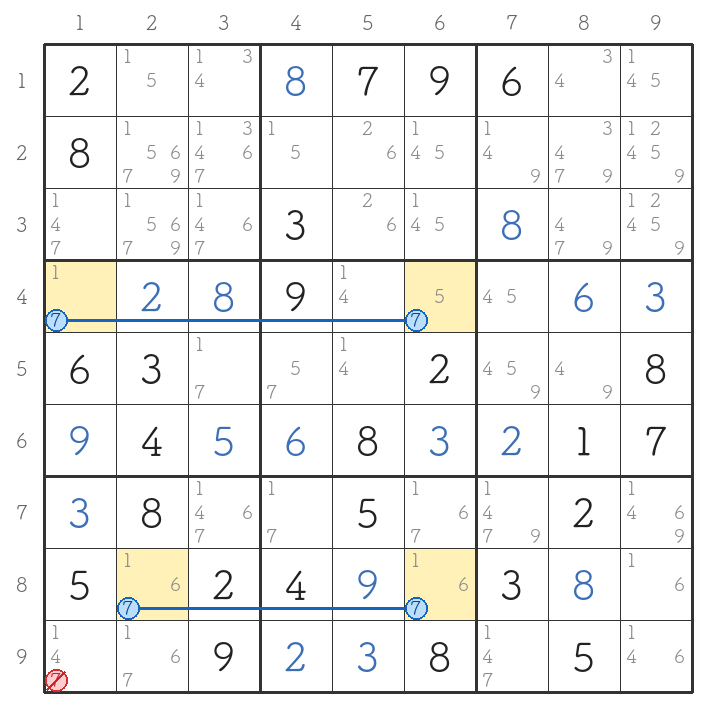
This example uses the digit 7. In row 4, 7 can only go in columns 1 and 6. In row 8, 7 can only go in columns 2 and 6. Both are strong links.
Row 4, column 6 and row 8, column 6 share column 6, so they cannot both be 7. Whichever one is not 7 forces the other end of its row to be 7. So either row 4, column 1 or row 8, column 2 must be 7.
Row 9, column 1 sees row 4, column 1 through column 1, and sees row 8, column 2 through the bottom-left box. It cannot be 7 either way, so you can remove 7 from row 9, column 1.
The difference from X-Wing is how the ends line up. If both pairs of ends share columns, it is an X-Wing. If only one pair does, it is a Skyscraper.
Technique 9: How does 2-String Kite work?
When a digit has a strong link in a row and another in a column, and one end of each sits in the same box, you can remove that digit from any cell that sees both remaining ends.
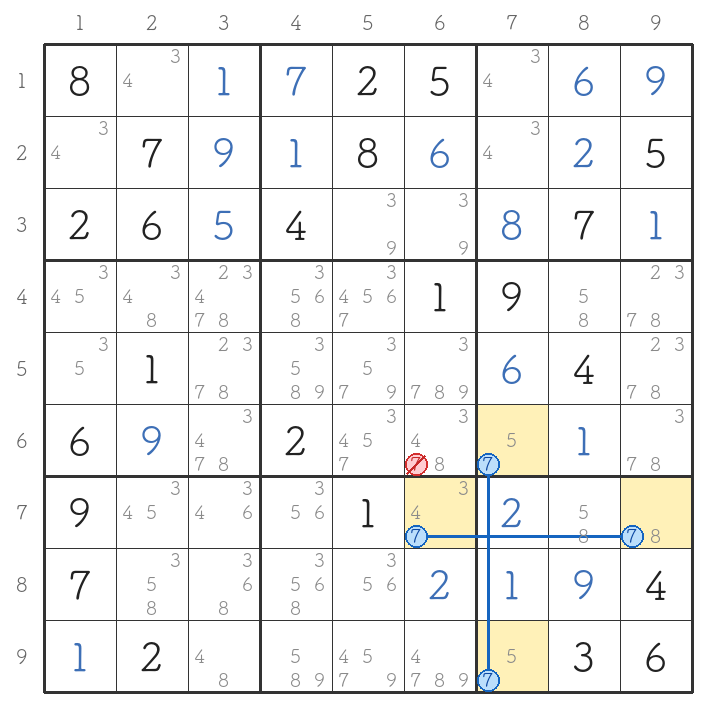
This example also uses 7. In row 7, 7 can only go in columns 6 and 9. In column 7, 7 can only go in rows 6 and 9.
The row link’s end at row 7, column 9 and the column link’s end at row 9, column 7 are both in the bottom-right box. They cannot both be 7, so either row 7, column 6 or row 6, column 7 must be 7.
Row 6, column 6 sees row 7, column 6 through column 6, and row 6, column 7 through row 6. You can remove 7 from row 6, column 6. Skyscraper uses two links in the same direction, while 2-String Kite uses one row link and one column link. In my 6,000 puzzles, it was the most useful advanced technique.
Technique 10: How does Simple Coloring work?
Chain the strong links of one digit and color them in two alternating colors. One color must be entirely correct, so any cell that sees both colors cannot hold the digit.
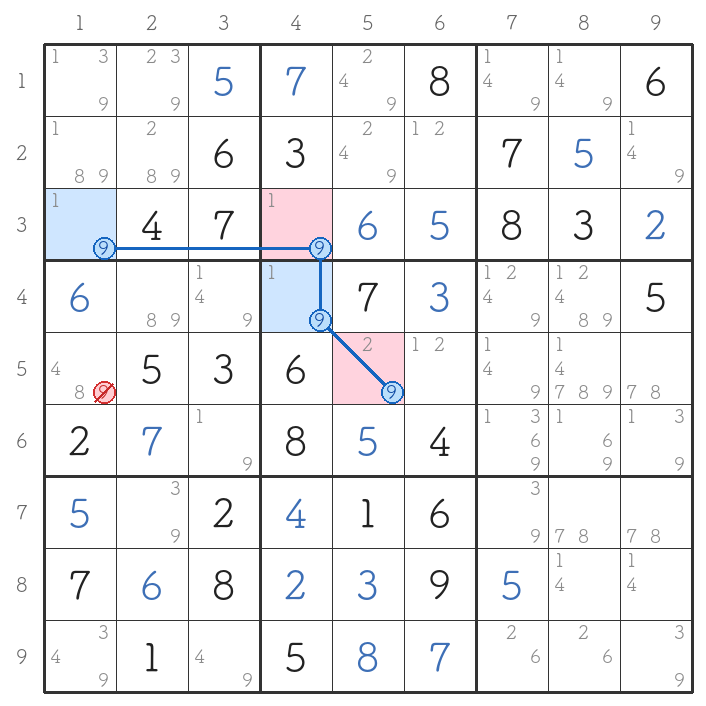
This example uses the digit 9. In row 3, 9 can only go in row 3, column 1 and row 3, column 4. In column 4, only row 3, column 4 and row 4, column 4. In the center box, only row 4, column 4 and row 5, column 5. These three strong links form one chain from row 3, column 1 to row 5, column 5.
Coloring along the chain gives blue for row 3, column 1 and row 4, column 4, and red for row 3, column 4 and row 5, column 5. A strong link means “if one is not 9, the other is”, so either every blue cell is 9 or every red cell is 9.
Row 5, column 1 sees blue row 3, column 1 through column 1, and red row 5, column 5 through row 5. It cannot be 9 whichever color is correct, so you can remove 9 from row 5, column 1.
If two cells of the same color share a row, column or box, that color cannot be correct. In that case, you can remove the digit from every cell of that color.
Technique 11: How does XY-Wing work?
It uses three cells with two candidates each. If the middle cell (the pivot) has {X, Y} and it sees cells with {X, Z} and {Y, Z}, you can remove Z from any cell that sees both of those cells.
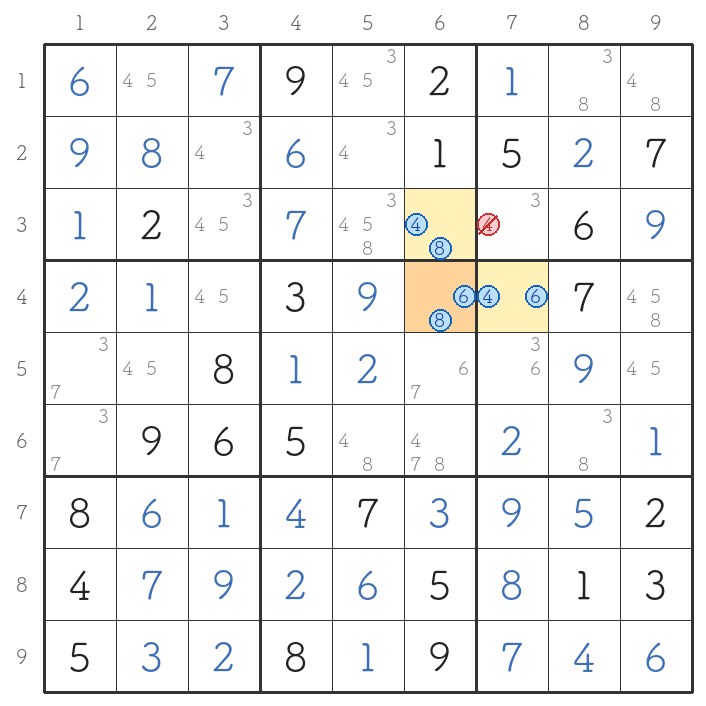
The pivot (orange) is row 4, column 6 with candidates {6, 8}. It sees row 3, column 6 with {4, 8} and row 4, column 7 with {4, 6}. Here Z is 4.
If the pivot is 8, row 3, column 6 in the same column cannot be 8, so it is 4. If the pivot is 6, row 4, column 7 in the same row cannot be 6, so it is 4. Either way, row 3, column 6 or row 4, column 7 is 4.
Row 3, column 7 sees row 3, column 6 through row 3 and row 4, column 7 through column 7. You can remove 4 from row 3, column 7.
Technique 12: How does W-Wing work?
When two cells far apart share the same candidates {X, Y}, and a strong link on X connects them, you can remove Y from any cell that sees both of those cells.
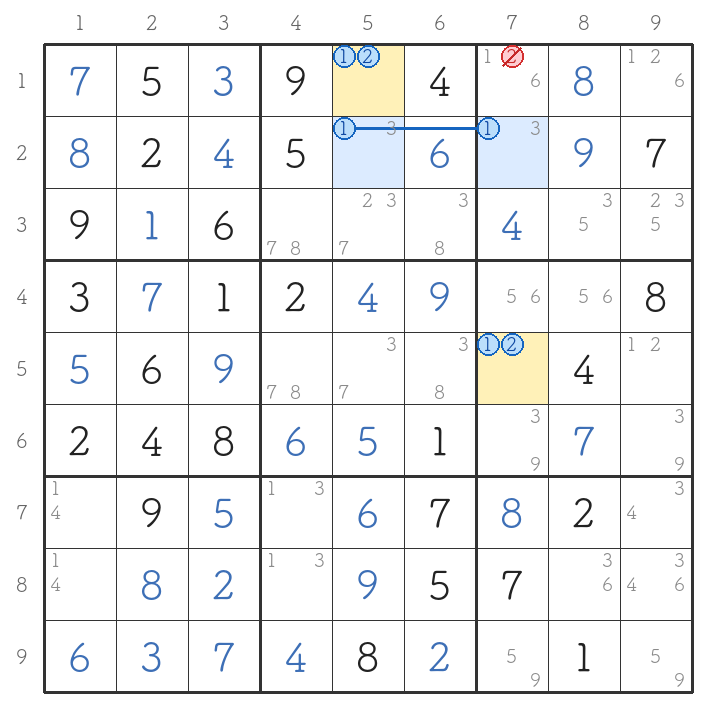
This example uses candidates {1, 2}. Row 1, column 5 and row 5, column 7 both have only {1, 2}. In row 2, 1 can only go in row 2, column 5 and row 2, column 7, which is a strong link.
Row 2, column 5 shares column 5 with row 1, column 5, and row 2, column 7 shares column 7 with row 5, column 7. If row 1, column 5 is not 2, it is 1. Then row 2, column 5 cannot be 1, so row 2, column 7 is 1. Then row 5, column 7 cannot be 1, so it is 2. Either row 1, column 5 or row 5, column 7 is 2.
Row 1, column 7 sees row 1, column 5 through row 1 and row 5, column 7 through column 7. You can remove 2 from row 1, column 7. Whenever you notice two distant cells with the same pair, look for a strong link on one of those digits that connects them.
Technique 13: How does XYZ-Wing work?
It is an XY-Wing whose pivot has three candidates {X, Y, Z}. You can only remove Z from cells that see all three cells, including the pivot.
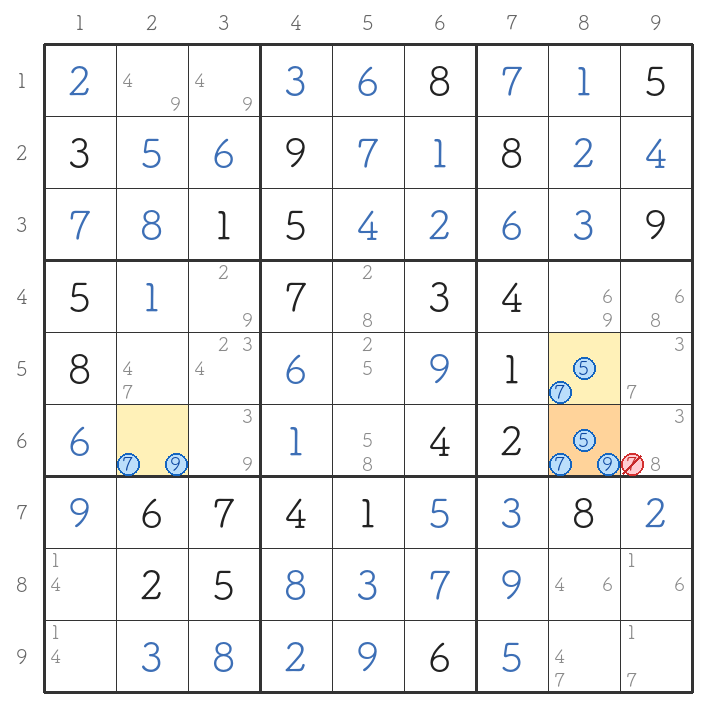
The pivot (orange) is row 6, column 8 with candidates {5, 7, 9}. It sees row 5, column 8 with {5, 7} and row 6, column 2 with {7, 9}. The digit shared by all three cells is 7.
If the pivot is 5, row 5, column 8 is 7. If it is 9, row 6, column 2 is 7. If it is 7, the pivot itself is 7. One of the three cells must be 7. Unlike XY-Wing, the pivot itself can be 7, so only cells that see all three cells are affected.
Row 6, column 9 sees row 6, column 8 and row 6, column 2 through row 6, and row 5, column 8 through the middle-right box. You can remove 7 from row 6, column 9.
Technique 14: How does Unique Rectangle work?
If three corners of a rectangle spanning two rows, two columns and two boxes all have exactly the same candidates {A, B}, you can remove A and B from the fourth corner. This only works for puzzles with one solution.
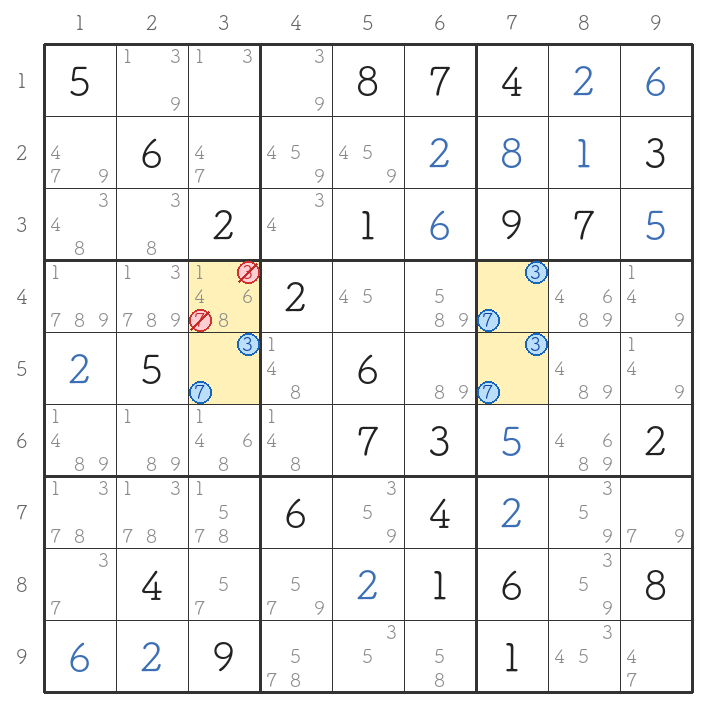
This example uses candidates {3, 7}. Row 4, column 7, row 5, column 3 and row 5, column 7 all have only {3, 7}. The fourth corner, row 4, column 3, also has 1, 4, 6 and 8.
If row 4, column 3 were also 3 or 7, all four corners would be filled with only 3 and 7. Swapping the 3s and 7s in those corners would then produce a second valid grid. A puzzle with one solution cannot have that pattern, so you can remove 3 and 7 from row 4, column 3.
The four corners must fit in exactly two boxes. If they sit in four different boxes, the swapped grid can break the box rule, and the logic no longer holds.
Do not use this technique on puzzles that are not guaranteed to have one solution. Without that guarantee, it can remove correct candidates.
Why can Swordfish wait?
Swordfish, which extends X-Wing to three rows, worked in only 1.8% of the stuck positions. Learning techniques 8 to 14 first will unblock more puzzles.
Swordfish applies when a digit’s candidates in three rows all fall within the same three columns. You can then remove that digit from those columns in every other row. It is a direct extension of X-Wing, so the logic is easy to follow, and it is sometimes introduced right after X-Wing.
In my 6,000 puzzles, though, it was rarely needed. Jellyfish, the four-row version, worked in only 0.8%. The larger the pattern, the fewer positions it appears in.
Where can you practice these techniques?
Techniques 8 to 14 are impossible to spot unless you write candidates down. A single missing candidate can make you misread a strong link and remove a digit you should keep.
The Sudoku (Number Place) web app on this blog (in Japanese) has a notes mode for writing candidates in each cell. On a 9×9 board at hard or expert, fill in every candidate first, then practice looking for strong links one digit at a time.
Related articles
▶ 7 Sudoku Techniques and the Order to Learn Them…techniques 1 to 7, from Naked Single to X-Wing
Summary
▼Key points
① The seven techniques up to X-Wing solved 3,664 of 6,000 puzzles (61.1%)
② In stuck positions, 2-String Kite worked in 47.3%, W-Wing in 36.3%, Simple Coloring in 34.1% and Skyscraper in 28.9%
③ Swordfish worked in only 1.8%, so it can wait
④ Learn single-digit techniques (8 to 10), then two-candidate cell techniques (11 to 13), then Unique Rectangle
⑤ Use Unique Rectangle only on puzzles with one solution
Like the first seven, every technique here combines one idea: “this digit must go somewhere in this set of cells, so it can be removed outside it.” Techniques 8 to 13 simply stretch that “somewhere” across the grid with strong links and two-candidate cells.
Technique names vary between sources. The statistics come from 6,000 puzzles with unique solutions that I generated in Python, so the distribution may differ from published puzzle books. Counted on September 12, 2026.