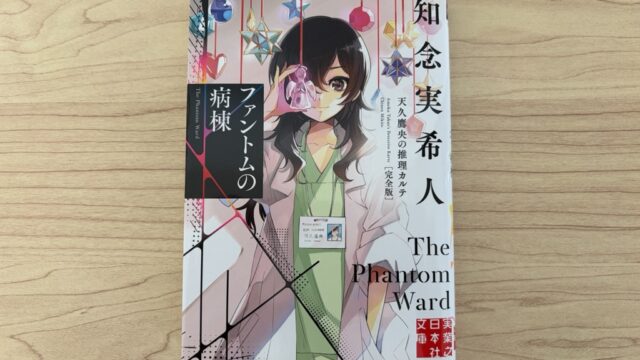
A Closed Ward, a “Death Angel,” and the Unease That Lingers — My Reflections on The Death Angel of the Sphere
This article explains how the setting of a closed hospital ward shapes the reading experience of this novel more strongly than the mystery itself, and why the lingering sense of unease matters more than a clean resolution.
It is written for readers who are interested in medical mysteries, character-driven crime fiction, and stories where atmosphere and structure are as important as logical explanation.
Although a hospital setting is nothing new for this series, this volume felt different from the opening pages. A sealed environment, a special ward known as the “Sphere,” and the ominous phrase “Death Angel” immediately changed the tone. As I kept reading, I realized that what stayed with me was not so much the case itself, but the pressure and distortion created by this particular space.
At the center of the story, as always, is Takao Ameku. Her behavior as a diagnostic physician—prioritizing logic, maintaining emotional distance, and moving quickly to conclusions—remains consistent with earlier volumes. What stood out to me this time was how her perspective felt more outward-facing than before. Patients, doctors, and nurses occupy clearly defined roles, yet they are forced into constant interaction. That structure kept pulling at my attention while reading.
The premise of the case is explained relatively early. However, instead of trying to “understand” those explanations in a technical sense, I found myself accepting them as things that had happened in this place. The phrase “Death Angel of the Sphere” began to feel less like a label for a single culprit and more like a symbol of the distortion produced by a closed ward itself.
1. The Unease Created by the “Sphere” as a Medical Setting
Hospitals are familiar territory in this series. In this novel, however, the addition of the “Sphere” changes how that territory is perceived. A place that should be governed entirely by rational systems and medical logic is marked by something that refuses to sit comfortably within them.
The realism expected of a medical mystery is preserved, yet the balance feels subtly off. That persistent imbalance shifts the reader’s focus. Rather than asking only what happened, I found myself asking why this space is portrayed in this way. The setting itself becomes an active element in the reading experience.
2. The Weight of the Name “Death Angel”
The term “Death Angel” carries more than the weight of a nickname. It points to a person, but at the same time it blankets the entire situation with a specific image. That ambiguity becomes increasingly difficult to ignore as the story progresses.
I did not read this name as simple decoration meant to heighten fear. Instead, it functions as a device that keeps the reader’s gaze fixed in a particular direction. You want to grasp its true meaning quickly, yet you sense that it will not be easily pinned down. That tension remains present throughout the book.
3. Distance Created by Takao Ameku’s Position
Takao Ameku’s role and demeanor are consistent with what the series has established. In this volume, however, her position feels slightly more pronounced. Her distance from others, her precise choice of words, and her speed in making judgments all drive the investigation forward.
At the same time, I occasionally felt left behind as a reader. This was not a flaw. It reinforced the idea that following this series means following her. I was not reading as a full participant or confidant, but as someone observing from a step behind.
4. Remembering the Structure More Than the Steps of the Case
The case unfolds through layered medical knowledge and logical procedures. Yet what stayed with me was not each individual explanation, but the repeated structural patterns. The motif of the Sphere appears again and again without changing shape, gradually unsettling things I thought I had already understood.
More than once, I found myself thinking I had grasped the situation, only to feel the urge to re-examine it. That back-and-forth defined the reading experience and left a stronger impression than the mechanics of the mystery itself.
5. What Remained After Pausing — and Whether I Would Recommend It
When I finished the book, I did not feel that everything had fallen neatly into place. Even after understanding what the Sphere and the “Death Angel” were meant to represent, something remained unresolved. That lingering discomfort seemed less about the difficulty of the case and more about how the story chose to depict it.
If asked whether I would recommend this novel, I would hesitate for readers seeking a medical mystery with clear, satisfying answers. On the other hand, for those who enjoy absorbing the atmosphere of a workplace, sitting with unresolved unease, and reading through ambiguity rather than past it, this volume can leave a lasting impression. I suspect that, for me, it is precisely that ambiguity that will make this book linger in memory.