Short version: Misshitsu no Paranoia (“Locked Room Paranoia”) is less about the locked-room trick than about suspicion amplifying inside a closed space. What remained afterwards was discomfort rather than resolution.
A sealed space, a chain of suspicion, medical explanation and psychological pressure — none of it tidily resolved, and more like something left deliberately under-organized.
What I was watching while reading was not the incident but how the characters reacted to the situation.
Sponsored
What kind of book is it?
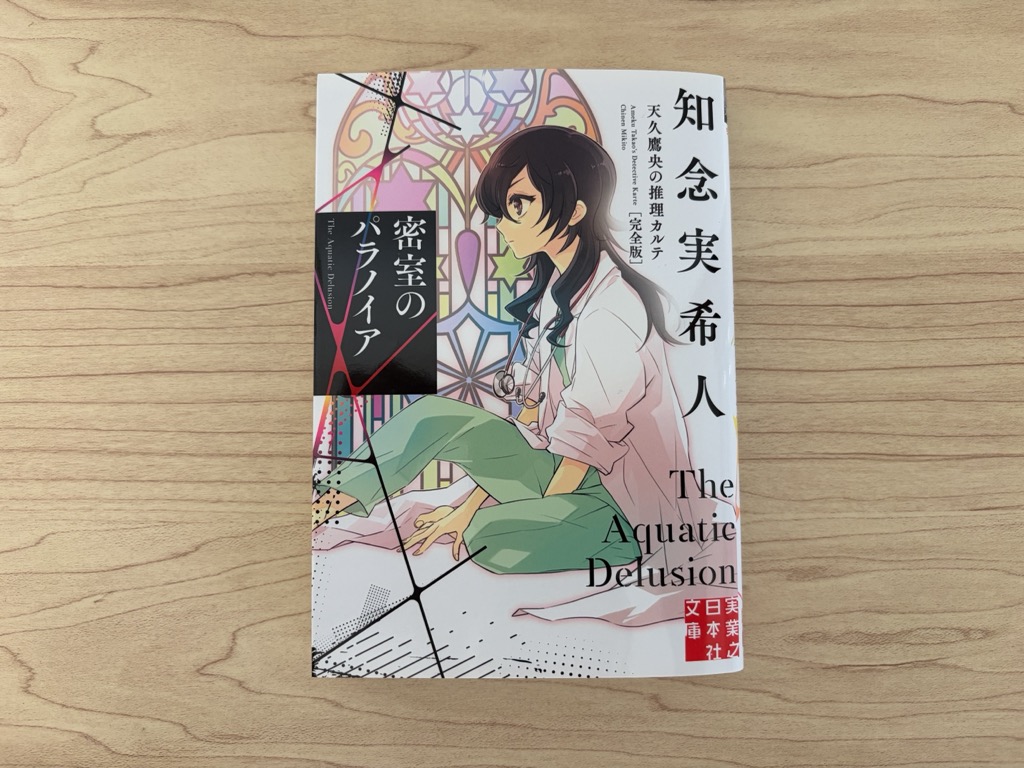
The fifth volume of the Ameku Takao series, and a short story collection — magazine stories plus new material.
| Title | 密室のパラノイア 天久鷹央の推理カルテ 完全版 |
|---|---|
| Author | Mikito Chinen |
| Imprint | Jitsugyo no Nihon Sha Bunko |
| Released | December 8, 2023 |
| Format | Suiri Karute = Short story collection |
| Reading order | fifth by publication date (full reading order) |
“Suiri Karute” against “Jiken Karute”
The subtitle decides how a volume reads. Not knowing this makes the differences between volumes confusing.
| Subtitle | Format | How it reads |
|---|---|---|
| Suiri Karute | Short stories | Each case resolves in one story. Easy to read in short sittings |
| Jiken Karute | Novel | One case followed to the end. Sustained tension |
“Suiri Karute” volumes collect magazine stories with new material added; “Jiken Karute” volumes are novels written directly for paperback. They alternate, so reading in publication order alternates between short stories and novels.
Characters and setting
| Takao Ameku (27) | Deputy director and head of the General Diagnostics Department. She has Asperger’s syndrome and savant traits, and diagnoses through extraordinary recall and calculation |
|---|---|
| Yu Takanashi (29) | The narrator. A former surgeon reassigned to General Diagnostics as a trainee internist |
| Mai Konoike (25) | A resident who admires Takao |
| General Diagnostics | Founded by Takao’s father to resolve undiagnosable patients and inexplicable incidents through diagnosis. It occupies a single-storey red brick building on the hospital roof |
Narrating through Takanashi rather than Takao is what keeps the series readable. The reader watches Takao from Takanashi’s position, so her strangeness never lands directly.
The series had passed 3.9 million copies as of May 2026, and a TV anime aired from January 2 to April 3, 2025 (produced by project No.9). The author, Mikito Chinen, was born in Okinawa in 1978, trained as an internist at Jikei University School of Medicine, and has been nominated four times for the Japan Booksellers’ Award.
Reading the opening while pulled along by the word “locked room”
The volume centres on a locked-room incident in a medical facility. With “locked room” in the title, I began with part of my attention on mechanism and structure.
But as it progressed, the misalignment in how the characters looked at and thought about things registered before the incident did. Takao’s knowledge and observational ability are laid out plainly, while the anxiety and suspicion of everyone else tangle with the closed situation.
The locked room exists as a physical condition, and yet “the air of suspicion amplifying inside a closed situation” made the stronger impression. Around there I drifted away from reading it purely as a puzzle to solve.
Sponsored
Distance as a medical mystery, and where it snagged
Medical knowledge and hospital detail underpin the story, but the technical explanation never pushes forward; it sits naturally as background to the incident.
I am not a medical professional and cannot claim to follow every detail. Still, there was no sense of being left behind, and keeping up with the story was not difficult.
What did snag was how the characters respond to the locked-room situation. The gap between those trying to stay calm and those building suspicion is stark, and clearly deliberate — and I found it slightly airless.
Not a fault in the book so much as the consequence of depicting psychological distortion in a closed environment head-on.
The stability and instability Takao creates
Logical, unswayed by emotion, organizing the situation with medical knowledge — she functions as an axis for the reader.
And because she is that stable, everyone else’s instability stands out.
I carried both “with her here it will be fine” and “and the air is still heavy” at once. The locked room moves toward resolution while the emotional register never releases. That gap is what stayed with me.
Sponsored
What remained was discomfort, not resolution
The process of the case converging and the facts being organized works as mystery. Given the information the book presents, the locked room holds up without obvious contradiction.
Even so, what remained most strongly on finishing was not clarity but something like the fatigue of having been in that space too long.
That is tied to what the book is about. Reasoning can organize the facts; suspicion and fear do not disperse so easily. The reader is made to experience that second-hand.
Would I recommend it?
| A good fit | Possibly not for you |
|---|---|
| Readers who want a locked-room mechanism | Readers who want to finish feeling light |
| Readers who like logic threaded through medicine | Readers who find sustained suspicion hard going |
| Anyone the phrase “locked room” catches | Anyone wanting a quick mood change |
Long afterwards, I still recall that closed air and the accumulation of suspicion. Whether that was enjoyable is arguable, but “nothing remained” is not something I could say.
Summary
- Misshitsu no Paranoia is the fifth volume, a short story collection (December 8, 2023)
- Suspicion amplifying in a closed space matters more than the trick
- Medical explanation stays in the background rather than out front
- Takao’s stability is what makes everyone else’s instability visible
- The case resolves; the emotional register does not release. That gap persists
- What remains is fatigue from the space, not the satisfaction of a solution
- Heavy for readers wanting lightness. For readers who can take the residue
Around this volume
- Previously read: ファントムの病棟
- Read next: 悲恋のシンドローム
- First in the series: Ameku Takao no Suiri Karute, Complete Edition