Short version: Phantom no Byoto (“The Phantom Ward”) is for readers who enjoy not being told everything. Wanting a clean resolution will snag on it — but that snag is the point.
Looking back some time after finishing, what remained ahead of the plot was the air of a few particular scenes. A closed ward, a highly specialized medical environment, and the “things that cannot be explained” occurring there as a matter of course.
None of it was emphasized especially hard, and yet I kept stopping mid-read and slowing down. The centre of gravity sits somewhere other than the tidy frame of “medicine plus puzzles”.
Sponsored
What kind of book is it?
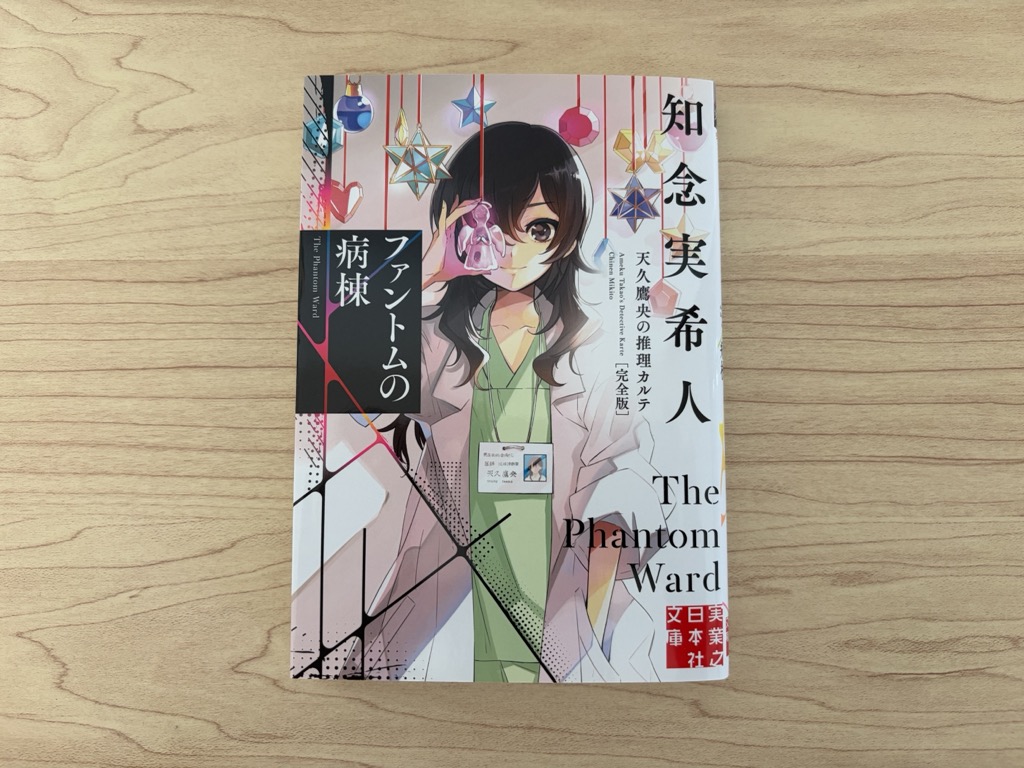
The third volume of the Ameku Takao series, and a short story collection — magazine stories plus new material.
| Title | ファントムの病棟 天久鷹央の推理カルテ 完全版 |
|---|---|
| Author | Mikito Chinen |
| Imprint | Jitsugyo no Nihon Sha Bunko |
| Released | November 9, 2023 |
| Format | Suiri Karute = Short story collection |
| Reading order | third by publication date (full reading order) |
“Suiri Karute” against “Jiken Karute”
The subtitle decides how a volume reads. Not knowing this makes the differences between volumes confusing.
| Subtitle | Format | How it reads |
|---|---|---|
| Suiri Karute | Short stories | Each case resolves in one story. Easy to read in short sittings |
| Jiken Karute | Novel | One case followed to the end. Sustained tension |
“Suiri Karute” volumes collect magazine stories with new material added; “Jiken Karute” volumes are novels written directly for paperback. They alternate, so reading in publication order alternates between short stories and novels.
Characters and setting
| Takao Ameku (27) | Deputy director and head of the General Diagnostics Department. She has Asperger’s syndrome and savant traits, and diagnoses through extraordinary recall and calculation |
|---|---|
| Yu Takanashi (29) | The narrator. A former surgeon reassigned to General Diagnostics as a trainee internist |
| Mai Konoike (25) | A resident who admires Takao |
| General Diagnostics | Founded by Takao’s father to resolve undiagnosable patients and inexplicable incidents through diagnosis. It occupies a single-storey red brick building on the hospital roof |
Narrating through Takanashi rather than Takao is what keeps the series readable. The reader watches Takao from Takanashi’s position, so her strangeness never lands directly.
The series had passed 3.9 million copies as of May 2026, and a TV anime aired from January 2 to April 3, 2025 (produced by project No.9). The author, Mikito Chinen, was born in Okinawa in 1978, trained as an internist at Jikei University School of Medicine, and has been nominated four times for the Japan Booksellers’ Award.
The unease built into the ward
The ward is drawn from the start as somewhere unsettled. Its function as a medical facility is explained properly, and it still does not feel safe. I could not put the reason into words while reading; I just carried the sense that “this is not normal”.
A hospital ought to be an accumulation of explanation and rationality: test results, symptoms, diagnoses, treatment plans, all organized into words and numbers.
Inside that, the ambiguity carried by the word “phantom” kept catching. Is this the supernatural, or a misperception? Being unable to settle on either gradually destabilizes the reader’s footing.
That instability is what drives the book forward. Less fear than the fact that an unexplained state is being left standing — that is what kept me turning pages.
Sponsored
The temperature of Takao Ameku
What registered was not her behaviour itself but her distance from everyone present.
Faced with what is happening in the ward, she stays calm and never drops the rational view. And precisely because she is calm, the anxiety and confusion around her are thrown into relief.
I kept thinking “this is not a person who provides reassurance”. That was not unpleasant. If anything, an attitude of accumulating facts suits this story better than emotional sympathy would.
With Takao at the centre, the temperature of the whole book stays constant. That constancy is what makes the ward’s strangeness stand out.
What gets explained, and what does not
The medical explanation is fairly explicit. Technical terms appear, but with care taken not to leave the reader behind. I am not a medical professional, and I rarely felt anxious from not following.
Even so, not everything is explained. If anything, the unexplainable parts feel deliberately left in place. Both the discomfort and the interest of this book live there.
Each time a rational explanation arrives, you think “is that it?” — and the next page sets down another anomaly. That cycle gradually shifts your reading rhythm.
Sponsored
The snag underneath the readability
The prose is easy to read. Plenty of dialogue, good pace. Which is exactly why the occasional snag stands out.
It is not the speed of events but the handling of emotion. Something happens, it is explained, the scene moves on. In between, I wanted a little time to work out how to take what just happened.
Some readers will call that thin; others will be glad there is no superfluous emotional description. I finished without landing on either.
What remained
Some time later, no firm conclusion or emotional payoff remains. What does remain, vaguely, is the air of the ward, Takao’s position, and the boundary between what gets explained and what does not.
Readers who want mystery to be clear-cut will catch on this. Readers interested in irreducibility placed inside a realistic medical setting will find it lands quietly.
I would not recommend it unconditionally. But anyone who finds a certain comfort in not being over-explained should try it.
Reading this volume alone conveys the atmosphere and the characters well enough. Whether you continue depends on whether the residue reads as intriguing or as simply not for you.
Summary
- Phantom no Byoto is the third volume, a short story collection (November 9, 2023)
- The ambiguity of “phantom” survives to the end — never settled as supernatural or misperception
- Because a hospital is an accumulation of rationality, the inexplicable stands out sharply
- Takao’s calm holds the temperature constant and makes the ward stranger
- Technical material is handled carefully; you are not left behind
- Its readability makes the unprocessed emotion more noticeable
- Not for readers who want clear resolution. For readers who can sit with irreducibility
Around this volume
- Previously read: 天久鷹央の推理カルテ
- Read next: 密室のパラノイア
- First in the series: Ameku Takao no Suiri Karute, Complete Edition